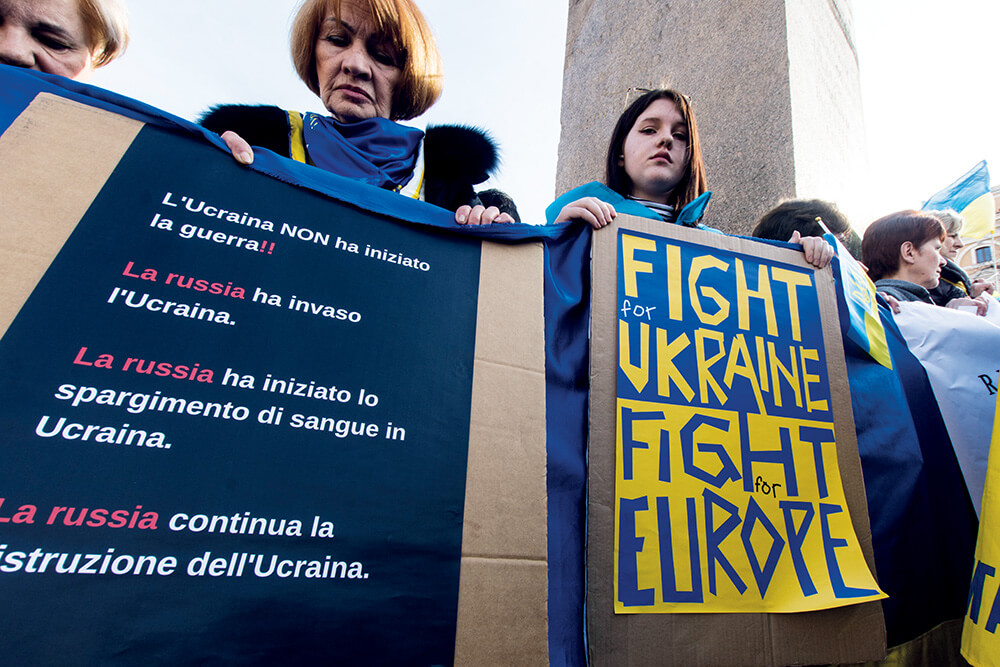
More than three years have passed since Russia launched one of its most brutal wars against Ukraine. Three years in which the country has shown extraordinary resilience—both military and civilian—not only to survive as a sovereign state but to transform the tragedy of war into a powerful drive toward a fully European future.
Yet in Italian public debate, there’s still a reluctance to acknowledge Ukraine’s agency. Even among those who firmly support Ukraine’s right to freedom and independence, there’s a lingering notion that the country’s fate hinges solely on the decisions of Trump and Putin. “Let’s not allow Trump to hand Ukraine over to Putin,” I read the other day. Fair enough. But Ukraine is not a parcel to be handed over. It is a nation that has not only halted the advance of an invading nuclear power, but that, in the midst of war, is pushing forward with reforms at a remarkable pace, all with the goal of full integration into the European Union.
Just a few weeks ago, the “EU–Ukraine Business Summit” took place—an event launched last year and this time organized in partnership with the European Commission, the Ukrainian government, and Italy, host of the 2025 Ukraine Reconstruction Conference in Rome.
Ukraine is a unique case in the history of EU enlargement: never before has a country sought to join the Union while actively at war. And yet, despite extraordinarily difficult conditions, we are witnessing an impressive reform process—ranging from justice and anti-corruption efforts to public procurement transparency and the development of efficient digital systems. A massive legislative harmonization is underway.
Starting early next year, for most industrial goods, Ukraine will effectively become part of the EU single market. Producers will be able to export goods from Kyiv to Europe as if they were operating from within any other EU member state. “Whatever happens, Ukraine will continue to deepen its integration into the European economy—not just at the moment of formal accession, but well before that. The process is already in motion,” said EU Enlargement Commissioner Marta Kos.
The EU has also signed an agreement with Ukraine on an energy security package, which includes full integration of the country into the European electricity market by 2027. For comparison, it took the Baltic states 15 years to achieve the same goal. Rebuilding Ukraine’s energy sector also means steering it toward renewables. One of the largest private renewable energy projects since the start of the full-scale invasion is now underway thanks to support from the EU and other international partners. The OKKO Group is building the country’s largest wind farm, which will provide clean energy to around 240,000 Ukrainian households, reducing CO₂ emissions by about 245,000 tons per year.
Meanwhile, homes, roads, bridges, and ports are being rebuilt to meet European energy efficiency standards—and many companies across the continent are already actively involved in the process. But this is not just about rebuilding what was lost. It’s about constructing a new, modern European country and economy from the ground up. Some success stories are already emerging.
It is almost unbelievable that Ukraine has managed to keep its railway system operational—thanks in part to European investment. Despite skies filled with drones and Russian missiles, despite sirens and interruptions, the trains continue to run—on time—across a country at war. An efficiency that many European states cannot boast (just a few days ago, my train from Rome to Milan arrived 130 minutes late). Meanwhile, the EU continues to support trade with Kyiv by funding land infrastructure through the “Solidarity Lanes” project.
Ukraine’s reconstruction will also be driven by advanced technologies, with artificial intelligence playing a key role. An EU representative recently presented an innovative approach showing how AI can support the rebuilding of war-torn cities and communities. The European AI Office is developing a project called Digital Twin for Reconstruction—a sophisticated tool already being tested in cities like Mykolaiv, Bucha, and Chernihiv. It combines satellite imagery, drone footage, on-site inspections, photographic and video documentation, official reports, and property registries to generate a three-dimensional replica of the damaged cities. Urban planners and citizens alike can interact with these models. A final dashboard compiles all the data, offering a clear overview of the damage and estimated costs, enabling targeted decisions and constant monitoring. In this way, Digital Twin for Reconstruction ensures transparency for citizens, policymakers, and the donor community.
A striking example of Ukrainian resilience is Nova Post, the country’s leading courier and logistics provider, supported by an EU loan. It now delivers 1.5 million parcels a day. In the early days of the invasion, delivery volumes plummeted, yet the company continued to operate. It rebuilt its entire logistics network, navigating mined roads and destroyed bridges, becoming a key distributor of humanitarian aid in war zones and newly liberated areas. Over 400 branches and sorting centers were destroyed in missile attacks, but Nova Post swiftly rerouted logistics flows to avoid delays. When power outages began, the company equipped all its sites with generators and Starlink satellite connections, and installed 25,000 battery- or solar-powered parcel lockers that function without electricity or internet.
Ukraine’s story is not only one of military and civilian resistance. It is also a story of courage and rebirth. A narrative in which a country devastated by war, with the help of the European Union, is rebuilding not only homes and infrastructure, but also hope and dignity.