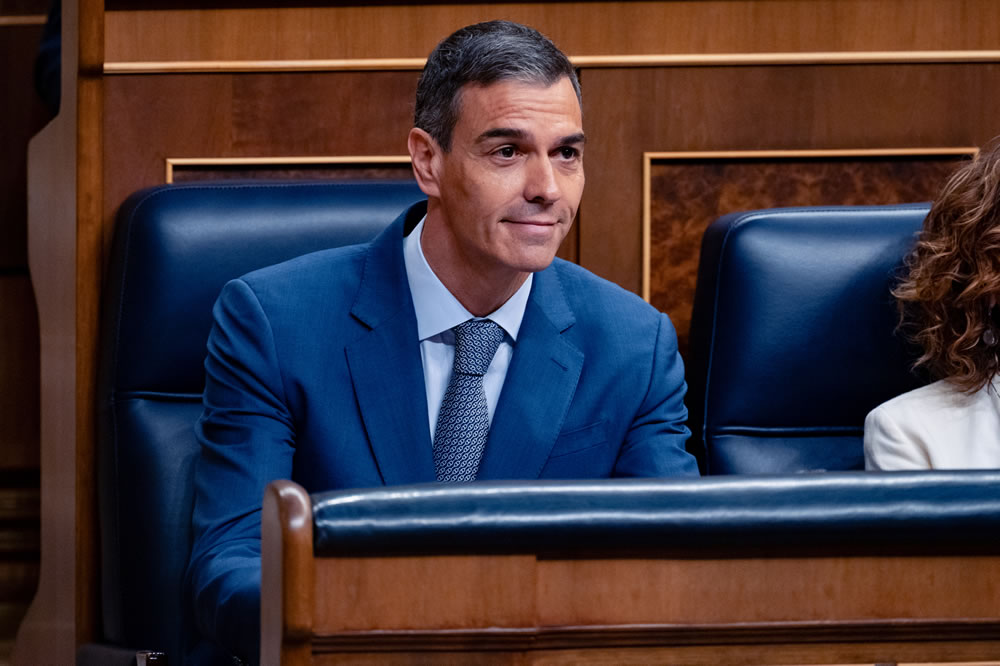
The shadows of evening seem to be lengthening and darkening over the Spanish government led by socialist Pedro Sánchez. Will we witness a sudden sunset or will the twilight linger until 2027? We do not know. Investigations into the alleged (but almost certain) corruption of some important socialist leaders and the whims of the parties that have supported the majority so far paint a picture of an executive whose permanent state of crisis now seems irreversible. But Sánchez has turned emergency management into an art form in which he excels to such an extent that it would be imprudent to rule out entirely a breach of the laws of astronomy and thus a rising of the sun from the horizon.
What is certain is that the Spanish economy is still in full light – or at least the parameters that measure its performance are. Last year, Spanish GDP grew by 3.2 percent, compared with +1.1 percent in France and the United Kingdom, +0.7 percent in Italy, and -0.2 percent in Germany, while the Eurozone average was +0.9 percent and even the United States (+2.8 percent) did not do better. The figure is even more impressive when you consider that Madrid accounts for 40 percent of the overall increase in Eurozone GDP in 2024. The forecasts for Spain for 2025 are also very positive: +2.5 percent, compared to +1.1 percent for the United Kingdom, +0.6 percent for France, +0.4 percent for Italy, and 0.0 percent for Germany. The same goes for unemployment, which has never been so low in seventeen years: sure, it’s still high (around 10 percent), but it’s still encouraging when you think that from 2010 to 2015 it was consistently (and well) above 20 percent.
After seven years in government, this bonanza can undoubtedly be attributed, at least in part, to the actions of Sánchez, who, in a country that had until then been stubbornly bipartisan, invented a whole new balance above the madness, namely a reckless barter economy with various parties of the Spanish radical left and a constellation of regionalist and/or independence movements in the Basque Country, Catalonia, and Galicia, ranging from the extreme left to conservatism. Catalans, and Galicians ranging from the extreme left to conservatism.
Thanks to the acrobatic ruthlessness of the prime minister, which his political opponents call “Sánchismo,” the labor market reform sought by Labor Minister and Deputy Prime Minister Yolanda Díaz, who also heads the radical left platform Sumar, came to fruition in 2022. And from those same acrobatics, which use the most daring do ut des as a springboard, a law to reduce the working week to 37.5 hours, also sponsored by Yolanda Díaz, could have emerged, but it is currently stuck in the veto of the Catalan separatists (although the last word has not yet been said).
If Sánchez manages to emerge unscathed from the crisis he is facing, the government could then aim for broader support, extended (perhaps through abstention) to the Popular Party, to turn into concrete measures the popular legislative initiative calling for the regularization of hundreds of thousands of immigrants. This is a political move that runs completely counter to the prevailing sentiment of closure throughout Europe. This is all the more so considering that just a few months ago (it came into force last May), the Spanish government already passed new regulations on the granting of residence permits that allow many migrants to regularize their status with relative ease. But Sánchez is convinced that there are still too many potential workers without documents. On further mass regularization, which the far-right Vox party opposes, a more conciliatory stance on the part of the center-right cannot be ruled out, given that the Church, which still whispers in the ears of the PP, is in favor of the popular initiative and that entrepreneurs also welcome a law that would expand the pool of workers.
This inclination to gamble recklessly on the future is a distinctive trait of Sánchez. And for him, betting on the future also means betting on the dwindling number of young Spaniards and the growing number of young migrants. “Spain must decide whether to be an open and prosperous country or a closed and poor country”, said the prime minister, linking the development of policies that help young people – both native and foreign – find work to the possibility of maintaining Spain’s Mediterranean welfare system now that an army of baby boomers is approaching retirement age.
Thanks to a long wave that stretches from “The Spanish Inn” to “Ten New Years”, Spain still appears very attractive to 20- to 40-year-olds across Europe. But the figures behind Madrid’s economic miracle can also be interpreted in another way. The main driver of GDP growth has been tourism, which in many places, from Barcelona downwards, has taken the form of horrific overtourism, further exacerbating the housing crisis that is hitting the young urban generation. The king of the new employment relationships that have reduced unemployment, especially among young people, is the ‘discontinuous fixed contract’ which, when viewed from one angle, seems like one thing, but when viewed from another, seems like the complete opposite. And the rapid spread of renewable energy production in Spain, another of Sánchez’s ‘youth’ and future-oriented strategies, is no stranger to the spectacular blackout that paralyzed the country for a whole day in April.
As if that were not enough, even though the government is considering lowering the voting age to 16, young people do not seem so eager to reward it. Already in the European elections, as far as voters aged 18-24 were concerned, the PSOE had to contend with Vox and Se acabó la fiesta, a movement produced by the most abominable form of social populism. And in the polls, the Socialists are still fighting with the far right for the votes of young Spaniards.