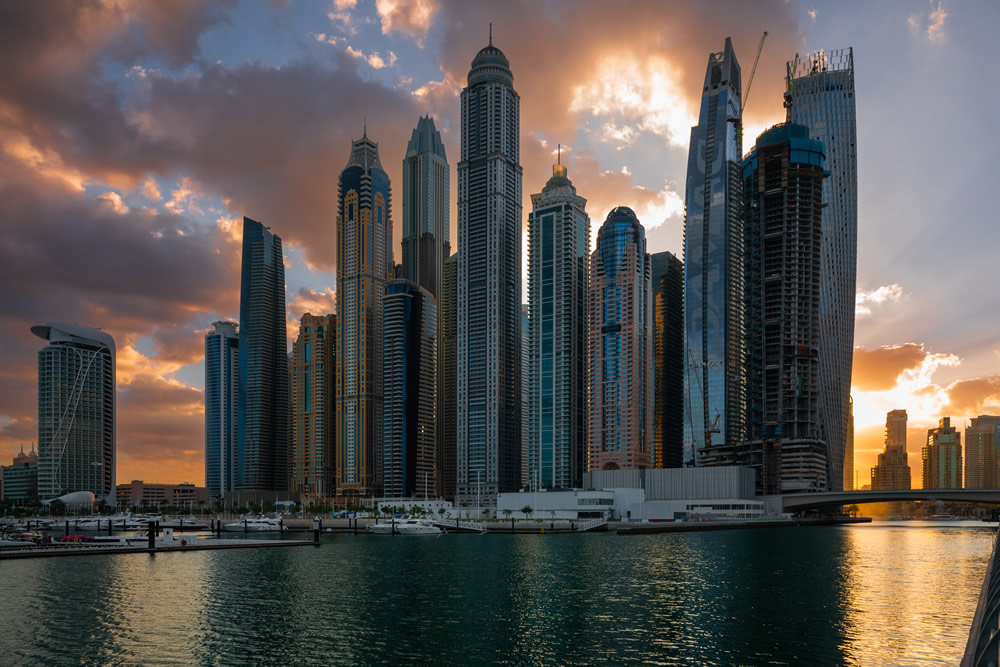
It is well known that the Emirates are now a construction El Dorado, a golden world that seems like a mirage (in the desert) to us. Construction, and no longer oil, is the leading contributor to GDP in Dubai, for example, the Milan of the United Arab Emirates, where Agata Kurzela, one of the most successful Polish architects in the federal state on the Arabian Gulf, lives and works. In 2020, she opened her studio in the city of Burj Khalifa, the world’s tallest skyscraper, and since then has racked up a series of ‘iconic’ projects featured in many international newspapers, from Monocle to Architectural Digest. With a degree in architecture and urban planning from Gdansk she practised first in France and the UK, this wandering European is very busy in the great Meccano that is the city that rose from the desert.
The logo of Emaar, the state-owned real estate company, is everywhere here: last year it posted record revenues of 65.4 billion Emirati dirhams (about 18 billion euros), with profits of 10 billion dirhams. Between now and 2029, 300,000 new homes will be built, but it never seems to be enough. What a bonanza compared to Europe (here they build buildings overnight, while here if you want to enlarge a small window you have to go to the Lazio Regional Administrative Court).
In short, over to the lucky architect. “My first project was the master plan for Mina Zayed, the port area of Abu Dhabi, the capital of the Emirates and also the country’s great architectural showcase”, she says happily. Abu Dhabi is home to the most sophisticated buildings, including on Sa’diyyat Island, which houses new museums, including Jean Nouvel’s Louvre Abu Dhabi and Frank Gehry’s soon-to-open Guggenheim.
Let’s start with the most obvious and banal of questions: have you ever had any problems as a female designer? “Yes, once, with a British boss”, she says on the phone from sweltering Dubai (but we are all in ubiquitous Dubai now, except that in Milan there is still no air conditioning outdoors and the skyscrapers are swaying). “I’ve never had any problems with local clients”.
She is currently working on an adaptive reuse of the government building in Abu Dhabi, which was formerly an armed forces officers’ club. “It’s a building with a complex floor plan set on a triangular grid, which poses many difficulties”. She should be used to it, having worked with Zaha Hadid. “Indeed. But it’s still a challenge”. The components of the project, which has been going on for years and has already won the 2023 Dezeen Award, features luxurious translucent walls and sexy opaque surfaces, as well as some interesting technical solutions. What about those perforated columns that look like beehives? “They’re enclosures for air conditioners that cool the open space under the roof which spans without support for over hundred meters across. The legacy solution, housed in chrome-clad mushroom shape had to give way to much more contemporary treatment. So, air conditioning again, in the disastrous year 2025, when the whole world is thermally an Emirate. But what’s it like working there? “Now it’s quite similar to Europe, but at first it was quite a culture shock. It happened that people arrived a couple of hours late. Now everybody is very punctual”, says Kurzela. Did you educate them? “No, no, it’s a market that evolves very quickly and matures”. “Another difference is that here, we deal with a lot of large scale and important projects. Like this building we’re talking about. The Adaptive reuse building we are talking about, now classified as modern heritage, is tens of thousands of sqm, and is set on a 75ha of land. We don’t say no when difficulties present themselves but see how things can be done, which is the mantra in Europe. Here is more of a can-do attitude where we have to be flexible and creative, sometimes negotiate. The office for the government, our smaller project housed within, and won the Dezeen Award is 2.500 sqm and tripled in size during the design process. We made it work by layering the program in the third dimension”.
So, time seems to be a different variable than in Europe. “In fact, for this complex, we are talking about reuse, almost industrial archaeology, but it dates back not to the 1800s or 1900s as it might be here. It’s from the 1990s. Impressive, isn’t it? But the country is young. It’s almost the same age as me”. An equivalence between architect and country, when does that happen again? Unity of time, place, and action. And taste too? Wandering around the Emirates, you find the most diverse architecture, even if not always very elegant. Smoky garages with pinnacles for billion-dollar sedans. What is the classic request of your typical client? “It’s difficult to define my typical client because they are quite exceptional, whether public or private. They are people who travel and are very well-versed in contemporary architecture and design. They don’t have that desire to impress that, that was associated with the UAE in the past, they want to build something new and relevant. They have become more refined. “Confident, that what we do is on par”. Do you like the term ‘Emirati quiet luxury’? “I would say vernacular minimalism. This complex we’re talking about, for example, was originally covered in marble and looked like a huge Turkish bath. Today, it’s smoothed with local stucco and stone. We study materials, origins, volumes, colors, drawing inspiration from the local environment”. And what did you do with all that marble? “We keep it because it is protected by law and in case the client changes their mind”. So, indecision, in addition to traffic, Johnny Stecchino style, is one of the big problems in the Emirates (traffic jams are indeed deadly).
But is there a chain of local artisans? Or do you import everything from abroad? “It depends. Look at this beautiful satin-finish steel sink. It was made by craftsmen in Dubai. This tap, on the other hand, is from an Italian company. This armchair is by Moroso, also Italian. There are good artisans here now. I have my own network of suppliers. And even in Europe, you always have to be careful, not everything is always top quality”. In another recent project, the Formula 1 VIP lounge inside the Shams Tower, another work by our very own, there are materials that would look good in London or Paris, perhaps in ten years’ time, in a tropicalization that follows the climate: light colors contrasted with a dark palette inspired by the tarmac and engine parts, neutral materials, “papyrus, wood, fabric, steel. Here too, there is no longer a desire to amaze, but rather to show and explain what the Emirates are today”.
And what about those large, rounded armchairs? “They are seven spheres tied together by a rope, symbolizing the seven emirates that make up the UAE, made of cast sand; they’re seats but also sculptures – a nod to the place we’re in”.
So, basically, another version of the famous Fantozzi-style beanbag chair by Zanotta – a pop icon immortalized in an Italian cult comedy. Or rather, for what used to be a desert and is now brimming with ideas and opportunities (and air conditioning – lucky them).