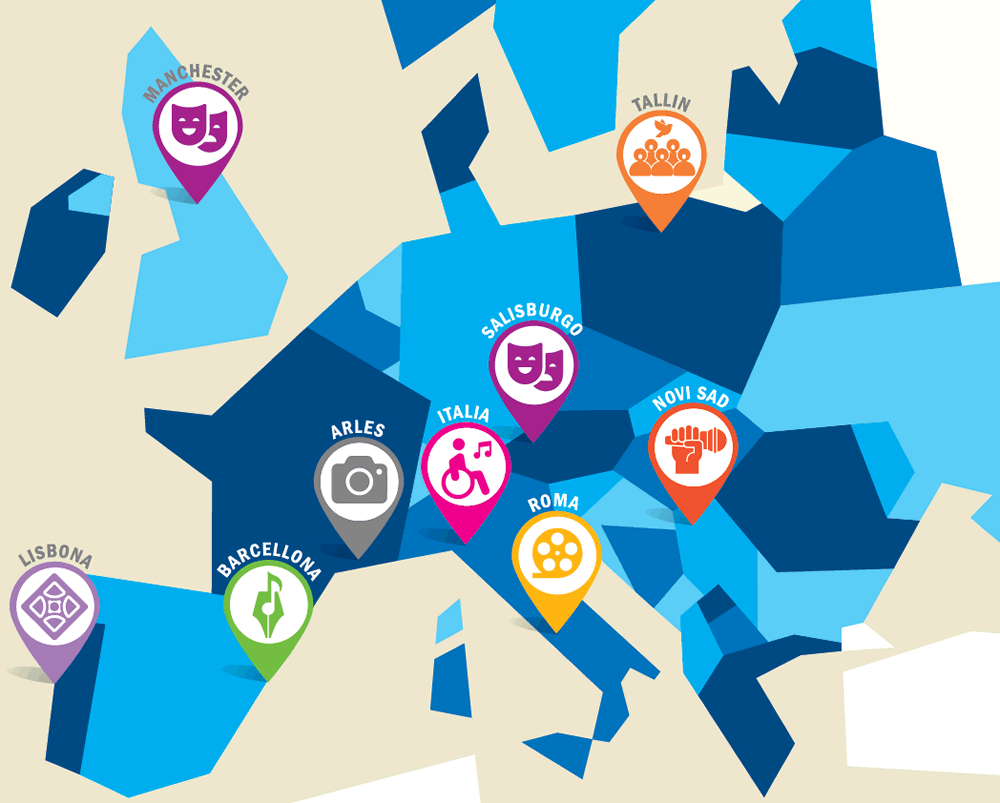
10-13 JULY 2025. EXIT FESTIVAL / NOVI SAD, SERBIA
The last rave party of democracy in Novi Sad
In 2000, the Exit Festival in Novi Sad, one of the most important music festivals in the world, was born out of a movement of young Serbs protesting for peace and freedom in the Balkans. For several months now, Novi Sad has once again been at the heart of student protests, with tireless demands for new democratic elections to the government of Aleksandar Vucic – 140,000 people took part in the demonstration in Belgrade on June 28. Exit openly supports the student protests and has stated that it has come under pressure from the government and had its public funding cut completely, despite being the most lucrative entity in the Balkan creative industry. For 25 years in July, Exit has been bringing the Petrovaradin fortress to life with more than a thousand artists in a festival featuring hundreds of hours of non-stop music, from punk to psytrance. It is a vital demonstration of how a movement can change society through art. However, given these anti-democratic conditions, the organizers have decided that 2025 will be the last edition at home in Serbia. They announce that it will be the most unforgettable, with a stellar line-up including DJs Nina Kraviz, Indira Paganotto, and Amelie Lens: “We owed the city one last party.” Italian artist Gala will also participate, whose “Freed from Desire” has become the anthem of Serbian students, who will never stop dancing.
JUNE 5-NOVEMBER 2. MARLENE DUMAS; LEROS PROJECT / GREECE
The bodies of archaeology and the salt as it vanishes
A vacation on a Greek island is a promise of paradise in two acts: it often includes a stopover in Athens. Here are two things to do, one on the peninsula and one on an island. In Athens, you can visit “Marlene Dumas: Cycladic Blues,” the South African artist’s first solo exhibition in Greece, which brings her works into dialogue with the antiquities of the Cycladic Museum. Each piece was personally selected by her together with curator Douglas Fogle. In her work, Dumas explores the vastness of the human soul, especially through the translation of feelings into the body, from expressions to posture. On this occasion, the intimacy and emotional intensity of her bodies interact with archeological artifacts, from the Neolithic to the Classical era, which have evoked in the artist something about love, life, death, and motherhood. A universal and timeless dialogue. After stopping in Piraeus, we finally arrive on the island. In Leros, in the Dodecanese, in a villa with walls peeling from the salt, she has inaugurated “Folding the sea into dresses that dissolve like salt,” the site-specific exhibition by the Istanbul collective Perasma, the third edition of the Leros Project. A project shaped by the architecture, ecosystem, and communities of the island, but above all by the silence, the rhythms slowed down by the sun and wind, and the goats perched on every rock. They write: “The sea folds, salt dissolves what remains is a trace of connection”.
UNTIL JULY 2025. AZULEJOS ON DISPLAY / LISBON, PORTUGAL
A kitchen of desire in Lisbon
One of the most significant aspects of the art of azulejo, the painted and glazed tiles widespread in Spain and Portugal, is its relationship with the context in which the work is placed. Whether it is a miradouro, a metro station or a kitchen, the painted tile enhances, and is in turn enhanced by, the space it decorates. This principle guided the exhibition at the Museo Nacional do Azulejo dedicated to master ceramist Querubim Lapa, on the centenary of his birth. “Uma Cozinha no Museo,” open until July 27, reconstructs a kitchen designed by Lapa for an apartment: the tiles are the space where his cultured, humorous, erotic imagination, linked to food and desire, comes to life. For a monographic immersion in tiles, there is also the exhibition “Journeys between London and Lisbon on Tiles”, on view until July 31 at the Galleria Ratton: an ideal dialogue between the works of the artist couple Paula Rego and Bartolomeu Cid dos Santos. To breathe new life into this traditional Iberian medium, the Galleria Ratton invited artists to work there already in the 1980s, including Rego and Cid dos Santos. It’s always a good idea to invest in bricks (or tiles).
JULY 11-20. PUNTASACRA FILM FEST / ROME, ITALY
A screen at the edge of the land
In Rome, summer really begins when the outdoor cinema programs start to appear. Among the many screens, only one lets you hear the sea. It is the Punta Sacra Film Festival, a free open-air cinema festival at the Idroscalo di Ostia, created by Alice nella città together with the local community. The Idroscalo is the last strip of land between the coast and the mouth of the Tiber River. It is considered the outskirts of Ostia, which is itself on the outskirts of Rome. River floods and rough seas, but above all the lack of infrastructure and neglect by the institutions have shaped the character of the community that lives there and teaches us to turn the perspective upside down and not consider it the end, but the beginning of the city – the beautiful story of their struggle is told in the film “Punta Sacra” by Francesca Mazzoleni. For a place to be a home, however, opportunities and culture must be built. This is what the festival is for, characterized by exchanges between guests, the public, and the inhabitants of the neighborhood, many of whom are very young. The program is online: it opens with “Non essere cattivo,” presented by Luca Marinelli, Giordano Meacci, and Simone Isola, ten years after its release. “Caro Diario” will also be screened, with the scene in which Moretti drives on his vespa through a deserted Rome on August 15 and arrives in Piazza dei Piroscafi, with boats and clothes hanging out to dry.
3-20 JULY. MANCHESTER INTERNATIONAL FESTIVAL / MANCHESTER, UNITED KINGDOM
The performing arts factory, and a herd
It is now unlikely to find tickets for Oasis, but in July you can still go to the Manchester International Festival, a biennial festival of performing arts and beyond produced by Factory+, a creative and experimental digital arts studio. A laboratory of imagination, but with a solid production structure: for the festival, the studio commissions events, performances, and installations to explore the future. One example is the production in collaboration with the Royal Ballet, which reinterprets Christopher Isherwood’s queer love in the form of contemporary ballet. For the opening event, a herd of life-size stuffed animals will arrive in the city, migrating on a journey from the Congo to the Arctic Circle to escape climate disaster: a climate and public art performance.
JULY 18 – AUGUST 31. SALZBURGE FESPIELE / SALZBURG, AUSTRIA
When European tolerance takes the stage
When Max Reinhardt and Hugo von Hofmannsthal created the Salzburg Festival after the First World War, they wanted to give Europe a place of cultural rebirth, a respite in art, a space for tolerance, reconciliation, peace, and Europeanism. More than a century later, the opera, classical music, and theater festival is still the main summer destination for music enthusiasts. It retains this conciliatory, almost chivalrous predisposition to tolerance, as one of the organizers points out: “The opening ceremony is an invitation to listen. Listening means being present. Being open to others, to new perspectives, to what resonates between the lines.” The cultural offering is high quality, not rigid, and provides an overview of what is happening in that world. As every year, the festival opens with the play “Jedermann”, directed for the second year by Robert Carsen. Also on stage are “Giulio Cesare in Egitto”, “Maria Stuarda”, “Kassandra” by Michael Jarrell, two “Macbeths” (Verdi and Sciarrino), and “Andrea Chénier” by Umberto Giordano. Pianist and former festival director Markus Hinterhäuser presented the program, and a feeling emerged among everyone, as only music can: wonder.
JULY 7 – OCTOBER 5. LES RENCONTRES DE LA PHOTOGRAPHIE / ARLES, FRANCE
The festival of photographs framed by summer
In July, enthusiasts flock to the Midi for Les Rencontres d’Arles, the world’s most prestigious photography festival, which offers more than forty exhibitions in the city’s most beautiful venues. Since 1970, it has exerted a major influence in promoting photography as an art form, identifying themes that are the subject of public debate and reflecting them through images, as well as discovering great talents. The proliferation of exhibitions, itineraries, immersion in archives, lectures, and concerts provides access to a plurality of perspectives in this edition as well, whose theme is “Disobedient images.” Although a certain mistrust of the overtly committed is understandable, the richness of diversity and attention is such that the result is a kaleidoscope of voices and perspectives: from the exploration of the theme of families by photographers such as Nan Goldin (who will give lectures during the opening week) and Erica Lennard, to young voices such as Diana Markosian, to collectives of new generations of Brazilian and Australian photographers, to the focus on marginalized bodies such as trans and racialized bodies. All the photos are framed by the most beautiful setting, “Le Sud”, where, as Nino Ferrer sings, “time lasts longer, life certainly does, more than a million years, and it’s always summer”.
July 3-6. ISEOMA DANCE AND SONG CELEBRATION / TALLINN, ESTONIA
The revolution that has always sung of freedom
To gain freedom and independence from the Soviet Union, a million citizens of the Baltic countries joined together in the longest human chain in history, stretching from Tallinn to Vilnius to Riga. They were carrying out the Singing Revolution, a non-violent civil movement whose symbol was music and whose magnificent story is told in an old documentary, “The Singing Revolution”. From July 3 to 6, the Estonian Song and Dance Festival returns to Tallinn, held every five years since 1869: the perfect opportunity to get to know what Estonians love to do most, namely dancing and singing. It is the most important national event, and during the Soviet years it operated a subtle but relentless resistance to keep Estonian culture alive and prepare people to unite in the peaceful revolution for freedom. Today, it hosts more than 41,000 artists, including choirs, orchestras, traditional dancers, and folk musicians, and is attended by more than 100,000 people. In this first edition since the large-scale invasion of Ukraine, a phrase uttered on stage during the Revolution is particularly relevant: “Is freedom coming?” “No, it is not freedom that is coming. We are going towards liberty. And we know that someday we will reach it”.
17 APRIL – 28 SEPTEMBER. STRIPSODY / BARCELONA, SPAIN
The melody that turns into comics and glossary
For Umberto Eco, singer and composer Cathy Berberian, born a hundred years ago in July in Massachusetts, had turned her voice into a laboratory. An eclectic and extravagant artist, today at the Vierreina Centre de la Imatge in Barcelona you can visit an exhibition that traces the genealogy of her “Stripsody” (1966), one of the most interesting and avant-garde vocal compositions of the 20th century, which combines experimentation and performance with the language and iconography of comics. From an early age, Berberian understood that the voice is the most unlimited instrument for a musician, and so she experimented with every melody, in a repertoire that embraced opera (she was a mezzo-soprano), jazz, Armenian folk music, electronic sounds, and the Beatles. The main motif of “Stripsody” is onomatopoeia, which Berberian kneads, expands, bends and recomposes freely. It then expands to become something else. First came a multimedia work for three: a volume consisting of her recordings, a glossary and a preface by Eco, and 14 plates inspired by the sounds of artist Eugenio Carmi, which would later be used as stage sets for concerts. Then, in 1967, illustrator and cartoonist Roberto Zamarin visually translated the Stripsody score, creating a hilarious musical comic strip. Despite high praise from intellectuals such as Adorno, Berberian insisted that for her it was pure fun. She was supposed to record the Internationale sung in the style of Marilyn Monroe for Rai, but she died of a heart attack the night before: her last sophisticated camp masterpiece.
HOPES FOR THE UPCOMING FUTURE. MANIFESTO LIVE FOR ALL / ITALY
United in culture, all of us
Enjoying a concert, a show, or a game to the fullest is a precious moment, and still a privilege: live events are not accessible in a dignified manner to people with disabilities, and accessibility is often considered an added service. For this reason, yesterday, in the Sala Caduti di Nassiriya at the Senate, the “Live For All” Manifesto was presented – a proposal with clear demands and a call for a shift in mindset, addressed to institutions and event organizers alike. Among its key points: transparent and fair booking systems, accessible seating distributed across multiple sections, and guaranteed visibility for everyone. Venues must be rethought and redesigned following the principles of universal design. After all, the first barrier to overcome is laziness.