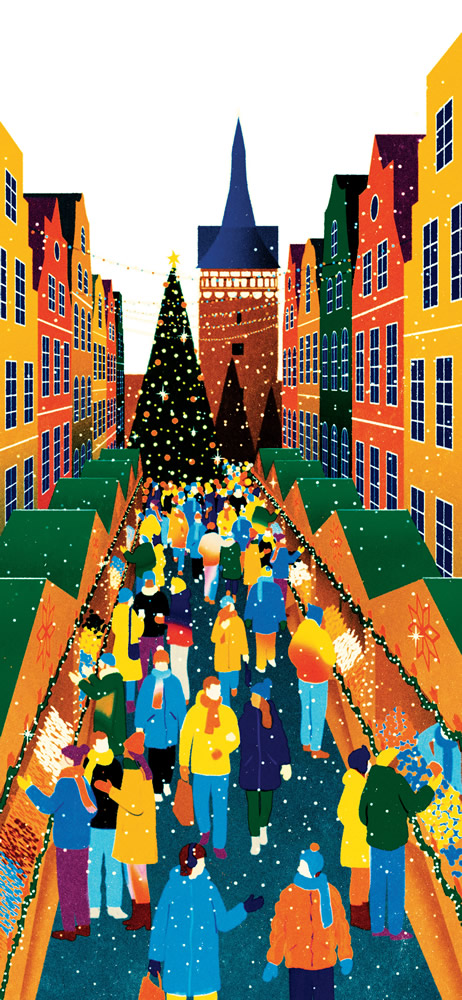
The centre of Gdańsk is once again filled with the aroma of mulled wine and dishes from around the world, and festive music can be heard coming from the loudspeakers. The Gdańsk Christmas Market began on the penultimate weekend of November. Last year, it won the title of Best Christmas Market in Europe in the Best Christmas Markets in Europe competition. The city authorities are very proud of this, which they mention at every opportunity.
‘We are very happy about this. When it gets dark earlier outside, we look forward even more to the beautiful lights and atmosphere that we create together,’ says Mayor Aleksandra Dulkiewicz.
The market began on the penultimate Saturday of November. As every year, the inauguration was marked by a Winter Parade, as well as a joint Oath of the Guardians of Christmas Magic and the symbolic opening of the Market Book, all accompanied by performances by the Academic Choir of the University of Gdańsk.
It is noisy, in some places you have to squeeze through the crowd, and you can hear the joyful laughter of children. The most crowded area is the food court, where you can eat traditional Polish dishes such as pierogi, but also cuisine from Sri Lanka or Japan. In total, you can taste 22 cuisines from around the world.
The heart of the fair is Targ Węglowy, which is usually filled with cars parked here. Now there is a stage here, ready for Christmas concerts and children’s entertainment. On Monday, a backdrop will appear on the stage to serve as an Instaspot. On Tuesdays, the stage will host a theatre, along with Christmas stories. And so on — a different event every day. Every year there are more and more streets with exhibitors, as the market grows. This year there are 222 stalls, 62% of the exhibitors come from the region whose capital is Gdańsk. To help visitors find their way around, large maps have been prepared to show where everything is located.
It is easy to find the market. There are tram and bus stops nearby, as well as a railway station. Before heading to Targ Węglowy, you can take a look at the courtyard of the Forum Gdańsk Shopping Centre, which is crowded with people going shopping, but also leaving cultural events organised by the City Culture Institute. Residents and tourists alike enjoy taking photos next to the several-metre-high Christmas tree, and there is a queue of people waiting for Canadian ice cream.
When you cross the street, a row of stalls leads you to the market. On the right, Bogłusławskiego Street branches off, stretching from Łos Lucek, the star of every fair. Łos Lucek speaks with a human voice, jokes, mumbles, accosts passers-by; there is always someone hanging around here. Further on, we pass the crafts and regional products zone, and finally arrive at the new food court next to the Shakespeare Theatre. This is a new addition this year.
When we go back and pass through the Golden Gate, which marks the beginning of Długa Street, it is part of the Royal Route. The first street on the left is Tkacka Street, decorated with illuminations. There are always queues for food stalls here, but Hungarian lavash is the most popular. Traditional products are also popular here, such as those from Lithuania with kindziuk – a hard, long-maturing sausage, which many people look forward to.
Along Tkacka Street stretches the back of the Academy of Fine Arts, a university that educates future artists, and right next to it is the Great Armoury in Gdańsk, a monument also known as the arsenal, which is the most impressive secular Mannerist building in the city. Inside, artists and craftsmen exhibit their unique products.
But the Gdańsk fair is not only about food, crafts, and unique products. The opening ceremony was one of more than a hundred artistic events that will take place until 23 December. Last year, the fair was visited by over one million people, and it gets crowded even on weekdays. Tourists from Scandinavia and Germany stroll through the streets of this city that is crucial to European history: the Second World War began here, Solidarity was born here—the movement led by Lech Wałęsa that steered the country, and part of Europe, out of communism—and both the current prime minister, Donald Tusk, and the president, Karol Nawrocki, were born here.
‘I like the Christmas market because it’s atmospheric and has a great vibe,’ comments Ewa, a resident of Gdańsk. “It used to look less aesthetically pleasing, with ugly tents and mulled wine served in plastic cups, but now you can really see the difference. Although it’s crowded, full of tourists, and the prices can be exorbitant, it still has its charm. Besides, for me it’s a great opportunity to meet friends, stroll around the stalls and feel that Christmas is really close.
However, not everyone likes the organisation around the fair. Paulina lives in the very centre and feels marginalised as a resident. ‘I walk around the streets, and this year the fair has taken over another street that could be used to avoid the crowds. On weekends, I give up my car altogether. In the crowds at the fair, people are unfriendly, aggression arises because it is too crowded. I don’t understand what they are looking for there, because it’s definitely not the festive atmosphere,’ she comments. I don’t understand what people are looking for here, because the festive atmosphere is nowhere to be found,” she comments. Her voice is not an isolated one: those who live in the center of this city, so crucial in European history, feel increasingly less at home. Holidays and fairs are the main cause of their discomfort.
But annual trips to Christmas markets in Austria and Germany are popular among Poles. ‘These are the most beautiful Christmas markets,’ comments Monika, a Gdańsk resident who has visited German cities many times. “There, the crowds are spread across different districts, people meet, drink mulled wine and eat currywurst. And there isn’t so much junk there, everything is of the highest quality. In Poland, there is no great debate about changing the way Christmas markets are organised. One of the few critical voices was last year’s comment by a Gdańsk architect and urban planner. ‘We need to change the way we think about fairs – creating trails and dispersing them may be the answer to the current criticism. In addition, this approach will also work as a mechanism for stimulating individual locations in the city in winter,’ wrote Hanna Obracht-Prondzyńska.
But there is a market in Poland that you might not find in the West. It has been the talk of Poland recently. The one in Warsaw is located… in the clouds. More precisely, on the 49th floor of the tallest building in the country, Varso Tower in Warsaw. It is the highest market in the European Union. It is a winter wonderland suspended between the sky and the city.