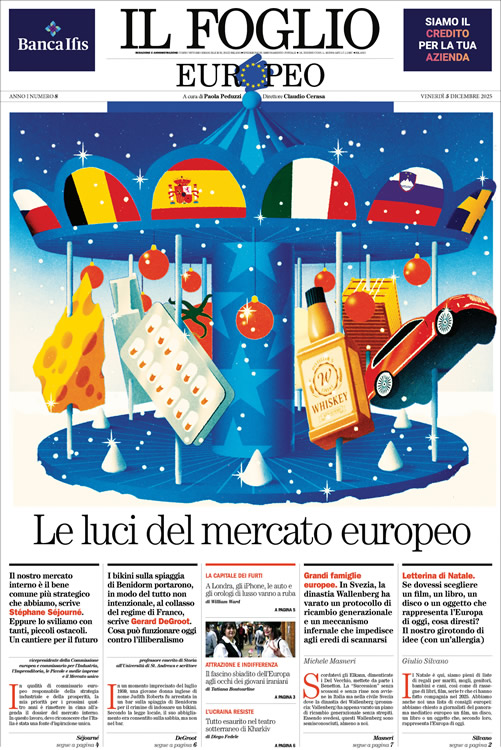
As the European Commissioner responsible for industrial strategy and prosperity, my priority for the next four years is to put the internal market dossier back at the top of the agenda.
In this work, I must acknowledge that Italy has been a unique source of inspiration.
All the most beautiful recent declarations of love addressed to the European internal market come from Italy. The first, poetic, is that of Roberto Benigni in the television program “Il Sogno” in March 2025, in which he delivers an ode to Europe and particularly to its market, the evocation of which earned applause. He also likes to describe the comic absurdity that a customs check between Lazio and Tuscany would represent today, while at the same time how little thought we would give to imagining such a situation between Italy and Austria. The second, urgent, is that of Mario Draghi who describes the internal market as an “untapped treasure.” The third, programmatic, is that of Enrico Letta, who in his report proposes a genuine action plan to revitalize it. Three styles, the same message: we have in our hands an immense asset, but we are not using it to the height of its potential.
And it must be said clearly: the single market remains largely undervalued in European public debate. We celebrate Schengen, Erasmus, the euro, but the internal market—this construction that underpins our economic development, that has enabled millions of businesses to prosper, that has made Europe the world’s leading integrated economic space—is often perceived as a technocratic framework rather than as a strategic common good. This lack of interest is not a minor detail: it has a political cost. Because an incomplete internal market is today our main weakness in a fragmenting global economy.
The world is changing rapidly. The United States and China are building cohesive economic blocs around controlled value chains and supported industrial policies. Geopolitics is reshaping trade. Technological tensions are becoming systemic. In this context, a Europe divided by internal obstacles loses competitiveness, speed and sovereignty. We can no longer depend on a distorted global market: what we lose externally, we must regain internally.
The need for New Momentum
The Single Act, the four freedoms, the major cross-cutting directives—all of this has produced considerable transformation. But when was the last time we projected ourselves toward far-reaching reforms as Delors would have done? On telecommunications, on capital markets, on digital, our market is still too fragmented. We must have the courage to confront this. Just as we must have the courage to look lucidly at reality: the blocks that impede the internal market are highly technical in nature, they are often minuscule but taken together they are devastating. It is no longer just about tearing down walls, but about removing thousands of small obstacles: a professional qualification recognized in one country but not in another; divergent packaging rules for the same product; duplicate administrative procedures that discourage SMEs; non-harmonized technical standards that delay the market introduction of essential technologies. These frictions are rarely visible, but they represent the equivalent of internal customs duties—up to 50 percent for goods, and 110 percent for services. This precision work has nothing spectacular about it. But it has become indispensable if we want to restore the internal market to its role as economic engine.
The responsibility belongs to everyone
Saying that the Delors cycle has ended does not mean that the Commission no longer has a role. It means that responsibility is now collective. The Commission can stimulate, propose, coordinate. But it cannot, alone, fill the gaps created by national governments. Too often, national regulations presented as technical improvements are in reality nothing but forms of disguised protectionism. The additional requirement, the procedure that differs slightly, the national standard maintained without objective justification: each time, it is an invisible barrier being erected. A barrier that protects an established player but weakens the entire European value chain.
The message is simple: without the commitment of member states, there will be no truly functional internal market.
But responsibility also lies with businesses. Certain practices, such as artificial market segmentation, unjustified territorial exclusivities, or restrictive clauses that prevent cross-border sales, maintain the very fragmentation that they denounce. One cannot demand a more integrated market while simultaneously trying to keep twenty-seven markets captive. In a world where external competition is intensifying, these strategies are not only ineffective, but dangerous. We can no longer live in a world where internationalization is, for a company, simpler than Europeanization.
A strategy to put the Internal Market back at the heart of the European project
Faced with these challenges, our Commission has decided to act. We have launched a strategy aimed at reinserting the internal market at the heart of our political project. It is based on concrete measures:
- Protecting our internal market by conditioning foreign investments that are not in the Union’s interest and finalizing the Customs Union;
- Identifying and eliminating the ten biggest obstacles penalizing businesses;
- Accelerating the recognition of professional qualifications to guarantee mobility;
- Harmonizing and simplifying consumer information, particularly through common digital labeling;
- Creating a voluntary “28th regime” to allow innovative companies to develop more easily at European scale;
Our conviction is simple: the best simplification is not deregulation, but harmonization. Common rules, applied everywhere, free market forces instead of restraining them.
Italy at the heart of tomorrow’s Internal Market
For Italy, all of this is central. Your small and medium-sized enterprises, your engineers, your artisans, your start-ups operate in a system where the fluidity of the internal market directly conditions their competitiveness. Your regions are among the most dynamic in Europe, but their development depends on frictionless access to neighboring markets. Your young talent needs a professional space without administrative barriers.
The work of Letta and Draghi reminds us that the internal market is simultaneously our greatest asset and our greatest missed opportunity. To remain an economic power and preserve our sovereignty, Europe must make the internal market not just an assumption, but an ambition. The internal market is not a legacy: it is a construction site. It is not only a success of the past: it is the condition of our success for the future. It falls to us—institutions, member states, businesses—to finally make it a reality that we fully support.