Viktor Orbán’s deadly trap
The Hungarian elections, to be held on 12 April, confirm a rule of romantic relationships: exes, if they want to, can be dangerous. They know the family lexicon, they know the weak points, they recognise panic, they know where to strike to cause pain. Péter Magyar, forty-four years old, is the leader of the Tisza party — the Party of Respect and Freedom — which is polling very strongly, and he is an ex: from 2002 to 2024 he was a member of Fidesz, the ruling party of Prime Minister Viktor Orbán, who after sixteen years in power risks losing badly, precisely because of this ex who holds a deadly competitive advantage. Magyar is not a left-wing leader; he is not one of those “liberals” who, according to Orbán, want to distort, impoverish, and debase Hungary — along with Europe, along with George Soros. He is not the establishment, not the elite, not any of the things the Hungarian government has cast as the enemy in that sovereignist, populist, and revisionist somersault by which the European Union is equated with the Soviet Union. No — Magyar is simply an ex. And to vote for him, Hungarians do not need to shift from right to left, reposition themselves, or reinvent themselves. They just need to be tired, which after sixteen years is only natural; they just need to be frustrated by broken promises, of which there are plenty; they just need to be a little angry at seeing their country at the top of the European ranking of the most corrupt, while Orbán keeps zebras in his garden and pensioners — if their health allows (and that is often a big if, since the Hungarian healthcare system has also become a disaster) — have to keep working because otherwise the money is not enough. No revolution is needed, in short — even though Orbán’s defeat would be a revolution, make no mistake, at least for Europeans, because the great difference between the two concerns precisely the relationship with the European Union, which Orbán has destroyed and which Magyar wants to rebuild. And as one might easily imagine, the Hungarian Prime Minister has no intention of giving this treacherous ex a free ride: he is prepared to do anything, and since the instruction manual comes directly from Russia, anything means anything — including inventing a war that does not exist in order to introduce a state of emergency that serves no one except to overturn an election that has looked like a foregone conclusion for months.
Why exes turn bitter
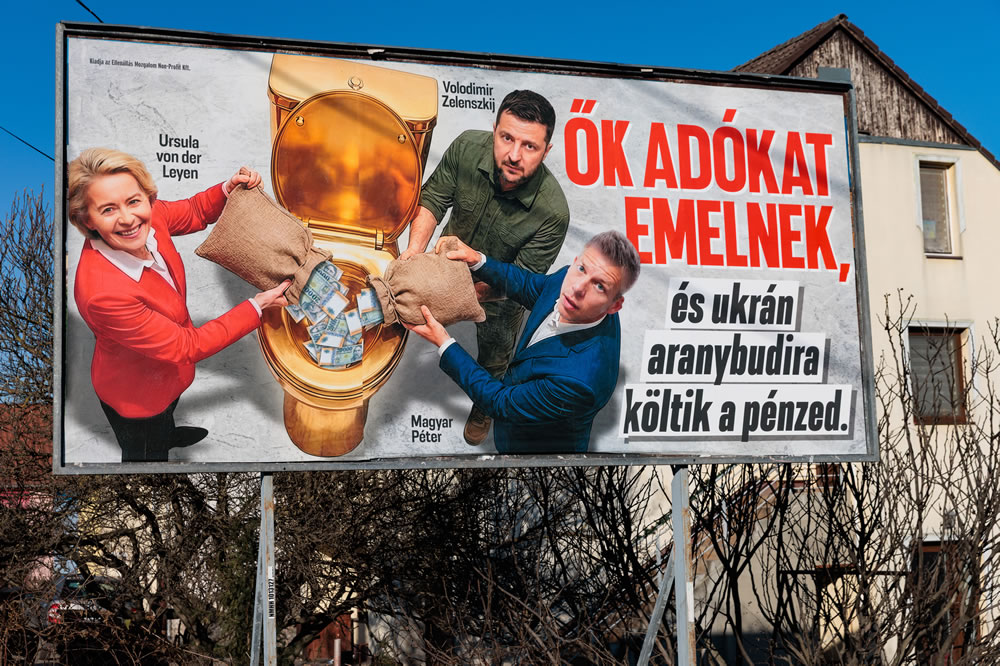
In addition to having been a Fidesz member for over twenty years, Péter Magyar is the ex-husband of former Justice Minister Judith Varga — for a long time the power couple of Orbánism: conservative upbringing, young students who joined Fidesz, marriage, three children. The perfect traditional Hungarian family, even if with an excessively Europhile touch — many years spent together in Brussels — but easily concealed when necessary. And the necessity arrived in 2018, when Orbán summoned Varga back to Budapest to appoint her as minister, and Magyar took on the role of the devoted husband and father sacrificing himself for his wife’s career: another flawless operation. But then love ended, and so did the marriage — except that even though Varga already had a new partner, Orbán decided that his showcase couple could not be allowed to separate, not in the middle of an election campaign, and he prevented the two spouses from divorcing until his 2022 victory. For a couple of years Magyar continued to keep a low profile, but then at the start of 2024 a scandal engulfed Orbán’s government, which — naturally — sacrificed its female minister, and Magyar exploded. He began to speak out, to denounce, to expose the system of corruption within Orbánism — at first sparing his ex-wife, but then no longer, as things descended into an all-against-all in which Magyar became enemy number one of the state. Orbán created a vengeful ex and, as many experts say, he may not even have noticed until it was too late — because one of the problems with the so-called Hungarian illiberal democracy (more illiberal than democracy, evidently), with its high rate of corruption, is that there is no one left to tell the boss that he needs to be careful, that there are threats to his dominance, and so the boss ends up underestimating them. Magyar, who knows everything about the system in which he was immersed for two decades, has known how to exploit it, wielding a weapon he still uses today: since the media are virtually all controlled by Orbán’s allies, Magyar, rather than be left without a voice, began speaking to the few independent outlets, to international media, and directly to Hungarians. In recent months the Tisza leader has held dozens of rallies, travelling to many of Orbán’s strongholds to stir the frustrations and weariness of an electorate that for years has given itself to the same prime minister, presenting himself as a broadly reassuring alternative — because, precisely, Magyar is a voice of conscience, not a revolutionary. Orbán, by contrast, prone to arrogance, has during this campaign held mostly invitation-only events with a selected, applauding audience, which has certainly allowed him to feel safe inside his bubble, but has also left him blind. We might say: he never saw it coming. And yet Magyar’s wave has been plainly visible — people have been talking about it for two years: there have been very well-attended rallies, widely quoted speeches, incontrovertible polling. Orbán underestimated the power of his ex, and so found himself having to manage this wave belatedly and breathlessly, at a point where only drastic measures can perhaps still work. And what is more drastic, more definitive, than a war? And who could possibly be waging war on Hungary? Why, Volodymyr Zelensky, of course. So the Ukrainian president is now the new Soros — Orbán’s people did not even bother to change the slogan: on Fidesz billboards, Soros’s face has been replaced by Zelensky’s, both captured mid-laugh, and the appeal has remained the same: don’t let him have the last laugh.
The war among friends
As the crow flies, Budapest is two thousand nine hundred and seventy kilometres from Tehran, and yet, suddenly — after Israelis and Americans launched their major assault on the Iranian regime on 28 February — Hungarian streets took on the tones of a wartime alarm. Police and military were deployed in the streets with no specific objective, other than to give the impression that war was coming — or rather, that it would already have arrived, were it not for Prime Minister Orbán. Hungary lives in a state of permanent emergency: a manufactured, performed emergency, not a real one — but since in 2022 the trick of convincing Hungarians that only he could protect them worked for the Prime Minister, the same script is being replayed now. The emergency began with Covid, dragged on with the start of the war in Ukraine, and the Middle East conflict is now offering a fresh opportunity — to the point that, according to some experts and observers of Hungary, the possibility that Orbán might choose to postpone the vote is not so remote. “He could do it,” Stefano Bottoni, an Italian-Hungarian historian who closely follows the changes and tremors of Hungary, where he lives, told us. “The state of emergency gives the Prime Minister the power to postpone the vote — he has never used it, but it exists.” Until now he had never faced a genuine challenger; a postponement would buy him time, and the Middle East conflict could simply be the latest pretext to exploit. Orbán seems to have difficulty commenting on what is happening in Iran for a very simple reason: they are all his friends. Donald Trump and Benjamin Netanyahu are his friends. But so too are the Iranians, the Russians, and the Chinese — and Bottoni reminds us that in 2024, the University of Budapest invited former Iranian president Mahmoud Ahmadinejad to give a lecture on environmental topics. Rather than taking sides, Orbán simply says that whatever happens, the world is a very dangerous place, and there is only one solution to staying safe: voting for him.
Ukraine has declared war on us
With Ukraine, things are simpler for the Hungarian Prime Minister: on one side is his friend Vladimir Putin; on the other are Volodymyr Zelensky and the Europeans. Showing who is right and who is wrong, according to Orbán, was not in the least complicated — on the contrary. Bottoni tells us that Hungarian streets are covered in Fidesz election campaign billboards. Partly, Magyar made a deliberate choice: no point in adding to the visual pollution and spending a lot of money. On the other hand, the reason is that Orbán wants this visual pollution. What is striking is that the advertisements contain no trace of him or his proposals — every billboard is there to remind voters who Hungary’s enemies are: Zelensky and the Europeans. “It looks like an election campaign about Zelensky, or against Zelensky. Hungarians are living in a state of induced coma, from which they risk never waking up,” the historian warns. Zelensky is the enemy — the man who is depriving Hungarians of their energy supplies, the dictator who wants to drag the country into war, who is putting the lives of the Magyar minority in the Transcarpathia region at risk. “And even with Iran, it is Zelensky’s fault. If petrol prices are rising, it is not because of the Middle East — it is because of Ukrainian sabotage.” Fidesz has shifted the focus to an election campaign that plays entirely on fear, with videos showing lives shattered by war, to show citizens the future that awaits them if they do not once again choose the eternal Orbán. Hungarians, like most Europeans, have no great interest in foreign policy — but by now Orbán has moved the debate onto Ukraine and the dangers of the world at large. He does so to conceal the state of decay to which he has brought the country. Magyar, by contrast, prefers not to talk about foreign affairs — he wants to discuss what has happened to the economy, to pensions, to healthcare. The election campaign is therefore one long exchange of statements with no one waiting for the other’s response. Orbán tries to draw Magyar into the minefield of international politics, accusing him of siding with those who want to spill Hungarian blood. Magyar stays silent on this, and instead tries to hold him to account for where citizens’ money is going.
Csapda
Direkt36 is an investigative journalism website that is indispensable for understanding Orbánism. It recently published a documentary titled “Csapda” — the trap — which tells the story of how Orbán squandered the greatest political and economic opportunity Hungary has had in the past hundred years. In 2010, Orbán won a two-thirds parliamentary majority while the world was trying to recover from the previous year’s financial shock, and the EU was pouring an unprecedented amount of money into his country. The stars were aligned for that determined Prime Minister — a persuasive orator with a past as a fighter against the Soviet Union: experienced, shrewd, with a socialist government behind him that had ended badly, crushed at the ballot box and destroyed in its public image. Everything was perfect — and yet. Orbán centralised the system, made loyalty a prerequisite for access to power, and subordinated a reforming vision to the consolidation of his own rule, using EU funds as the financial engine of a clientelist state: the documentary is full of example after example — money intended to build hospitals or schools ending up in projects designed to line the pockets and feed the vanity of his most loyal allies. The much-celebrated Hungarian growth of 2015 and 2016 was the product of EU transfers and cheap credit, but it became the alibi for ignoring — and here European institutions bear immense responsibility — the progressive deterioration of the rule of law, the rise of corruption, the scapegoating of immigrants (when Hungary’s problem for years has not been immigration but emigration), and illiberalism across the board. Everything — education, healthcare, motorways, railways — has gone to rack and ruin, taking with it Hungary’s human capital. The opportunity was squandered; the Budapest government undermined Europe’s attempts at unity and instead inspired extremist movements across Europe and, alas, in America too — Trumpists have been taking notes from Orbán for years. And the extraordinary opportunity of sixteen years ago is today a black hole swallowing up reforms, values, security, and alliances: a trap.