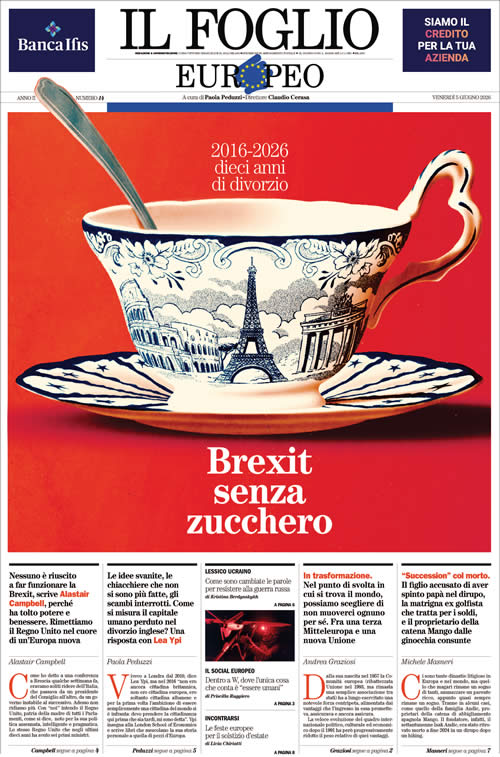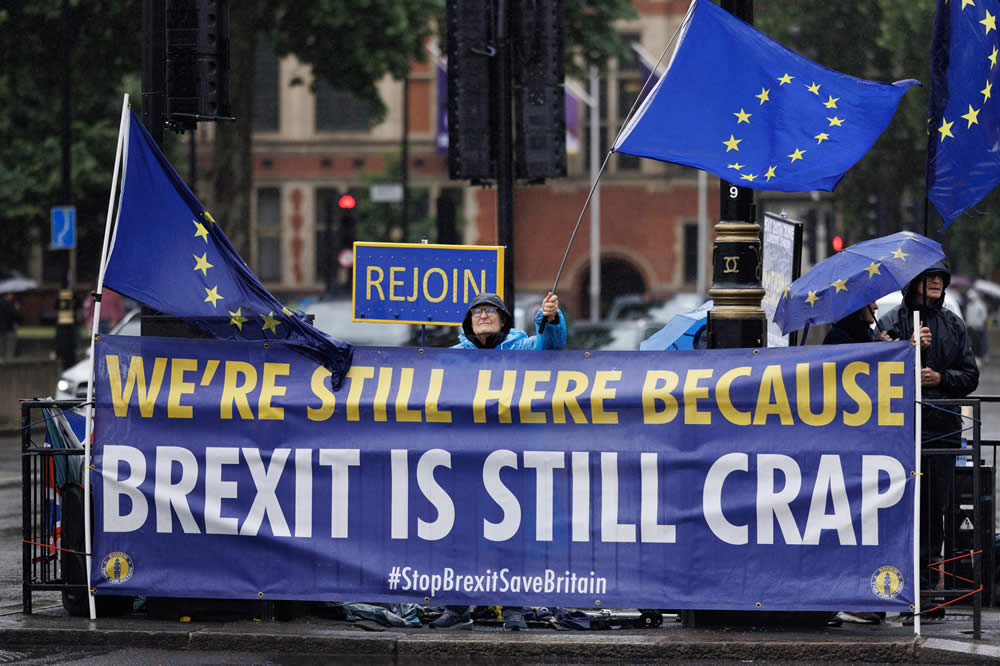
Brexit is so awful that in ten years nobody has copied it. In fact, if there was ever a silver lining to the vote on 23 June 2016 – it was hot and rainy in London back then, and people walked around in a daze, trying to stick together – it was that it stemmed the tide of anti-European sentiment that was sweeping across the continent. Remember? Looking back, the slogans of those days make you smile – simple and clear: ‘Let’s take back control’, ‘Let’s give the money we pay to the EU to the NHS’, as if Brussels were a gym whose expensive membership could be put to better use elsewhere, and so on. Not that we’ve become any wiser in the meantime; on the contrary, populism has made itself at home in our lives and taken the insidious form of polarisation. That ‘we’ in ‘let’s take back’ hardly exists anymore, but as things stand, no one would dream of promoting a rigid utopia like the one that descended upon the UK exactly ten years ago. It’s rather touching to look back at the politically engaged cultural works on the subject, with Benedict Cumberbatch playing Dominic Cummings, and the indignant tone with which we envisaged an altered order — an order to which, perhaps, we might one day return, as if by magic.
Now that talk is turning to a reversal, a ‘Bre-entry’ or a ‘Rejoin’, the veins in our wrists are trembling once more: wasn’t it said that referendums were the wrong tool for such important decisions? Better to proceed in small steps, the pro-Europeans think, and better to have constant, minor discontent, seem to think those at Reform UK, rather than the staunch defence of an isolationist utopia which, when put to the test, has violated two of the pillars of the national psyche – the hatred of bureaucracy and the love of the free market – leading to political instability now bordering on vaudeville, with carnival-like peaks. Without keeping the grand promise to manage immigration, so much so that we rejoice that it has returned ‘almost’ to pre-referendum levels, with just 171,000 arrivals a year – half the figure of 2024 and far more than David Cameron’s infamous promise to bring the figure down to tens of thousands in 2010. Asylum seekers are arriving, whilst the former young European talents who gave so much to London are leaving, but such is life. The economic damage is clear: growth has lost momentum and now matches that of the continental countries – a figure once derided – and Brexit has had the further side-effect of providing a cover for a great deal of lazy thinking, policies which, if they failed, were certainly the fault of the referendum and not of those who devised them. Since 2016, the country has become more European than ever, writes the astute Janan Ganesh in the Financial Times: no stability, no two-party system, sky-high statism, institutional credibility at an all-time low.
But how to organise the return, the rapprochement with the EU after these mad years? The much-maligned Keir Starmer, a man who did what he could with what he had and who may well be missed at some point, sacrificed himself on the pro-European altar for the sake of his country, returning to talks with Brussels for an ‘alignment’ whose red lines are increasingly fluid and intermittent: there is no re-entry, but we can discuss food standards, tariffs on coal and electricity, and who knows what else. No awkward topics such as the free movement of people, for instance, and this led to the first attempt to see the UK return to the single market for goods being rejected with some indignation. The famous ‘cherry-picking’ – picking the best cherries – is not an option, and this is something to bear in mind ahead of the next meeting in July. Everyone is always criticising Starmer, as if caution were a cardinal sin, but even his rival Andy Burnham knows that playing the lion-hearted on this issue is risky, especially if you’re trying to win over a Eurosceptic electorate in the north, who see the EU as a gift to London and London alone. The city was the centre of the world; it almost seemed as though its splendour needed to be tamed, its success reined in, and who knows who is happy now that it is growing at a rate 20 times slower than 20 years ago and has empty restaurants, perhaps because of the €15 glasses of Vermentino. It no longer attracts the best and the brightest, but global elites continue to emerge from British universities, and this continues to fuel a certain mystique – somewhat faded compared to the past, but still solid given the instability of the rest of the world. As for the Europeans, they send their children to study elsewhere and enjoy an EU where decisions are made without constant British sabotage. It is pleasing, even flattering, that there is a rethink, even if for now it is limited to Labour and the Lib Dems, whilst the Conservatives lie low and Reform looms menacingly.
The doors of Brussels are not wide open: for now, enthusiasm in the EU corridors is muted. For however sad the EU is without the UK, why welcome back the cultural and identity-related volatility of a country adrift, where it took ten years for a prime minister to start mumbling something about the need for ‘alignment’ and where the architect of Brexit, Nigel Farage, continues to enjoy unstoppable political growth which, from one nightmare to the next, could take him to Downing Street? Is it possible that in ten years they have failed to make him face up to his responsibilities, to escort him off the stage as happened with Boris Johnson? His Reform Party continues to be treated with that mixture of fear and contempt that has allowed it to grow magnificently to this point: it turns out that Farage will neither be nor be invited to the BBC’s “Desert Island Discs” to avoid a boycott by other guests; let’s hope it’s just a rumour to make him feel excluded from the establishment, not least because if there’s one figure we should always be asking loads of questions, it’s him. Starting with the first: if Brexit was so brilliant, why hasn’t anyone copied it?