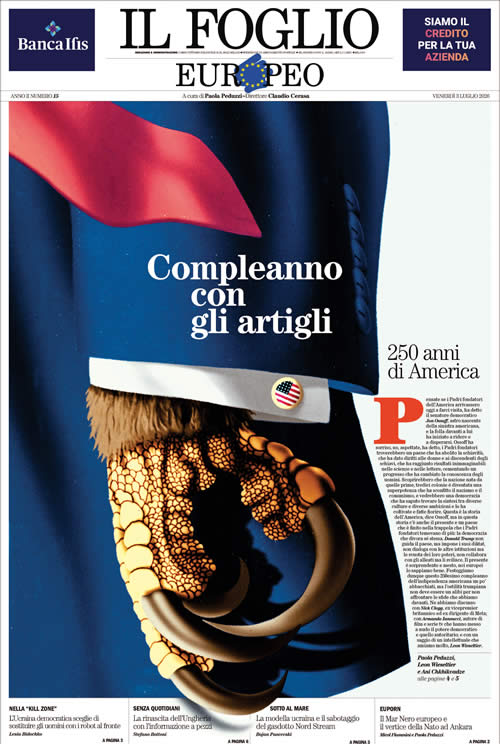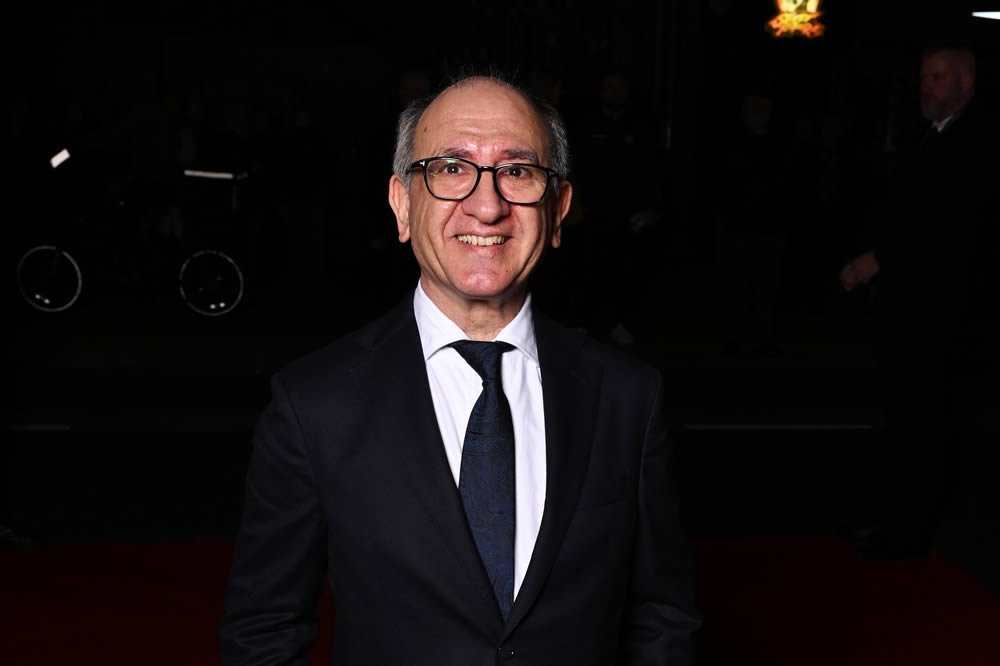
The man who turned Stalin’s death into one of modern cinema’s sharpest political comedies came to Stalin’s birthplace to talk about laughter. In a café in Tbilisi, Armando Iannucci, the director of “The Death of Stalin”, spoke about the thing dictators have always feared most: being laughed at.
Russia proved his point. In 2018, authorities banned the film from Russian cinemas. The Death of Stalin follows the chaos after the Soviet tyrant’s final hours, as his terrified inner circle scrambles for power and survival.
Across his film career, Iannucci has returned to the same terrain: the comical absurdity behind the power. His work has stripped the leaders of the seriousness they try to project and exposed their vanity from the offices of Westminster to the corridors of Washington DC. Born in Glasgow in 1963 to an Italian immigrant family, Iannucci is the son of a father who fought Mussolini’s regime as a teenage partisan before settling into a Glasgow pizza business. He read English at Oxford and then set it aside for comedy. His “The Thick of It” portrayed the British government in a permanent emergency; “In the Loop” carried that same bureaucratic panic and Veep took a crack at American political dysfunction.
“I’m genuinely fascinated by what goes on behind closed doors, because it’s just human beings being human beings,” he explained, talking about why he ridicules power. “Outwardly people are projecting a stance, and privately it’s something else. The more I talk to people who’ve been in those situations, the more frightening it becomes, because you realise that decision wasn’t made after months of careful thought. It was made that morning, because that’s the only time you had to make it.”
Looking at the present moment, Iannucci sees a world sliding backward. The decades after the Cold War were supposed to settle into calm, and instead they keep returning to war. “It was meant to be the end of history,” he said, “but it’s not. It’s like, why are we going backwards, why are we having wars?”
Iannucci does not find Donald Trump funny. For him the American president belongs to the age of showbiz. He describes him as an “entertainer,” a politician with an instinct for attention and spectacle. But he separates his performance from comedy. “Very few people are laughing at Trump’s jokes,” Iannucci said, describing his humor as crass, closer to “the locker room of the 1980s.”
Trump changed the conditions in which satire works. If older political comedy exposed the hidden absurdity, Trump brings much of that absurdity onto the stage himself.
In “In the Loop”, Iannucci shed light on how the “special relationship” between the United States and the United Kingdom plays out behind closed doors. With Trump in the White House, often blurting out what would once have remained private, what Iannucci would most like to overhear now is the candour that breaks out among European leaders the moment the American president leaves the room.
“In front of him they’re all, this is a magnificent agreement, thank you for your work on the treaty,” he said. “Then he goes, and they’re probably going, he’s completely screwed everything up.”
Europe, Iannucci suggested, has fallen out with the American leadership rather than with America itself. He is no fan of Trump. “We’re now very wary of relying on America as a supportive friend,” he said. He turned Trump’s complaints about NATO and European allies, back on the president. The alliance came to America’s defense once, after the 9/11 attacks, the only occasion Article 5 was invoked. On Iran, the United States walked in of its own accord. Underneath it all, he saw the political irony: Trump won election on a pledge to keep clear of new wars.
“They thought it’s all about power: we’ve got more power, we’ll inflict it on them, and they’ll crumble. What we now have is an Iran who knows it can hold the world economy to ransom whenever it likes,” he said. “It’s about a lack of understanding of how countries work.”
Still, Iannucci resists the satirist label that others happily attach. His influences, he said, run from Billy Connolly, who came from the same Glasgow streets, Charles Dickens and George Orwell to Buster Keaton, Charlie Chaplin, Stanley Kubrick, Terry Gilliam, Vittorio De Sica and Federico Fellini. He wakes up wanting to make something funny, to the best of his ability, and leaves the meaning to the audience. Anyone willing to dictate votes or beliefs, he reasoned, should enter politics or journalism instead.
“I’m not trying to tell people how to vote or how to think,” he remarked. “My work is my response to what’s happened. I find this amusing, or crazy, and I hope you find it entertaining. If it raises topics that are complicated, I hope it allows you to start thinking about them. But I don’t want to ram my politics down other people’s throats, because that’s not my job.”
In the British context, where debates over censorship, hate speech and online expression have pulled the police into questions of language and intent, he sees a worrying transfer of responsibility from society to the law. For Iannucci the danger begins when the government tries to settle those disputes in legal terms. “If you have to legislate for it,” he said, “it’s an admission that you haven’t won the argument and that they haven’t persuaded you enough. That they have to actually make it illegal rather than an aspect of how we just agree we should get on. It’s an admission of failure.”
Iannucci had picked a fitting place to make the argument. This part of the world has long turned political fear into absurd comedy, one of the examples is Radio Yerevan, the fictional Armenian station whose deadpan answers needled Soviet life. “Is it true that the Constitution of the USSR guarantees freedom of speech, just like the Constitution of the USA?” ran one. “In principle, yes. But the US Constitution guarantees freedom after the speech”
Humor tends to outlast the regimes that try to ban it. In Georgia today power already looks like something Iannucci might have invented. With protesters on the streets, the country sliding toward the kind of rule jokes once mocked and an informal ruler reportedly surrounded by sharks, zebras and penguins, moving ancient trees as if the country itself were his private estate – irony is once again a necessity to survive.
Censorship fails to control the human instinct to laugh. For Iannucci, that gives people a certain sense of control at a time when power can come down on them at any moment.
“There were joke books circulated about Stalin and Beria. You could be killed if you were reported to have said those jokes, but people wanted to be able to tell the jokes,” he told Il Foglio. “The humour kept them alive in a way. It meant that even if they can tell me what to say and think, they can take my life, they can lock me up, but if I could still tell jokes about them, then they haven’t shut me down.”
Ani Chkhikvadze, a journalist based in Washington, previously with Voice of America. She’s a contributor to various international publications.