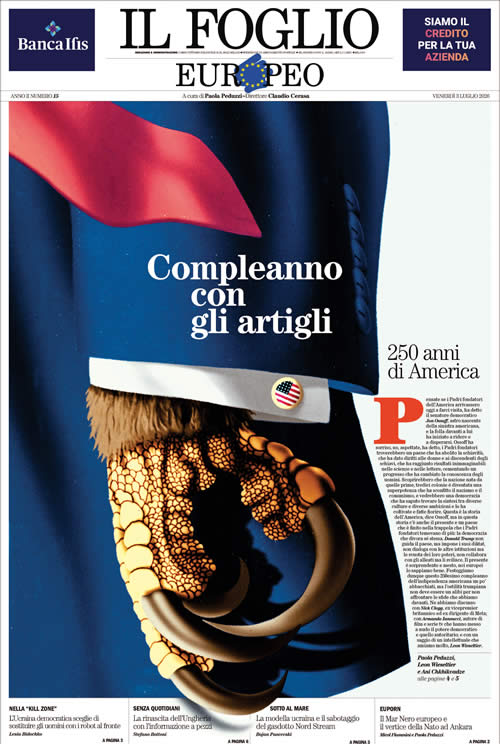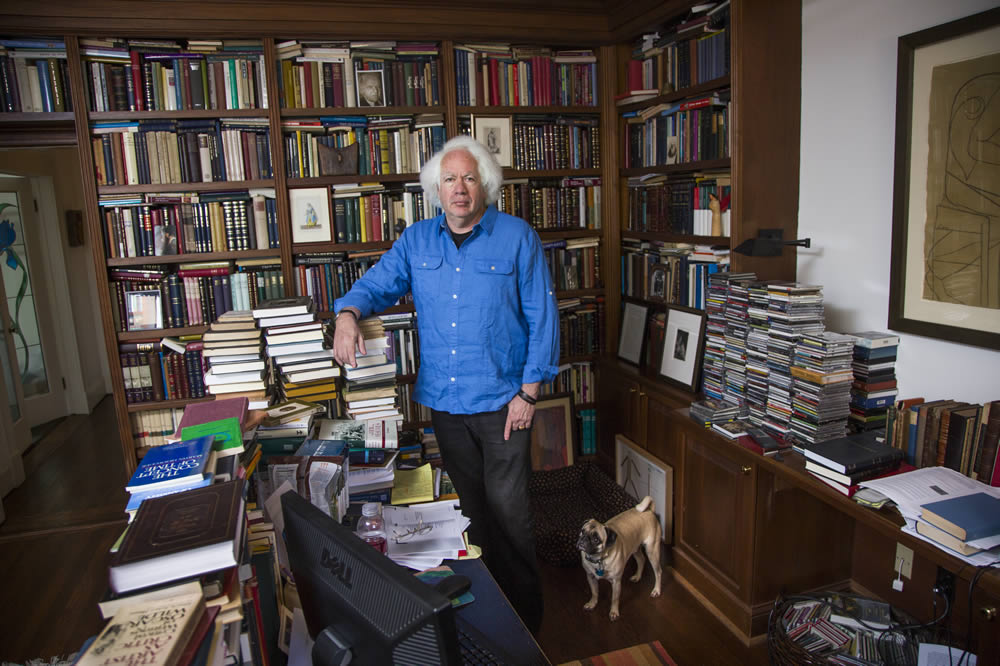
American intellectual Leon Wieseltier shared with us an essay that will appear in the upcoming issue of Liberties, the magazine he founded in 2020 after his years at The Atlantic and The New Republic. In the essay, written to mark the 250th anniversary of the Declaration of Independence, Wieseltier identifies and examines the different forms of American patriotism. His aim is to help Europeans better understand the birth of a nation “from scratch” and the Founding Fathers’ experiment in republican liberty two and a half centuries ago.
Many millions of Americans will mark this anniversary with a mixture of gratitude and melancholy, of ardor and distress. As for the millions of Americans who will celebrate it in a state of unalloyed happiness, I can only remind you that all of us love this country that you are ruining. I understand that for a long time you have held the view that it was I, and those of my persuasion, who were ruining it; but still I would have you assent that the liberal dream of America, the one that prefers opportunity to authenticity, equality to hierarchy, decency to rapacity, governance to revolution, fairness to privilege, reflection to paroxysm, work to grandiosity — that this dream, too, is a patriotic dream.
The patriotism of justice
There is no such patriotism, because there is no just society. There is not and there has never been a just society; history provides not a single example. Anyone who prides himself on the moral perfection of his society is a fool or on the payroll. All the countries that have ever commanded the allegiance of their citizens have been unjust polities.
Patriotism, therefore, is, to borrow a phrase, the last refuge of relativists. It takes place in the realm of “better than” and “worse than;” the celebration is always comparative. And it should be uncontroversial to say that some countries have more to be proud of than others. Forgive me for getting into the unholy business of distinctions, but some societies are more just than others. (Not all distinctions are invidious.) I am relieved to owe my devotion to my country in part to its democratic character, though I do not claim that its democracy is remotely perfect; and I make the argument in good faith, having done my best — honestly, my best — to police within myself the intellectual corruption known as ethnocentrism. Democratic societies, even with the anti-democratic tendencies that they always contain, really are better than undemocratic societies.
“Better” is of course a triggering word, but I mean it to refer to universal and rationally examined criteria for moral conduct, though “universal” and “rational” are also triggering words.
The problem with “civilizational” discourse is that it is too often animated by disrespect for one of the civilizations under discussion; and speaking for myself, and with a vivid awareness of how my own people have fared over the centuries in debates about the alleged superiority of cultures and religions, I feel no burning wish to crown my own. I detest the exercise. There is something pitiable about needing to be Number 1. There are great civilizations that are not my own; and the world-historical contributions of the West, whose tradition I am honored to serve, include not only liberal and democratic politics but also Nazi and Communist totalitarianism, which together slaughtered more people than any other causes in history.
And yet, if it is the increasing welfare of more and more people all over the world that is our goal, it is still right, and unironically right, to prefer more just places to less just places, whatever the national and regional inflections of the language of justice. In a world without perfection we can do no more than select intelligently between imperfections, and unecstatically affirm flawed but fairer patrimonies and places. The question is how to make the selection among the imperfections, by what standards, and how to prevent the celebration of the less imperfect, the Fourth of July, from excluding shame and humility.
The patriotism of reason and unreason
The premise of such a way of thinking about patriotism is that national pride should have a basis in national reality — that it must to some extent be objectively justified. “To make us love our country,” Edmund Burke observed, “our country ought to be lovely.” Which is to say, patriotism should possess some degree of rationality. But sometimes no basis at all is found for the national vanity, and sometimes one discovers that one is a member of an evil society. (Which is not the same thing as a society all of whose members are evil: such a society has also never existed.) The disillusioned and disgusted citizen has a choice: he can secede, spiritually or physically, and find a new country that is worthy of his admiration, or he can revert to a type of patriotism that has nothing at all to do with reason and reality — a well-documented type. I have known extraordinary examples of the former, exiles and emigres from tyrannical states who bravely came to these shores and to their dying day despised their country of birth and stridently called themselves, in their almost hilariously heavy accents, Americans. (Joseph Brodsky’s notion of rhyming in English nicely illustrated the charms of an adopted patriotism.) A dissident is a patriot in grave crisis. My friends chose not only defection but also conversion. They demanded a life of justified loyalty. It was a matter not of politics but of integrity.
But I had other friends from totalitarian societies who now and then could be heard to speak tenderly about their old countries. I do not mean to be harsh about them. Nostalgia is unavoidable, and comforting, in exile: I was raised in a long tradition of nostalgia in exile. And yet what I heard sometimes sounded like something more — a vestigial patriotism, a warm remnant of a still living loyalty. The conclusion was obvious: the veneration of the imperfect implies that in the absence of complete justification the boast about belonging must base itself outside the realm of reason. It is anyway a stretch to think that patriotism, even in the finest of moral circumstances, can be entirely, or even mainly, rational. It is, for a start, an emotion, and what do emotions have to do with reasoning? (Tell me, somebody!) If patriotism were rational, chauvinism and jingoism and ethnonationalism might not have scorched as much of the earth as they have.
Patriotism, in other words, is love in the domain of history. If you have ever been brought to tears by a national catastrophe or a national epiphany, or just by the sight of the flag or the sound of Martin Luther King, Jr’s voice, then you know that patriotism is a form of love, with all its joy and gratitude and intensity and volatility — and blindness. Love is often the enemy of clarity, it is a glittering exemption from reason, a mental holiday, which accounts in large part for the pleasures of its swoon; there are no poems about falling in and out of objectivity. I confess that even a Sousa march can choke me up — this country saved my parents’ lives; and who is not a sobbing French patriot when they sing the Marseillaise in Rick’s Café Americain? When the cynical Yvonne, played by the refugee Madeleine Lebeau, re-discovers her patrie and sings its anthem like no song has ever been sung, our American hearts are hers, owing not to their fickleness but to their range. Only the wrong sort of patriot is moved only by his own country.
The patriotism of provenance
Do accidents have moral meaning? As Ludwig Boerne, an affecting and caustic Jewish writer in nineteenth-century Germany, once remarked about the assimilationist anguish of his time: “You can change your religion but not your grandfather.” Patriotism is most commonly determined by accidents of birth — indeed, patriotism is a method for making the arbitrary into the necessary and randomness into luck. The most tragic feature of human existence must be the extent to which lives are determined by locations, and life prospects by life givens, and this, I suppose, is one reason why disadvantaged people can be ardently patriotic. The nation — the combined social whole, its solidarity, its dignity-conferring symbols and practices, its sense of agency — is nothing less than a retort to fate, an empowering and ennobling way of playing a bad hand.
For this reason, the poverty of poor people is often not the most salient aspect of their existences to themselves: they prefer to define themselves in other terms, by their religion, their culture, their customs, their music, their food, their parents and their children, by anything but money. Economic inequality, especially over generations, is not a purely economic problem, and proposals for mitigating it must be accompanied by more than a merely economic understanding.
“I love my country because it is mine.” I have uttered the words myself. There is no disgrace in them, only an absence of reflection. An attachment to origins is natural, even if it begs the question of the extent to which origins should have the last word. Often a natural state of affairs must be rectified or rejected, but not always. We are not plants but we have roots, and the affections and dispositions that they inspire can be significant for the creation of character. Our racination can also be a source of wrenching sweetness. And so, like belonging, alienation too must be justified.
Yet scrupulousness in this matter requires that we not exaggerate the allure of our own sway, our possession and sovereignty. In itself, the first person singular and plural hallows very little. Nothing is better or higher or deeper merely because it is mine. The admirable qualities of an object or a worldview are not owed to its circumstances. When a beautiful painting hangs on my wall, I am the fortunate one, not the painting. Even though I own it, I do not own it. Beauty and the other attainments of the spirit can never become property. The Torah was not lucky, the Jews were lucky.
The literature on patriotism is a long debate on the moral worth of the local. It was Orwell who most notably defended the local as the proper grounds of patriotism. In his view patriotism is not primarily a political emotion and it threatens nobody. “By ‘patriotism,’” he wrote in 1945, “I mean devotion to a particular place and a particular way of life, which one believes to be the best in the world but has no wish to force upon other people.” He contrasted patriotism with nationalism, which he despised because it is “inseparable from the desire for power.” Nationalism flourishes in enmity, he says, but not patriotism. It is a somewhat baffling distinction, since patriotic feeling has certainly been as responsible for cruelty and aggression as nationalist feeling, and the patriot may be guilty of the same trespasses as the nationalist.
QUESTA FORSE TOGLIERE The scholarly and activist project that in recent decades has come to be called “global justice” is a tribute to the extraordinarily wide reach of our ethical concern, to the growing expanse of human suffering that we now include in the purview of our duties and our policies. Global emergencies, such as the spoliation of the environment or genocide in a distant land, demand a measure of cosmopolitanism from every village idiot. And so I was ashamed, as an American, when Trump and Rubio unconscionably terminated USAID and similar programs of assistance far away from home. We made the deaths of vast numbers of Africans inevitable — more simply, we killed them; and this heartlessness does not comport well with my construction of American amour-propre, of American patriotism. Isolationism is, among other things, the belief that non-American lives are worth less than American lives, and that indifference beyond our borders is a sign of our moral health as a nation. Alas, I do not yet see what it will take to persuade my fellow citizens, in both political parties, that we always carry, as a result of our powers and our principles, two sets of obligations: the obligation to the near and the obligation to the far. In space and in time, the near and the far; over here and over there, for now and for later. Otherwise we will slowly, or not so slowly, become Little America, a giant who is a dwarf, a self-defeating self-enclosure, and American patriotism will become a puny calling.
The patriotism of mixture
This patriotism does not yet exist, at least in large numbers. This is because mixture has not yet been widely accepted as a social ideal and a social reality. Too many citizens of heterogeneous societies entertain fantasies of homogeneity. How many catastrophes of sameness, from legal discrimination to physical destruction, must we witness until we realize that otherness is precisely what may save us from ourselves? The fervor for likeness leads only to illusion, anger, and grief. Too many Americans inhabit the America in their mind rather than the America outside their front door. They regard multiplicity, and any version of America with the infamous prefix “multi,” as the problem, when it is the solution. If we were all alike we would respect nothing.
As with all our characteristics, we emphasize or consecrate them on certain occasions. Every day is not the Fourth of July. But on the Fourth of July, we express, or we ponder, the love of country — even, or especially, the love of a country in free fall. In 2026 anxiety becomes an American patriot.
It’s Independence Day! Tomorrow is another day. Patriotism is a social truce, a hopeful simulation of the unity that we lack, a wager on the sympathy and the benevolence that remain after our quarrels; and a diversified patriotism is patriotism of the highest kind.
The patriotism of sorrow
There are times when the truest expression of patriotism is sorrow. After all, we mourn only for what we love. Ubi lacrimae ibi patria. Sometimes infidelity is made most clearly manifest in the absence of grief.
I do not grasp Americans who shed no tears for America and Israelis who shed no tears for Israel. Shame on the dry eyes! They, the dry eyes, are emblems of complacency or delusion or prejudice. Historians will explain how the countries took their sickening turns and surrendered so many of the stirring values upon which they were established, but we cannot postpone the attempt to comprehend why so many of their citizens are satisfied with the new national courses. I have heard no adequate defense of all the violence that has been committed, all the unending and unreluctant brutality.
Some of the finest patriotic compositions in history have been lamentations. I dare say that there is no language in which they have not appeared. Who will write our own? We do our political work in sackcloth. We wear black to the ballot box. At the patriots’ ball this year let us not omit the heartbreak waltz, if we can bear it. Strike up the band.