Something is rotten in the state of Denmark, and that something is a park where parents are offered coffee and their children a bladed weapon.
At Valbyparken in Copenhagen there are dunes of rocks and sand, every piece of play equipment is crooked, you can light a bonfire in the middle of miles of woods, and — here’s the curious part, maybe even a bit legally dubious — children are handed small swords or small axes. That’s not all: in photos of the park you see kids walking around with long wooden sticks, the kind of thing that in Milan would normally get social services called.
Back in July, The Economist ran a piece with the problematic headline “In praise of Scandinavia’s risky and dirty playgrounds.” I say “problematic” because I know quite a few mothers who might have a heart attack at the words “risky” and “dirty.” In the piece, the journalist described his visit to Valbyparken with his kids and a nephew. At this park, children could get dirty, could handle small knives under the supervision of staff in charge of the “armory,” could climb, crawl, run, throw themselves into the mud, use fire, and pick up the odd scrape.
I know quite a few mothers — the heart-attack ones — who, faced with a scrape, first sue the pavement, then post about it on Facebook, and finally give their little ones a hydrogen-peroxide bath for good measure.
Helle Nebelong, the landscape architect who designed the park, has said: “It’s the children who have to be aware of every step they take. They have to take responsibility for their own safety.”
Needless to say, I know mothers — the same heart-attack ones, the same hydrogen-peroxide ones — who’d start screaming at the words “responsibility for their own safety,” though not before writing an anonymous post about it on Facebook.
Controlled risk is a concept most parents reject, for the simple reason that the only acceptable goal is zero risk.
I’ve seen things Danes couldn’t even imagine: a corner guard on every corner in the house, backpacks with a cushion on the back for toddlers learning to walk, rounded scissors for twelve-year-olds, and bike helmets worn indoors, bumping into the living-room doorframe — moments that will be lost in time, like tears in rain, but always with the raincoat within reach.
One thing that’s very common, for instance, is hiding a GPS tracker in a child’s buttons or shoes — not just for a school trip somewhere, but even when they’re home with Grandma.
I never did it, because my own paranoia beats theirs: I’ve always imagined the worst-case scenario — the GPS stops tracking the child, heart attack, hospitalization.
Something similar happened to me once when, due to a technical error, the school’s electronic register marked my son absent, even though I had dropped him off at the door ten minutes earlier. I was certain I had walked him in, because every morning I take a photo of the school gate. Why do I do that? Because I don’t trust anyone — least of all my own brain: I could leave my son on the street, forget him at home, sell him to someone.
Zero risk, unfortunately, carries an unsolvable — and extremely dangerous — problem of its own: if a child never gets hurt, how is he supposed to understand what “hurt” even is?
There’s a whole generation of parents living in a constant attempt to eliminate anything that might, even and especially in the most hypothetical of ways, lead their children to get hurt.
Some time ago I read a post from a mother who couldn’t take her kids to the park anymore because they insisted on wanting to play on the ground, and the ground is full of germs.
There were hundreds of comments agreeing with her, because honestly, people just can’t take these parks anymore that are neither sterile nor hyperbaric: my suggestion is to replace playgrounds with operating rooms.
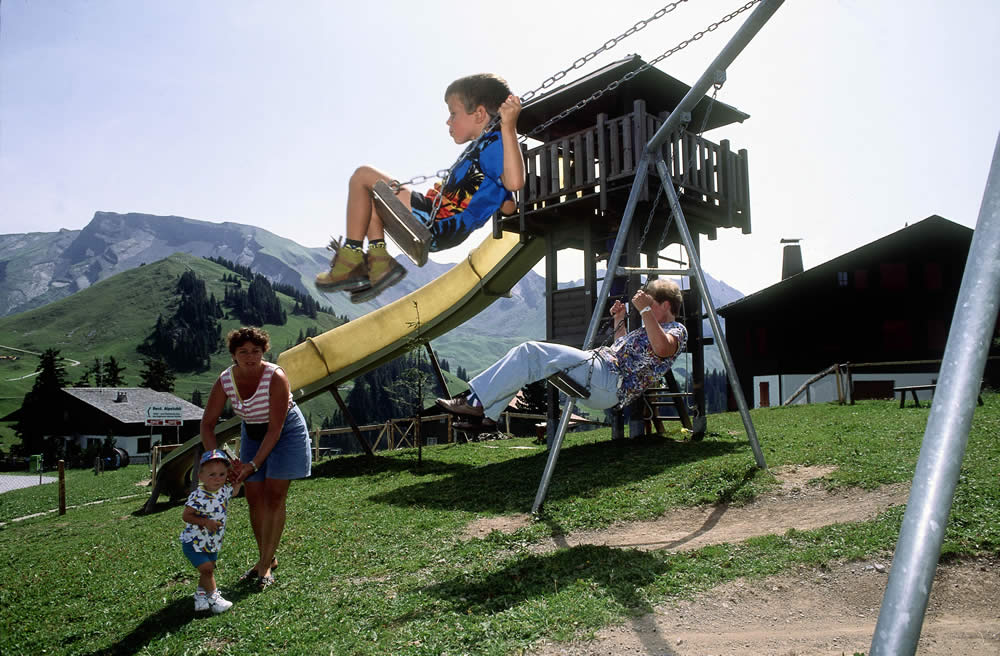
In Italy, for instance, there are countless playgrounds with soft rubber flooring. Kids run around on a kind of foam-rubber layer, because a child must never fall — at most, a child should bounce. From what I see in Milan, the main problem seems to be that playgrounds appear to have been designed for adults to play in. The latest-generation ones are all Swedish ladders and gym equipment, equipment that’s always taken up by gym-bros filming themselves, just like the ping-pong tables are always taken, since Milanese people have inexplicably all turned into Marty Supreme.
What I see around town are functional parks, whereas the Nordic approach is different: through imagination, the park turns boredom into work.
Behind my house there’s a brand-new park whose main attraction is giant concrete blocks shaped like computer keys. What exactly are our kids supposed to imagine — sending an email? I understand the aversion to children, but I think the cruel architecture of playgrounds is starting to go a bit too far.
I asked a friend who lives in Germany, in Düsseldorf, to send me some photos of the parks near her house, just to see whether they have the bouncy floors over there too. In the first photo she sends, there are three stylized rocking horses made of iron — presumably red-hot, given the temperatures — set in the middle of a little square of gravel and stones, somewhere between Brutalist and Cold War.
In the second photo there’s a classic wooden castle, but with no staircase to climb up — I assume the kids are meant to free-solo it, Alex Honnold-on-El-Capitan style.
There’s an aluminum slide, some wooden poles, a rope walkway, and a sign listing various bans: no dogs, no bikes, no helmets.
A playground isn’t just about calculated risk — a playground should above all be a place to hide.
In Nice, there’s the Promenade du Paillon, with a giant wooden whale-shaped sculpture where children hide and climb around inside its net-woven belly.
At a children’s center in Roissy-en-France, near Paris, the architect Olivier Vadrot designed a playground called Conversations, made up of three sculptures: “Trône ventriloque” (the ventriloquist’s throne), “Cockpit Rose” (the pink cone), and “Conseil des Sièges” (the council of seats).
They’re sculptures built for sharing secrets — they look like stone confessionals, with a wall to hide behind and a hole to peek through. In a world where we can see everything, the playground should remain the one barrier that protects mystery. A wall, the belly of a whale, knives for making up stories: imagination is free, too, and if you ask me, everyone stands to gain from it.