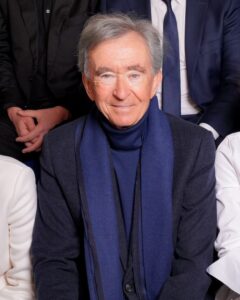
The richest man in France — and occasionally in the world — has built a two-hundred-and-fifty-billion empire with brands that read like a luxury rap sheet: Dior, Louis Vuitton, Bulgari, Tiffany, Loro Piana, Moët, Hennessy. All very gold, all very calfskin, but beneath the monogrammed veneer an age-old, cross-class drama is playing out: the father refuses to die, the children are waiting, the wife talks too much, the sons-in-law are scheming. The communications people communicate mostly among themselves, and no one dares utter the most vulgar word in family capitalism: succession.
Bernard Arnault, seventy-seven, is universally described as a control freak. The little man who accounts for 1 percent of French GDP — the country’s top taxpayer, top employer, top everything — makes surprise appearances even in the last shop in Madagascar and Papua, checking window displays, sales assistants, lighting, the folds of scarves, the arrangement of handbags: an Armani, but more neurotic, more financial, more Catholic-French. He is said to be obsessed with death, terrified of illness, ready to change the subject the moment anyone mentions cancer, strokes, accidents, test results, diabetes. He lives on broccoli and thinks only of work. He has recently been elected to the Académie des Sciences morales et politiques — technically, he has become an immortel (an institutional solution to a biological problem, fair enough).
They say he hates the whole world, “but he is madly in love with the group and his children.” The problem is that the children are five, from two marriages — like the Berlusconis — and each one governs a province of the empire. Delphine, 51, the eldest and only daughter, runs Dior, the crown jewel recently entrusted to the Northern Irish designer Jonathan Anderson. Antoine, 48, oversees the group’s newspapers, communications, image, and sustainability — whatever that means. Then there are the three children from the second marriage to Hélène Mercier, a Canadian pianist: Alexandre, 33, who moved from Tiffany and is now heading the wines and spirits division; Frédéric, 31, at Loro Piana; and Jean, 27, the youngest, in charge of Louis Vuitton watches. They are essentially playing with brands where they can’t do too much damage.
And yet they are all talented, all attractive, all slim, raised on piano, performance, discretion, and cashmere. No Edoardo Agnelli, no Lapo Elkann — at least for now, and as far as anyone knows. We are not, in other words, in the Italian dynasty of trauma, but in the French dynasty of excellence. A family where even neurosis appears to have graduated from the École Polytechnique.
A family that has suddenly become rather noisy, too: farewell to the age of quiet luxury — luxury itself, as everyone knows, has gone out of fashion, and so, it seems, has the quiet. When business was booming, the heirs were young and dutiful, but now that the revolution might just mean dressing from Zara rather than Dior, now that “luxury” — a magic word for EBITDA and revenues for years and now radioactive — all the dirty laundry is coming out. LVMH lost 5 percent of its revenue last year, something like €4 billion, and 25 percent of its stock market value. There is even talk of selling off brands such as Marc Jacobs, in the largest corporate restructuring in the company’s history. Nobody need worry about where their next meal is coming from, of course, but the heirs are none too pleased.
Antoine and Delphine, the children of the first marriage — the Marina and Piersilvio of the story — had long made it clear that the top job didn’t really interest them. Too much effort, too much exposure, why would we bother? Then the half-siblings grew up, joined the group, began climbing through brands and boardrooms, and suddenly even modesty became a luxury. Inside the group, Alexandre and Frédéric are said to be the most competitive — the ones who truly dream of the throne. The patriarch, small detail, has absolutely no intention of stepping down. Last year he amended the company’s bylaws so that he could remain in charge until the age of 85 (the previous limit was 80). “You should have put 100,” Warren Buffett advised him — another extremely liquid old man, who has, however, finally stepped aside. Arnault has not. Someone, according to French newspapers that have thrown themselves headlong into the saga of this once supremely private family, floated the idea of bringing in an outside chief executive — a foreign pope, as they always say in the Italian centre-left — but Arnault won’t hear of it: he’s not running the Socialist Party, LVMH must remain a family business. So what happens? Nothing. When a shareholder asked him how he intended to manage “the great ambitions of his five children,” he replied: “We’ll discuss that in seven or eight years.” Which is to say never, by the calendar of the immortals.
But there is something worse than fighting. For these capitalist tribes, it is talking. And talk, it turns out, has begun — in public. The nightmare is Hélène. Hélène Mercier-Arnault, pianist, Bernard’s wife since 1991, mother of the second brood, was for thirty-five years as silent as a handbag in a shop window. Now she’s singing: to promote her new album, she has given a string of interviews. Ten. Television, newspapers, radio. A lyrical-family press tour. “If my husband were really a control freak, do you think he would have married a woman like me?” she says. An interesting question, admittedly. She talks, she wells up, she accuses, she laughs, she recants, she starts again. She says that homeless people live without a roof “also by lifestyle choice.” All hell breaks loose. She goes back on television, tearful and apologetic, telling the story of her bipolar sister — now dead — who had fallen in love with a tramp. Above all, she reveals an image so chilling it could give children nightmares, never mind the collapse of the luxury sector and the Strait of Hormuz: that seventy-seven-year-old Bernard sleeps naked, wearing only a pair of underpants.
Hélène is a bit of a Veronica Lario, though for now she hasn’t sent open letters to newspapers — although she would have the entire family press empire at her disposal, from Paris Match to Les Echos to Le Parisien. The children did not go to Steiner schools but to an expensive private lycée (two of them had Brigitte Macron as their teacher — she may have some regrets about the husband she chose). The pianist tells her children that money numbs everything, that they are “brainwashés,” prisoners of the system. In a household where fear of the left is passed down from generation to generation, where the very word “wealth tax” makes the horses rear, she confesses that, if forced to choose between Bardella (Le Pen’s far-right heir) and the leftist firebrand Mélenchon, she would vote for the latter. Her husband is horrified — he fears the left the way Russian aristocrats feared 1917 — and on the eve of major elections he invariably flees abroad (to Quebec before the 1978 parliamentary elections, when all the polls were predicting a socialist and communist victory; to the United States in 1981 after François Mitterrand’s win; and to Belgium in 2012 to escape François Hollande’s France — though he then changed his mind).
In this respect the French are different from us: when they threaten to leave for political — or fiscal — reasons, they actually leave. Here in Italy they never do; at most they just don’t pay their taxes. The other great difference is that fashion in Italy remains the preserve of ladies of a certain age or of fawning obituaries when a centenarian designer dies surrounded by his “chosen family.” In France, by contrast, the president attends fashion shows, the First Lady wears Vuitton, Brigitte is in the front row at Dior. Here, a politician gets far more mileage from making a pilgrimage to Padre Pio. It is also hard to imagine an Italian Bernard Arnault: he would be a Diego Della Valle on steroids having lunch with Mattarella every day, or a Miuccia Prada with an army, newspapers, champagne, football clubs, and a direct line to Trump (though maybe Arnault has one too, who knows).
To put it another way: some time ago Macron awarded Arnault the Grand Cross of the Legion of Honour, a distinction reserved for 75 living recipients. At the ceremony were Elon Musk, Beyoncé, Jay-Z, and Queen Rania of Jordan (like the setup to a joke — all that was missing was the Shah of Persia). The president gave a Proustian speech: “Bernard Arnault, you are a French destiny and, in the end, a life spent in search of lost time.” He evoked the fateful year of 1984, when a young Bernard acquired Dior, as a moment only slightly less important to the history of France than the storming of the Bastille.
But all the ceremonies and medals are powerless against Arnault’s troubles — a poor soul who sleeps in his underwear, with 40,000 employees in France, a billion invested in the country every year and three billion in taxes paid, and who would justifiably like a little gratitude in return. Instead, he always smells the fiscal guillotine in the air, and now he has quarrelling children and a chatty wife into the bargain. Madame the pianist’s bête noire is above all Xavier Niel — Delphine’s partner, father of her children, founder of Free (telecoms and internet), shareholder of Le Monde, a self-made entrepreneur, the Obelix of French capitalism, a man who says he wants to abolish inheritance while having chosen the richest heiress in France. He is Arnault’s anthropological opposite: hacker versus monarch, hoodie versus pinstripe, flab versus broccoli. Hélène calls him “El Diablo” and fears that, as in Succession, when the dust settles it will be the son-in-law — the husband of the daughter who came from nothing — who wins (and one wonders with what feelings the very rich, people like the Arnaults, watch Succession. A distorting lens? A documentary? A home movie?).
When Delphine was appointed to Dior in 2023 — a position that, according to her stepmother, rightfully belonged to Alexandre — Hélène fired off a lengthy text to Niel accusing him of delusions of grandeur and jealousy. The message was forwarded around the children and reportedly landed on the desks of several government ministers, who were astonished by the ferocity of this apparently immaculate family. Because the pianist doesn’t only talk — she writes, too. She is a prolific texter, firing off messages along the lines of “I know everything” to all members of the clan; these then end up in the newspapers, newspapers that are practically all owned either by Arnault or by Niel (who controls, directly and through Le Monde, Le Nouvel Obs, which is currently running a gleeful serialised exposé from inside the Arnault household, like a naturalist novel straight out of Zola). Antoine has blocked his stepmother’s number. Niel is no longer welcome at Christmas or christenings. Meanwhile the communications officers are at war: Jean-Charles Tréhan, the all-powerful head of external relations, is accused by one faction of the clan of working for Antoine; Louis Jublin, a former adviser to Gabriel Attal, recruited by Frédéric and then by Hélène, is accused in the corridors of LVMH of having nudged Madame towards her grand media unburdening. She’s the one who’s been brainwashed, they say.
And perhaps because luxury is no longer selling, the in-house newspapers have become the theatre of war. Le Parisien, the daily acquired by LVMH in 2015, loses €35 million a year. Alexandre and Frédéric — like the De Benedetti sons with Repubblica in its day — are pushing to sell it; the buyer stepping forward is not some Greek magnate but the reactionary Vincent Bolloré, the Breton businessman behind Vivendi, fresh from controversy over his alleged dismissal of Olivier Nora, the long-serving director of the publishing house Grasset under his control, reportedly for refusing to publish far-right authors (provoking a rebellion by 170 writers). With the newspapers, we enter the full Succession française: selling Le Parisien to Bolloré, a year before the presidential elections, would mean handing a piece of France’s media landscape to the reactionary right. Delphine and Antoine — Shiv and Kendall — fear the reputational damage. Meanwhile, other subplots straight out of the Roy family: Stéphane Bianchi, LVMH’s number two, convened Antoine, Alexandre, and Frédéric for a kind of group therapy session (like episode 7 of season 1, when the patriarch gathers everyone at the ranch. A failure in fiction as in reality).
A kickaround to ease the tension? Episode 1, season 1. The Arnault brothers bought Paris FC, the French capital’s second club, partly to cultivate a more populist image, far from the world of luxury, and perhaps to repair bonds that have become paper-thin. Their father has never once shown up at the stadium. “What position are you in the table? Thirteenth? I have never been thirteenth in my life,” he said — charming as ever — promising he will come only when the club is in the top three.
So there you have it: Bernard Arnault, the man who owns Dior, Vuitton, Bulgari, and champagne, yachts, newspapers, presidents, his own body weight — the man who controls everything, above all his shop windows — cannot control his own succession. Or his wife. Or death. For that last problem, at least, he has found a very French workaround: joining the immortals. What remains to be seen is who among the mortals will inherit the shop — and who, given the current climate and these prices, will still be walking through its doors. We’ll see.