

Europe aboard
Beyond borders: the strategic role of a European rail network
Where would Europe be without trains?
Rail powered Europe’s industrial revolution, providing fast, affordable and reliable transport for goods, raw materials and workers. It enabled cross-border trade, helped drive Italy’s manufacturing boom in the late 19th century, and opened leisure travel to all social classes. It is no exaggeration to say that rail transformed Europe.
My message today is simple: rail can continue to transform Europe, supporting economic growth, mass transit and sustainability. And in these volatile times, it can also help us defend our continent.
But rail is not yet the best possible version of itself. With commitment from all sides, it can be.
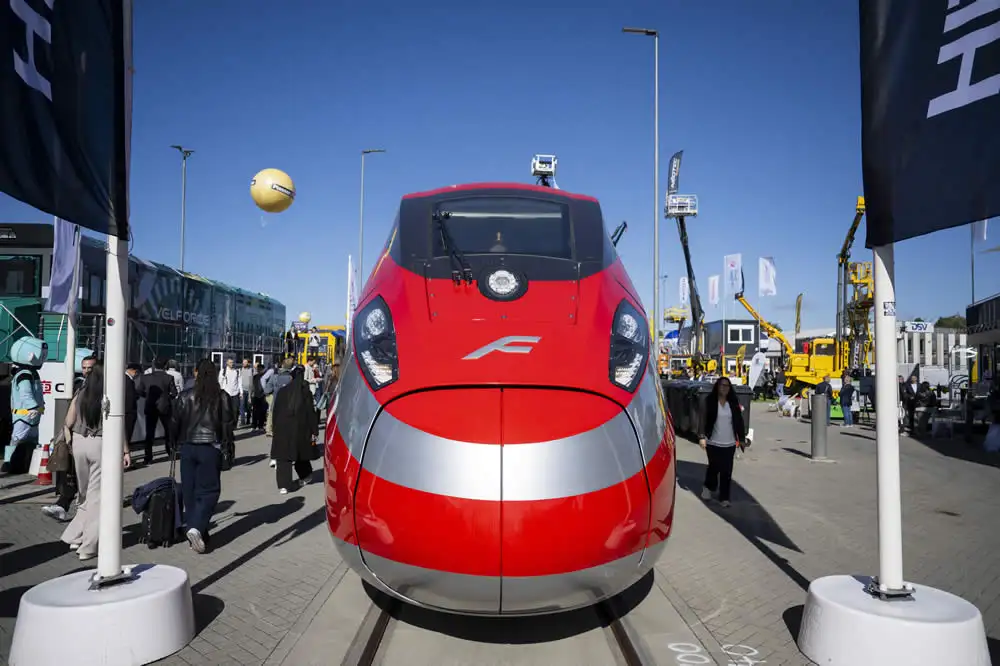
Earlier this month, I attended the opening of InnoTrans in Berlin, the world’s leading trade fair for transport technology and a showcase for the global rail industry. Seeing our brand-new trains, ready to speed across Europe’s rail network, made me proud. We should value Europe’s industrial leadership in this sector, but we cannot take it for granted. We have all the ingredients to succeed. Now we must make the right choices to sustain that leadership.
To begin with, the EU is building a more integrated European rail network. The Trans-European Transport Network, the TEN-T connects the continent’s main rail arteries. Technical standards such as ERTMS allow trains to operate across borders. We have invested billions in the network, alongside legislation to improve interoperability, cross-border services and capacity management.
To complete the TEN-T, by 2030 for the core network, 2040 for the extended core network and 2050 for the comprehensive network, we need new tracks in places. But concrete and steel are only part of the equation. Our goal is to provide a connected, interoperable, high-performing rail across borders, for passengers and freight.
Progress is visible, although uneven. High-speed rail has expanded in several Member States, with Italy a forerunner. Cross-border links are growing and ERTMS is being rolled out.
But some obstacles remain stubborn: insufficient capacity at certain borders, different national technical and operational systems, and bottlenecks around major freight terminals and ports.
In short, the policy architecture is there, financing exists and projects are advancing. The challenge is implementation speed.
And geography makes Italy central to this effort. As a gateway between central and northern Europe and the Mediterranean, Europe depends on efficient rail links across the Alps and strong connections with Italy’s ports.
Italy is already central to some of Europe’s most strategic cross-border projects, including Lyon-Turin and the Brenner Base Tunnel.
The Lyon-Turin link will provide an alternative to air travel on the Paris-Milan-Rome axis. Its 57.5-kilometre Mont Cenis base tunnel is the centrepiece of a wider cross-border project requiring investment in both France and Italy, including new access routes and upgrades to existing lines.
The Brenner Base Tunnel will remove a major bottleneck between Italy and Austria. Of the planned 230 kilometres, 221 kilometres have been excavated, with more than €2.8 billion in EU funding. The tunnel is expected to open in 2032. The focus must now turn to the access routes: most are complete in Austria, while major sections in Italy, including Fortezza–Ponte Gardena, are ongoing or about to start.
Other strategic projects include the Napoli–Bari railway, the Palermo–Catania–Messina upgrade and the Messina Strait Bridge.
In 2025, I also presented the Action Plan for Connecting Europe through High-Speed Rail. It is a roadmap to expand cross-border high-speed rail, connect Europe’s major cities and cut travel times. By 2030, Berlin and Copenhagen will be four hours apart by train, compared with seven today. And new connections will make Paris–Lisbon, via Madrid, possible by 2035.
This year, we will present a financing strategy to identify financial schemes for rapid investment in high-speed infrastructure and rolling stock.
High-speed rail works particularly well when it delivers clear time savings. Italy shows this. On routes such as Milan–Rome and Rome–Naples, rail is highly competitive and has become an attractive intercity option, contributing to a shift away from some domestic flights over the past decade.
Italy is relatively advanced in high-speed rail, and open-access competition has played a role. Different companies can operate trains on the same high-speed infrastructure – still relatively rare in Europe.
This model is highly relevant at EU level. It shows how infrastructure investment, market opening and service quality can work together to encourage passengers to shift from air and road to rail.
Times have changed. But the importance of an efficient, resilient and modern rail network has not. We will complete that network by working together: the rail sector, Member States and the European Commission.
Because Europe’s rail network must go beyond borders.
Apostolos Tzitzikostas
European Commissioner for Sustainable Transport and Tourism