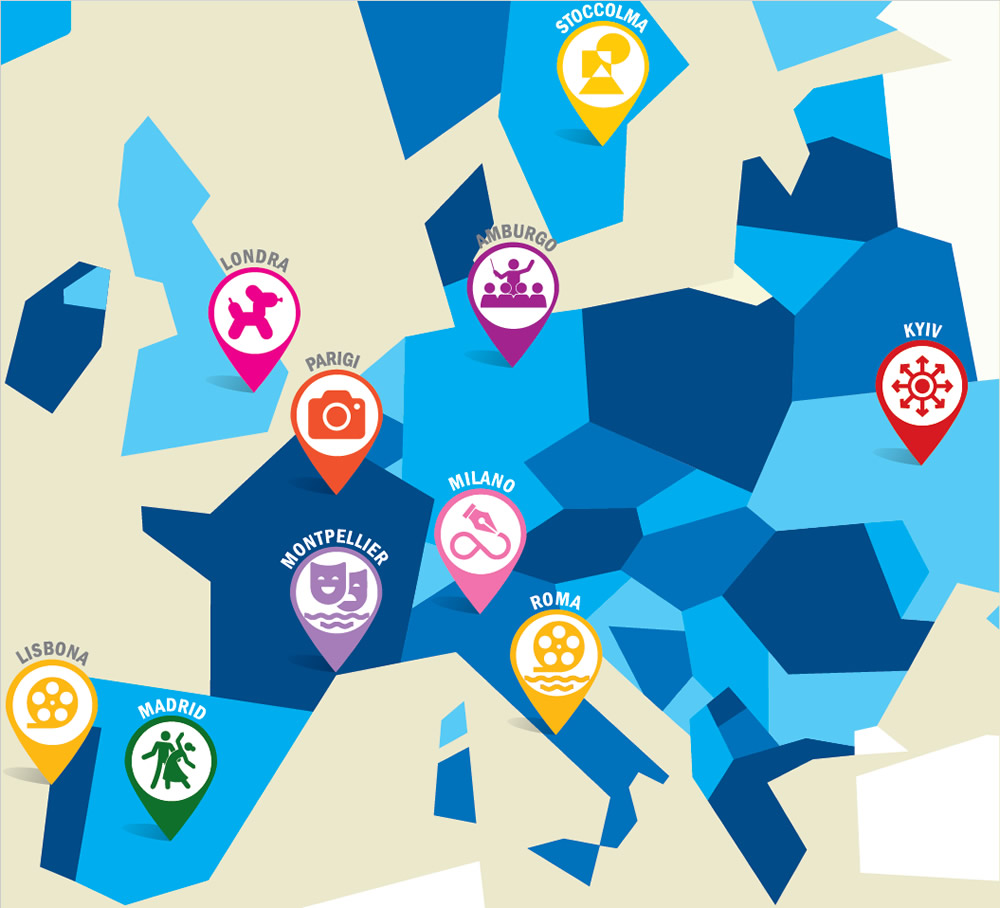
OCTOBER 3, 2025-FEBRUARY 7, 2026. KYIV BIENNALE / VARIOUS CITIES IN EUROPE
The Kyiv Biennale in diaspora due to the war
While Russian drones and missiles continue to strike Ukrainians, in October “Near East, Far West,” the Kyiv Biennale, opened. Like an organism in diaspora, after the 2023 edition this one too is spread across Europe, in Warsaw, Antwerp, Dnipro, Kyiv and Linz, where on November 11 the last of the coordinated exhibitions opens. Curated by L’Internationale, a European network of museums, institutions and universities, the Biennale invites viewers to reorient obsolete notions of east and west, arguing that the fate of Europe and Western values is tied to its eastern borders, and beyond. The exhibitions interweave stories of violence, oppression and survival in “Middle Eastern Europe,” a territory that embraces Central and Eastern Europe, the former USSR and the Middle East. The main exhibition is in Warsaw, with 23 artists, and together with the one in Antwerp investigates the past and present of colonial violence, annihilation and genocide. Kyiv and Dnipro become living archives, where memory is reconstructed while being destroyed by the Russians. What does international solidarity as a political and cultural practice mean today? Artists respond with different languages and the result is evident: the vitality and resources to make Europe today are found above all in the east, in its peripheries, where democracy is under attack.
NOVEMBER 6-22. BIENNALE DES ARTS DE LA SCÈNE EN MÉDITERRANÉE / MONTPELLIER, FRANCE
The Mediterranean on stage, abundance of opportunities
Paolo Rumiz in Robinson recounted the myth of Europa: a Phoenician princess, therefore Lebanese, abducted by Zeus and carried across the sea to Crete, where she will generate our lineage. He continues with some “undeniable evidence”: Europa is not continental, but daughter of the Mediterranean Sea. She is a woman, maternal, blessed by the gods. But above all she is Asian, “our people come from the east,” like Aeneas, Christ, Saint Paul and Saint Peter, and “there exists only one world, Eurasia.” The Mediterranean, “fabulous abundance of opportunities,” is its cradle. In Montpellier, La Biennale des Arts de la Scène en Méditerranée explores the richness and diversity of contemporary cultures, with performances, concerts, encounters with artists from Spain, Palestine, Morocco, Lebanon, Syria, Greece, Italy, Israel, France. Here is Kenza Berrada’s show “Boujloud,” a mythological figure of the Atlas, half man half beast; “Yes Daddy,” by Bashar Murkus and Khulood Basel, from Haifa’s Khasabi theater, a play about the meeting between two lonely men; the concert of Moroccan Sufi poet Walid Ben Selim, and the Bolognese company Kepler-452, which spent time on the Sea-Watch 5 ship, which rescues migrants at sea, and created a documentary piece with members of the mission. Rumiz’s final consideration on the myth of Europa, who crosses the sea frightened at night, is that she is the progenitor of migrants, of “all those who, for millennia, seek where the sun goes to die, a landing to escape war and misery.”
NOVEMBER 6-16. MEDFILM FESTIVAL / ROME, ITALY
The richness of cinema from the sea that connects us all
Yesterday the MedFilm Festival opened in Rome, the longest-running international film festival in the city, founded and directed by Ginella Vocca. Since 1995 it has been the only event entirely dedicated to Euro-Mediterranean and Middle Eastern cinema, and promotes intercultural dialogue and cooperation between Europe and the other shores of the Mediterranean. MedFilm intercepts the “cultural routes” of the Mediterranean and seeks to trace new ones: in addition to distributing cinema, it is a platform for exchange and development for the industry. Some of these routes return in the film selection, grouped into thematic strands, from the courage of women to the denunciation of oppression, to the narration of Palestine—yesterday and today, with the new “With Hasan in Gaza” by Kamal Aljafari, and the classics “The Dupes” by Tawfik Saleh and “The Time That Remains” by Elia Suleiman. The theme of love, bodies and desire is at the heart of two films also competing for the 2026 Oscars for their respective countries, the latest works by Moroccan Maryam Touzani and Lebanese Cyril Aris. Alongside the feature films, a rich program of shorts enriches the precise map of contemporary Mediterranean cinema. The “Perle” (pearls) section is dedicated to excellent little-known Italian films.
OCTOBER 4, 2025-APRIL 26, 2026. HUGUETTE CALAND – A LIFE IN A FEW LINES / HAMBURG, GERMANY
Huguette Caland’s uninterrupted line
A line is a continuous and infinite succession of points. Without interruption, without discontinuity: thus the exhibition “Huguette Caland – A life in a few lines” at the Deichtorhallen in Hamburg interprets the work of Huguette Caland, a Lebanese artist for whom the line was the principle. When in the 1960s she studied graphic design at the American University of Beirut, she had learned the technique of single-line drawing, a trace without ever lifting the pencil from the paper. With those minimal lines she had drawn noses, mouths, kisses on paper, on canvas, on linen, on wood. The eroticism and freedom with which she challenged social norms is one of the keys to reading this retrospective. Daughter of the first president of independent Lebanon, Bechara El Khoury, she recounts that while Lebanon was fighting for its independence, she was fighting for her own: thus she married Paul Caland, the son of her father’s political opponent, only to leave everything and move to Paris, where she began to paint, and finally left for California. This search for freedom, and her life multiplied in different places, is reflected in her paintings and fabrics, soft, erotic colors and shapes. Speaking of shapes and lines, she made extremely chic caftans only for herself, until Pierre Cardin asked her to make a line.
NOVEMBER 8-DECEMBER 6. ANNUAL OPEN 2025 / LONDON, UNITED KINGDOM
“I could have made that.” Then go ahead, make it
The value of a contemporary artwork is shaped by the market, the boundary between a brilliant work and a banal one is tenuous, the public comments with “I could have done that too,” often rightly so, art is often inaccessible. The Annual Open exhibition at the Southwark Park Galleries cancels all these divergent forces and every year since 1984 has given any artist at any stage of their career the opportunity to exhibit their works. What is art? In this case it’s an inclusive and democratic platform that celebrates diversity, is accessible and creates opportunities. Submitting one’s work costs 25 pounds, there is no selection at entry and the best wins a prize named after Ada Walter, social reformer, environmentalist and first female mayor of London. 500 works that can be democratically criticized.
NOVEMBER 7-16. LEFFEST LISBOA FILM FESTIVAL / LISBON, PORTUGAL
Another arthouse film festival
Every film festival has its own stylistic signature. That of Leffest in Lisbon is to give an idea of the abundance of quality film productions from different geographies, and to present them in the city’s historic cinemas. A reference point for auteur cinema, it was founded by Paulo Branco, one of the most prolific and recognized Portuguese independent producers. The official competition selection offers eleven films of international significance, including “Blue Moon” by Richard Linklater—the director of “Boyhood” and the “Before” trilogy—and “In the Land of Brothers,” already presented at Sundance, by Raha Amirfazli and Alireza Ghasemi, the story of a family of Afghan political refugees in Iran. The “Out of Competition” section previews major expectations of the film season, and the “Discoveries” section introduces little-known voices, such as that of Macedonian Georgi M. Unkovski with “Dj Ahmet,” currently in Italian theaters. The controversial “Mektoub, My Love: Canto Due” by Abdellatif Kechiche, already presented at Locarno, will also be screened. The multidisciplinary program of music, talks and visual art spread throughout the city allows for a pit stop for a bifana or a ginjinha between one screening and another.
NOVEMBER 28, 2025-APRIL 12, 2026. ŠEJLA KAMERIC – EX YOU / STOCKHOLM, SWEDEN
Disintegrating the borders of former Yugoslavia
“No teeth…? A mustache…? Smell like shit…? Bosnian girl!” is the abhorrent graffiti found on the walls of the UN barracks in Potočari, in Srebrenica. In 2003 Šejla Kameric, a Bosnian visual artist born in Yugoslavia, reproduced this writing in front of a photo of herself in Calvin Klein cover girl style, and made posters and billboards of it. “Bosnian Girl,” a purely iconic work (thanks to reproducibility), not only denounces sexual violence as a weapon of war but becomes a portrait of survivors, denigrated and unprotected. The marginalization of the Balkans, the wound of the Yugoslav war, identity as construction run through all of the artist’s work. In the exhibition EX YOU (which sounds like Ex Yu), coming to Fotografiska Stockholm, Kameric investigates what it means to be expelled from history, from belonging, from one’s own body. Through photographs and immersive, disturbing installations – like the passport photos of three generations of women superimposed in the EX YOU PORTRAIT, or the corpus created with her 9-year-old daughter – the exhibition is an act of self-reappropriation and at the same time a disintegration of Yugoslavia’s borders. In 2000, the very young Kameric already reflected on social exclusion and identity, with the installation “EU/Others,” a reflection on the violence of bureaucratic language, which determines who is inside and who remains outside.
NOVEMBER 23, DECEMBER 1. ANNA A. / MILAN, ITALY
Poetry in front of the Leningrad prison
“Among us one dies for poetry,” says Nadezhda Mandelstam in “Anna A.,” the opera about Russian poet Anna Akhmatova that explores the relationship between art and power through fragments of her life and her voice, while around her twentieth-century Russia unfolds. Composed by Silvia Colasanti, with a libretto by Paolo Nori in collaboration with Fabrizio Sinisi, it will be on stage at La Scala on November 23 and December 1. The narrative moves on two different timelines: 1966, at the Domoyevo sanatorium, where Anna, in her last days of life, recalls memories with her friend Lydia Chukovskaya. And the past, the memories staged, which open in front of the Leningrad prison, where Akhmatova spent 17 months together with the “chorus of mothers” to ask for news and the release of their sons and husbands imprisoned by the Stalinist regime. From the pain of her son Lev’s imprisonment was born “Requiem,” the clandestine collection transmitted by learning the verses by heart and then burning them, the poetic fulcrum of “Anna A.,” whose score alternates concerted pieces, polkas, waltzes, recitatives with orchestra and singing. While on stage move the intellectuals purged or exiled– from Mandelstam to Tsvetaeva to Bulgakov –, the discourse on the senselessness of authoritarian power and the persecution of artists becomes frighteningly urgent in Putin’s Russia.
NOVEMBER 13-16. Paris Photo / France
The largest photography exhibition in the world
Paris Photo is the largest photography exhibition in the world, with 222 exhibitors: 179 galleries and 43 publishers from 33 countries, under the majestic glass domes of the Grand Palais, the immense Art Nouveau palace inaugurated for the Paris Expo in 1900 and which in 2025 reopened all its spaces after a long restoration. The direction is formed entirely of women: director Florence Bourgeois, artistic director Anna Planas and the guest curators of the Voices section Nadine Wietlisbach, Devika Singh and Devrim Bayar (a note: the formal and institutional commitment to close the gender gap has resulted in female artists doubling in the last seven years). All the actors of this gigantic fair, a composite exhibition of the state of the art of photography, share the vision of a “photography open to the world, shaped by contemporary issues, which embraces transmission, diversity of expression and the breaking down of boundaries between languages.” Each gallery or publisher falls within a specific section, and many of them have chosen to dedicate their entire space to a solo show, as for example the Brazilian gallery Vermelho did, presenting some photographic series from the 1970s by Claudia Andujar, a European Jew naturalized Brazilian who survived the war and then emigrated to the American continent. Or the Tahore gallery in New York that brings the engaged and colorful glamour of Mexican and Colombian photographer Camilla Falquez, protagonist of the emerging section.
NOVEMBER 15-23. ROCÍO MOLINA, CALENTAMIENTO / MADRID, SPAIN
Flamenco to warm up
The bailaora Rocío Molina is considered one of the most innovative figures of contemporary flamenco. After recently bringing “Vuelta a uno” with guitarist Yerai Cortés to Florence, the third and final act of “Trilogía sobre la guitara,” in November she arrives at the Centro Danza Matadero in Madrid to present her latest show, “Calentamiento.” Meaning “warm-up,” the piece stages the preparation for a show, together with a group of cantaoras (flamenco singers). The warm-up slides from the athletic meaning to the metaphorical one of warming someone up to the point of arousing sexual excitement, in an open, round movement.