May 13, 15, and 17. Basel, Switzerland
The hits of a Europe that sings together
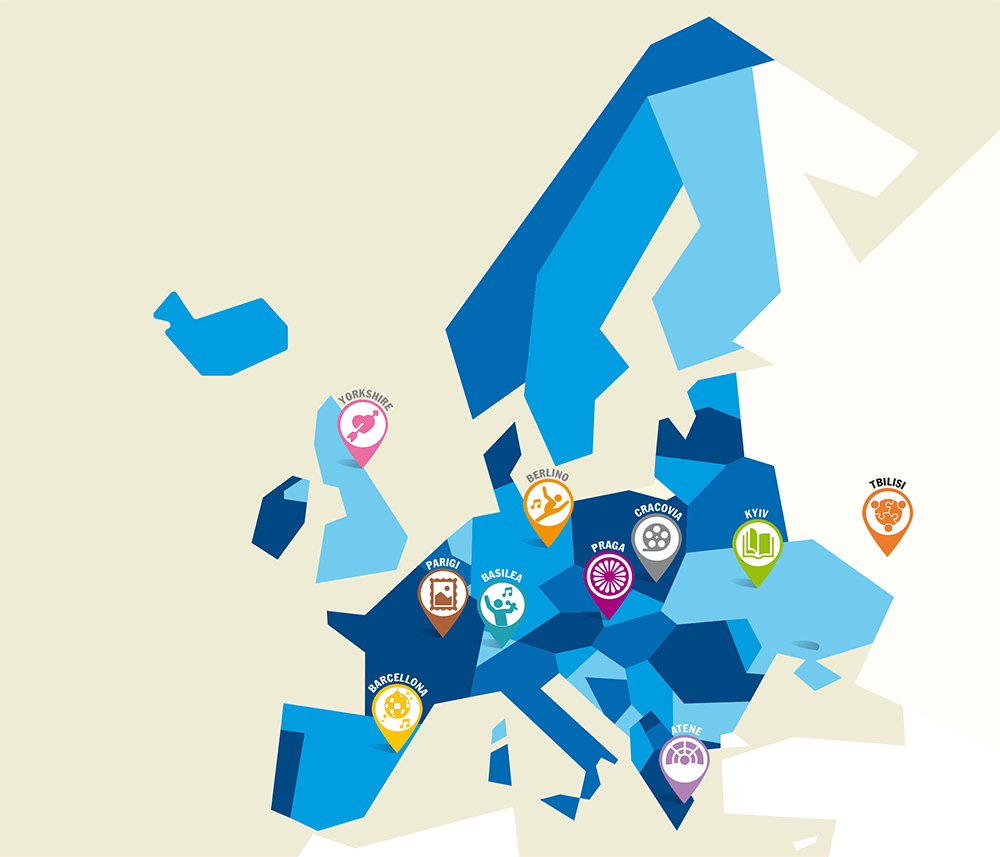
The sixty-ninth edition of the Eurovision Song Contest will be held in Basel on May 13, 15, and 17. It’s a homecoming, since Switzerland hosted and won the very first edition of the competition in 1956. By now, even in Italy, the authority of the event followed by hundreds of millions of viewers is legitimized—the former “trashy circus”, today recognized as a vehicle of European feeling and incubator of pop stars and, according to Martin Österdahl, executive supervisor of ESC, “a Super Bowl on steroids.” The euphoria is visible on the Instagram channel, full of images from the Eurovision party in Madrid in April. The participants have already released their songs, almost all in their own language, bringing their own culture, more or less cleverly seasoned with stereotypes. Some are already hits, like the sauna-themed song by the Swedes Kaj. Then there’s a parade of hotties, male and female, from Armenia to Serbia, Lucio Corsi and Gabry Ponte, the two ends of the spectrum of Italianness, separated by taste and the Apennines, but also the Israeli Yuval Raphael, survivor of the Nova Festival massacre, and Mariam Shengelia from Georgia singing about freedom. And of course, the old ladies from Ostuni, Tommy Cash’s dance troupe, proof that, if not the whole world, at least the whole of Europe is still a small village.
May 29 – June 1, International Book Arsenal Festival. Kyiv, Ukraine
Ukrainian resistance in the Arsenal of books
The thirteenth edition of Kyiv’s international book fair, the third since Ukraine was invaded by Russia in 2022, is held at the Mystetskyi Arsenal. The title and theme for 2025 is “Everything is Translation,” and was born from a conversation between the two curators, Yale historian and professor Marci Shore and writer, translator, editor of PEN Ukraine Oksana Forostyna. Shore writes: “I fear that an enormous amount of human suffering remains silent for eternity. And precisely because of this, we should appreciate what language can do, however imperfect, and appreciate those who try to translate into words moments at the extreme edges of human experience.” And again: “The act of translating is an act of faith in the possibility of some form of understanding.” In addition to strong participation from publishers, the program, curated by Iryna Slavinska, Olya Rusina, Yuliia Konopliana and Oksana Karpiul, features lectures, meetings, presentations, discussions, performances, interviews, poetry readings. The fair also hosts the Translatorium Literary and Translation Festival, dedicated to translation and curated by Tania Rodionova. The Book Arsenal Festival represents one of the countless acts of Ukrainian resistance, the tireless will to respond with life and normalcy to Russia’s attempt to annihilate it. The festival includes a bomb shelter.
June 12–14, Sónar. Barcelona, Spain
Rave and artistic experimentation
Some call Barcelona the European Silicon Valley; it is certainly a place devoted to innovation. Since 1994, it has been the main home of Sónar, Music, Innovation & Creativity, a temple for lovers of electronic music and culture, with 300,000 attendees in 2024. Born as a temporary space where musical and performance experimentation intersects with technology and science, it is structured in three sections. Sónar by Day, at Fira Montjuïc in Plaça de Espanya, and Sónar by Night, in the suburbs, host a lineup of more than fifty artists of contemporary, electronic, experimental music, with a technical and acoustic setup accessible even to those who aren’t clubbing fans. The Sónar+D section opens the conversation between the creative industry, innovation, and technology, with a rich schedule of panels, discussions, performances, masterclasses and an interactive exhibition space. The meetings to explore non-mainstream curation, sustainable technology, and the relationship between music and AI perfectly integrate with the boiler rooms and concerts and open the boundaries of a world that wants to explore and understand the potential of our relationship with technology. How to make the new arts accessible to non-nerds? With a party.
May 2–18, Theatertreffen. Berlin, Germany
The state of health of German theatre
In 1978, Pina Bausch debuted with her show “Kontakthof,” and ever since had imagined restaging it with the same cast of dancers, only older. Forty-seven years later, choreographer Meryl Tankard, one of the stars of the original production, inherits her legacy with “Kontakthof – Echoes of ’78,” creating a moving dialogue between past and present and involving eight of the original dancers. It’s one of the projects selected by the jury of the Theatertreffen festival, which since 1963 chooses each year, from more than 600 shows, the ten most interesting German-language productions to bring to Berlin. The Festival is one of the events of the Berliner Festspiele, a cultural promoter central to Berlin’s cultural life. The productions invited in 2025 question and interpret the present with expressions, aesthetic visions and content very different from one another, but all reflect the spirit of the times and show the good health of theatre. The program also includes panels and discussions between theatre companies and the public. During the Cold War, Theatertreffen was a “showcase of the West” in a divided Germany; today it tells the story of German-language theatre, but is also a showcase for Europe’s best values.
From May 30, 70th Athens Epidaurus Festival. Athens, Greece
Athens, classical contemporary
The Athens Epidaurus Festival is a cultural institution that existed long before Athens gained its new status as one of Europe’s liveliest and most interesting capitals (confirmed even by Monocle magazine, European arbiter of taste). On May 30, it opens the seventieth edition of the festival that brings Greek classical theatre into the present, in dialogue with contemporary dramaturgy. And it’s a pioneer in contamination and experimentation across disciplines like theatre, music, and dance. The festival’s most evocative venue is the amphitheatre, the Odeon of Herodes Atticus, which also hosts concerts of classical music by orchestras and soloists from around the world. Why read the classics? For the answer, the festival’s opening show is recommended: Sophocles’ Antigone, directed by Ulrich Rasche.
May 2 – October 19, Austen and Turner. Yorkshire, United Kingdom
Romantic trip to the country house
“I’m not romantic, you know. I never have been.” Jane Austen has Charlotte Lucas say this to Elizabeth Bennet to explain her marriage to Reverend Collins for financial security. Austen was born in 1775, the same year as William Turner, the artist who more than any other shaped the English imagination of the Romantic period. For their 250th birth anniversary, the historic country house-turned-museum Harewood House dedicates to them “Austen and Turner: A Country House Encounter,” the first event to put these two icons of English and world culture in dialogue. Curated by Harewood House Trust and the Centre for Eighteenth Century Studies at the University of York, it tells the story of society and culture in the English country house and landscape during the Regency period, through lesser-known paintings by JMW Turner and the words and manuscripts of Jane Austen, including the unfinished Sanditon. The countryside and country houses were central to the history of English culture—often prospering on profits from African slave trades—and Austen and Turner portrayed their features: the vast, windy horizons (Turner), and the social relationships and daily life (Austen).
May 25 – June 1, 65th Krakow Film Festival. Kraków, Poland
Watching films to see the present
The Krakow Film Festival is one of the longest-running film events in the world dedicated to documentaries, animation films, and shorts. Since 1961, it explores the present through a vast program (250 in 2025) of Polish and international films, as well as exhibitions, concerts, performances and meetings with artists, with more than 900 guests. It’s an open window to look at the world through cinema and gain tools to understand reality. It gives space to more peripheral and lesser-known perspectives, but has historically hosted filmmakers from all over the world, like Pasolini and Werner Herzog, and is where great Polish directors like Krzysztof Kieslowski took their first steps. Among the competing films this year, The Big Chief by Tomasz Wolski recounts a 1972 interview with Leopold Trepper, Polish Jew, head of the anti-Nazi spy network, later branded a public enemy; the festival will open with The Queen and the Smokehouse by Iga Lis, a story of tourism, gentrification, and vanishing local traditions, and of a matriarch with a fish smokehouse in a Baltic Sea town. Also in competition, the film by Trond Kvig Andreassen on Kyiv’s Soloists orchestra, a group of Ukrainian musicians in exile in a Norwegian fjord since the beginning of the Russian invasion, February 24, 2022.
May 9, Europe Day 2025. Tbilisi, Georgia
In the streets of Tbilisi to learn Europe
Rustaveli is always closed to traffic. The peaceful protests of Georgians against the government have continued tirelessly for months—today it’s day 163—despite snow, beatings, threats, and repression by law enforcement. They demand the release of those arrested—opponents, journalists, youth—and new elections to continue the interrupted path toward Europe. The relationship between Georgia and the European Union is the theme of Europe Day on May 9 at the Tbilisi Expo, with Georgian thinkers, intellectuals, and artists from every generation. Among the events: a speech by director Lana Gogoberidze, witness and narrator of all of the 20th century, daughter of a Stalin purge victim and of Nutsa Gogoberidze, the first Georgian director; a panel by Lika Zakashvili, director of the media outlet Publika, on the role of independent journalism in spreading EU values; the exhibit “10 Years in Focus” tells Georgia’s recent history through iconic images. It’s a European celebration woven into the daily, tireless protests, where each evening the road to Europe—interrupted by the government—is rebuilt with flags, songs, memory. It’s here you feel what it means to be European.
April 9 – August 31, David Hockney 25. Paris, France
They can’t cancel spring, remember that
The spirit of life, that animates a lover’s body, a laugh or a flower’s bud, is the heart of David Hockney’s art, great English painter to whom the Fondation Louis Vuitton in Paris dedicates the biggest retrospective ever held, David Hockney 25. Hockney collaborated in building the exhibit, with his partner Jean-Pierre Gonçalves Lima and curators Sir Norman Rosenthal and Suzanne Pagé, artistic director of the Foundation. A journey through four hundred works—introduced by a neon phrase of his: “Do remember they can’t cancel the spring”—to span seventy years of freedom, joy of life, and unrepentant curiosity about human nature: the pools and sunlit scenes of California, the exploration of intimacy and tenderness of gay relationships, dozens of portraits, including Christopher Isherwood and Harry Styles. Also, expressive experimentation and the triumph of nature, from flower vases painted with a tablet to the 220 for 2020 series, dedicated to the seasons in Normandy’s landscapes. Play Within a Play Within a Play and Me, his most recent self-portrait, from 2025, conveys the spirit of his career: free, playful, in a secular communion with a nature alive like the daffodils in the garden. The work had been chosen as the poster for the show, and later censored by Paris Metro because Hockney depicts himself with a cigarette. But you can’t stop art, you can’t stop spring—least of all in the Bois de Boulogne.
May 25–31, Khamoro Festival. Prague, Czech Republic
In the sunlight
Khamoro in Romani means sunlight, and the Khamoro Festival in Prague has, since 1999, illuminated a culture belonging to more than 10 million people in Europe. It is the world’s largest Romani cultural event, meant to promote it, spread it, and bring non-Roma people (the gagé) closer through art. The heart of the festival is music, especially gypsy jazz concerts—a genre combining classic jazz and traditional Roma music—by artists from around the world. But also art, performances, screenings, dance workshops and conferences, for adults and children, to explore a vital and often overlooked piece of European identity.