When did you last hear Ukrainian officials asking for tanks and long-range missiles? Those requests, once the main sound of the war, have become quite rare. This is not because the war is coming to an end. It is because the war has changed fundamentally, and Ukraine has adapted to these changes faster than anyone expected. What started as a makeshift response to problems with artillery supply has turned into a complex “drone economy,” providing important lessons for Europe’s defense.
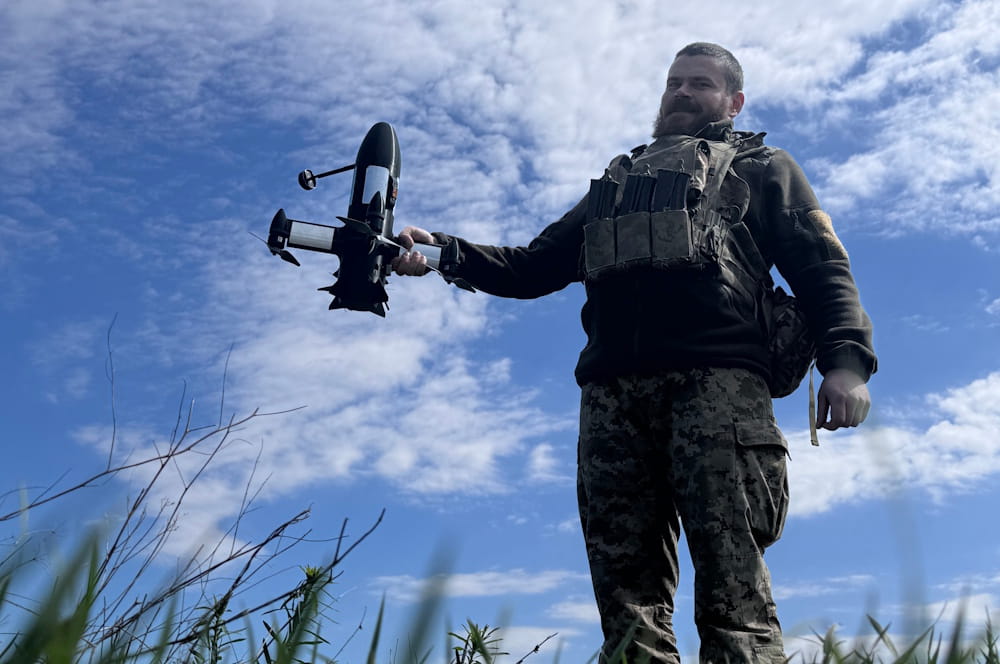
First-person-view (FPV) drones, small and agile pilotless aircraft controlled in real time by operators, became widely used in 2023. They are cheap and effective, taking on tasks that were once done by costly artillery shells. Ukrainian production has surged, rising from a few thousand units in 2022 to about 3 million in 2025, with capacity surpassing 8 million FPV drones each year as of early 2026. A lot of this production comes from a decentralized network of over 500 private companies, volunteer groups, and small workshops, backed by state programs.
Russia, despite vastly greater resources, produced only around 2 million FPV drones in 2025. Per capita, Ukraine outpaces Russia by a factor of six to nine. Ukraine’s civilian engineering talent, engineers, IT specialists, and even hobbyists, has been rapidly redirected toward defence needs, while preserving the potential for postwar civilian applications. This “dronisation” of the economy demonstrates that a smaller nation can generate disproportionate military effect through innovation and flexibility, rather than sheer mass. On the battlefield, the impact is profound. Drones provide continuous reconnaissance, enable precise strikes, and shorten engagement cycles dramatically. They have also become a vital, low-cost layer of air defence.
This is now a war of drones, autonomous systems, and software. And in this war, Ukraine has gone from student to teacher. The proof came this spring in the Gulf. As Iran attacked the UAE and Saudi Arabia with waves of cheap Shahed drones, Gulf militaries started looking into a Ukrainian startup’s interceptor drone that costs around $2,500 (€2,100). This was a change from the expensive American Patriot missiles that cost millions per shot. Ukraine had already spent three years addressing this challenge in real combat situations.
The scale of drones’ battlefield impact is difficult to overstate. Ukrainian assessments indicate that drones now account for 70 to 80 percent of Russian casualties and equipment losses on the front.
These small, pilotless aircraft intercept other drones, often replacing expensive surface-to-air missiles. They perform vital surveillance and holding tasks over contested ground, reducing the need to expose infantry to constant danger and thereby helping to compensate for Ukraine’s chronic manpower shortage.
And crucially, they strike deep into Russian logistics, supply depots, and oil infrastructure – targets that Western-supplied long-range missiles could also reach. However, these systems often face political limits from donor governments, who worry about possible escalation.
Ukrainian-made drones carry no such restrictions. This autonomy matters enormously: without the ability to systematically degrade Russian logistics even on Russian territory, Ukraine cannot fundamentally alter the war’s trajectory. Drones are currently the main, and in many cases the only, instrument that allows Ukraine to try.
In June 2025, 117 Ukrainian small, pilotless aircraft, costing a total of around $117,000 (€100,000), damaged or destroyed more than 40 Russian aircraft on the ground. These assets were worth an estimated seven billion euros. This is the key math of modern warfare: cheap and disposable systems causing huge damage to costly and irreplaceable ones. They do this hundreds of kilometres from the front line, deep inside areas that were once thought to be safely out of reach.
Recent operations, including strikes on Russian oil refineries and fuel depots, have periodically forced Moscow to redirect air defences and resources away from the front, imposing real economic pressure on the aggressor’s war machine.
The lesson for Europe is decentralize, speed up efforts, and stop viewing Ukraine as a charity case. Ukraine is currently the only player on the continent that intercepts and destroys Russian drones at an industrial scale every night. Its engineers have faced and solved problems that no NATO member has dealt with yet. This knowledge is a valuable asset for all of Europe.
Italy’s distance from the front line makes this an opportunity rather than an obligation. Unlike Poland or the Baltic states, Italy is not building drone defences under existential pressure. Italy’s engineering tradition, manufacturing base and SME culture are precisely the ingredients Ukraine’s model runs on. The question is whether procurement frameworks will evolve fast enough to make room for them. Any future conflict will have a significant drone and electronic warfare dimension. The countries that have already built institutional knowledge in this domain will not be starting from scratch.
Ukraine has shown that “dronisation” does not mean militarisation, but rather the intelligent mobilisation of civilian ingenuity for collective security. The opportunity to embrace this model, with Ukraine as a full and equal partner, should not be missed.