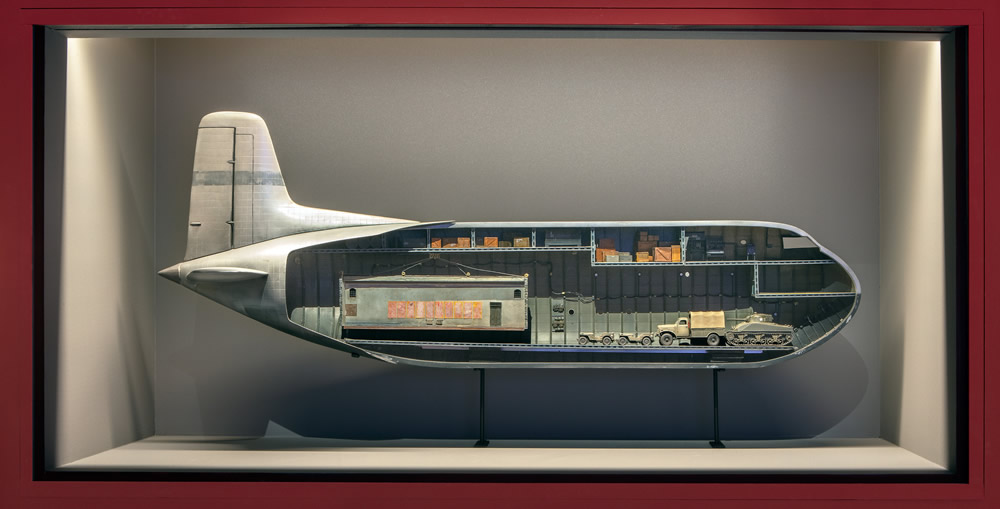
In his Berlin workshop, Simon Weisse builds worlds—in miniature. Surrounded by walls covered in sketches, glue, and plastic, entire cities, deserts, space stations, funiculars, and tin trains take shape. They’re not toys, even if they may seem so at first glance. These are miniature film sets, crafted with obsessive precision for some of the most stylish directors working today: from Wes Anderson to Luca Guadagnino, from Terry Gilliam to Paul W.S. Anderson. While Hollywood leans heavily on ubiquitous CGI and generative algorithms, he continues sculpting scaled-down reality with the patience and creativity of a Renaissance artisan. He created the theatrical miniature backdrops for The Grand Budapest Hotel and much of Anderson’s filmography.
“I don’t like the term maquettiste,” he says. “It makes you think of someone with a room full of toy trains who plays with them after work.” But Weisse is anything but a hobbyist. Though credited as “miniature effects supervisor,” in practice he’s a designer, an artistic craftsman, an engineer of wonder. His career was built centimeter by centimeter, starting almost by accident thanks to his father, Leo Weisse, a still photographer on the sets of films like The Umbrellas of Cherbourg. “He got me my first internships on set,” Simon recalls, “and one day I found myself working on The Adventures of Baron Munchausen by Terry Gilliam.”
In 1988, on the visionary English director’s set, the then-twenty-year-old Simon learned everything hands-on. The British special effects team handed him plastic, wood, silicone, papier-mâché. Models, props, visual effects items. “There were no manuals. I learned by doing. That first contact with the Brits led me to work with Richard Conway, who had worked with Spielberg, Danny Boyle, Stephen Frears. He was a kind of mentor.”
Then came the digital age. As CGI took over, models were relegated to the attic. “On Event Horizon (1997), there were still about thirty of us building space stations and spaceships at Pinewood Studios in London. But it was one of the last films where miniatures were part of the visual effects.” When computers took the reins, Weisse reinvented himself, focusing on prop construction. And just then, miniatures began to make a quiet comeback—partly for aesthetic reasons, partly for budgetary ones, but above all because some directors longed to reclaim a concrete, artisanal approach to filmmaking.
Wes Anderson is one of them. The Texan director, with whom Weisse has worked for years, has made miniatures a hallmark of his style. “With Wes, everything is very particular,” says Weisse. “He likes to film the models outdoors, with natural light. It works well, but it’s not always easy.” For The Wonderful Story of Henry Sugar, for instance, they had to shoot a scene with a 50-meter-long street—in November, in Berlin. “Luckily, I knew of an old greenhouse that was 50 meters long. We filmed there, in natural light, shielded from the cold.”
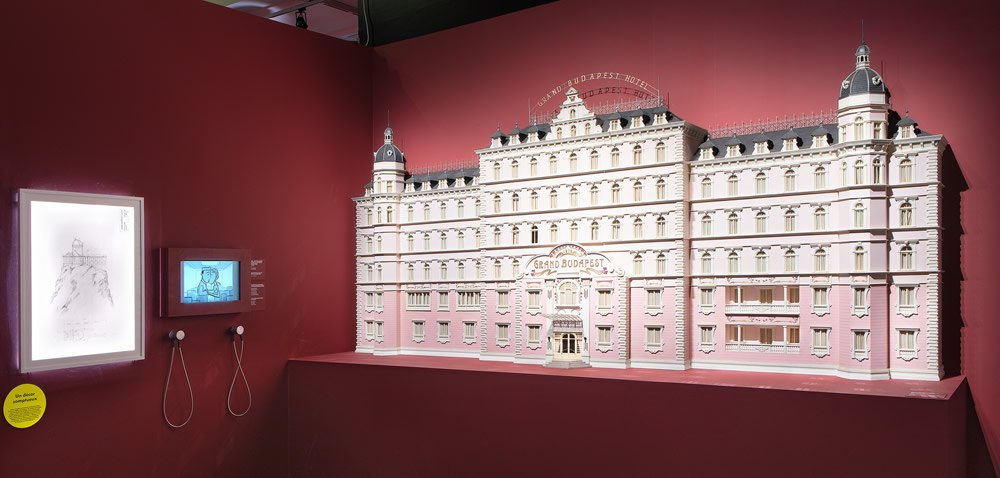
Miniature for the film The Grand Budapest Hotel, exhibited at the Wes Anderson exhibition © Stéphane Dabrowski – La Cinémathèque française
Often, Weisse explains, the models are much larger than one might expect. In The Grand Budapest Hotel, the hotel’s façade was as tall as two men. But for close-up shots of guests entering and cars pulling up, they built a second version, full scale, at 1:1. In other cases, the scale is the main issue. In Asteroid City, where they had to build a train, the Americans insisted on a 1:8 scale—huge, almost a meter tall. “In Europe, we use G scale, 1:22. At that scale, everything’s available. But 1:8 doesn’t exist here. Nothing was commercially available. We received disassembled pieces, with no manual. We had to build everything from scratch: wagons, cars, tractors. And there was no IKEA-style instruction guide. The locomotive weighed 500 kilos—it was all steel. I had to call in a car bodywork friend to paint it.”
The same care went into the hand-painted mountains serving as a backdrop to a suspended elevator, or the funicular featured in a long sequence. Three months of work, just to build the models. And Wes was still asking for changes “five minutes before shooting.” Didn’t the production complain? “Actually, once they realize how expensive it is to do everything digitally, they end up appreciating these ‘DIY’ solutions.”
Another director who values his work is Luca Guadagnino: Weisse was entrusted with recreating many miniatures for Queer, including airplanes taking off from a fake Mexico City—actually built at Cinecittà—and a mise en abyme of the hotel where poor Craig enamorado sleeps with the elusive perfumer Eugene Allerton.
And yet, the market for cinematic miniatures today is tiny. “In Europe there are very few specialized studios left, apart from Budapest and a few operations in England, where a good stop-motion market still survives.”
In an age when AI can generate entire sets with a single click, what remains of film craftsmanship? “I still believe there’s a need for the human touch. Even just to tell what’s real and what’s not. CGI can be perfect, but there’s always something missing. A model, however imperfect, conveys warmth. Emotion.”
And maybe that’s exactly what directors like Anderson and Guadagnino are looking for: the poetic imperfection of handmade work. As for the toy trains—they don’t appeal to him either. “Even though everyone thinks I build model trains for a living, I’ve actually never liked them that much.”