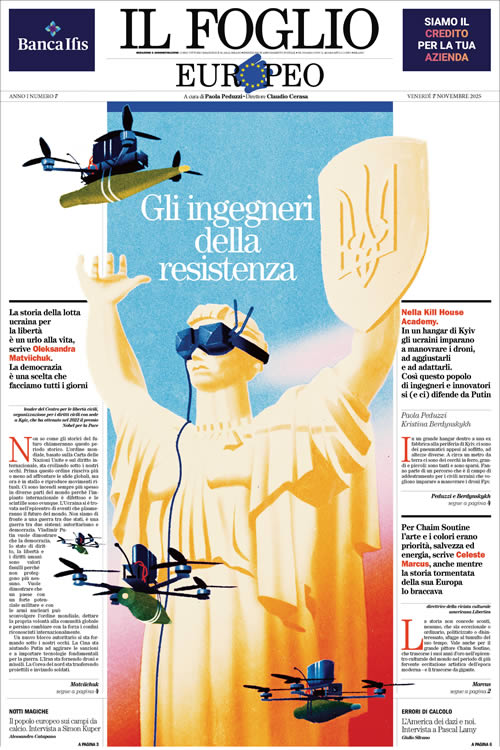
In a large hangar inside a former factory on the outskirts of Kyiv, tires hang from the ceiling at different heights. About a meter from the ground, there are iron hoops, large and small: there are many of them scattered around. They are part of a course that serves as the training ground for Ukrainian civilians who want to learn how to operate FPV drones.
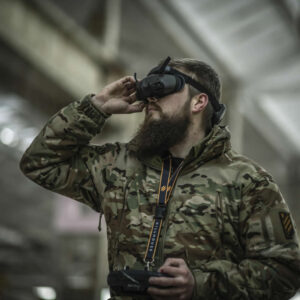
We are inside the Kill House Academy, the drone school founded two years ago by the Third Assault Brigade of the Ukrainian army. “A person who pilots a drone is like a bird in flight,” says “Shark,” the battle name of the instructor showing us around the Academy. FPV stands for “first person view,” because by looking through special goggles you get the “first person” effect, like in a video game: “The pilot sees everything from the drone’s camera, as if he himself were the drone,” says Shark, who is 27 years old, tall and athletic, and until 2022 had never had anything to do with war. A graduate of a technical university, during the large-scale invasion he realized that his knowledge and skills would be useful to the army, so he enlisted, fought at the front, including in the extremely dangerous Donetsk region, and now teaches how to pilot drones to civilian and military students. “The more experienced FPV pilots there are,” he says, “the greater the chance of stopping enemy attacks, because an FPV drone, which costs between 500 and 1,000 dollars, can destroy Russian equipment worth millions of dollars that represents a major threat to Ukraine and to our army.”
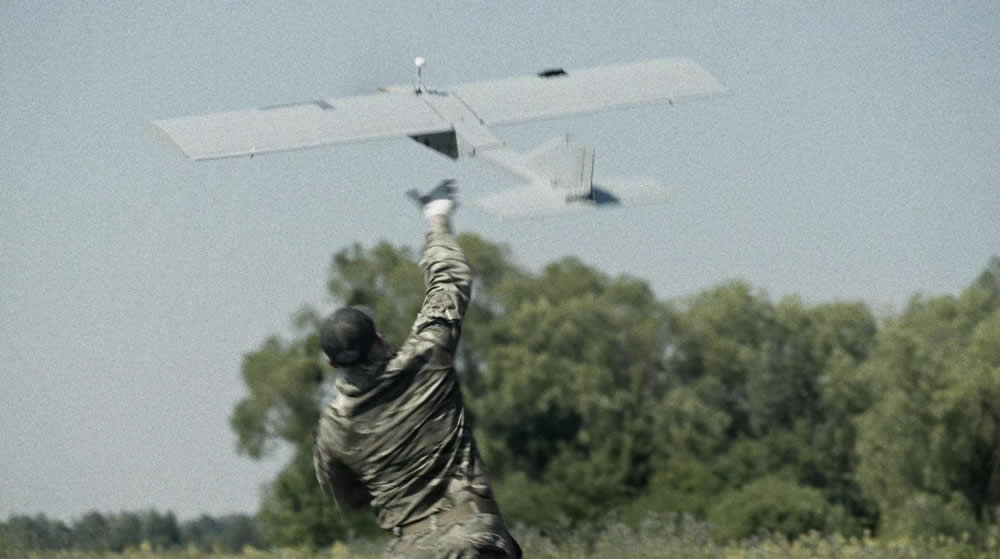
 The combination of Ukrainian ingenuity, innovation, engineering studies, and courage is the foundation of the resistance of an ironic and brilliant people defending themselves against large-scale Russian aggression for nearly four years. Fil is a liaison officer with the Third Army Corps of the Ukrainian army that controls an area of about 130 square kilometers at a deliberately unspecified point on the front line: “When Russia entered the war,” he tells us in a phone conversation, “it had a technological advantage over Ukraine regarding drones, because it had the Orlan and Zala, fixed-wing drones capable of flying over fairly long distances, which allowed them to control large areas of territory. Ukraine had some drones of this type, but in limited quantities, so we can say that the Ukrainian history of drones begins with the Mavics,” which are the ones we can also buy on Amazon. “The civilians who entered the army,” Fil continues, “brought with them their experience, their studies, and also civilian drones, but in massive quantities. And that’s how it all started, rapidly the ground units of the army understood that observing the enemy and controlling the terrain gives a significant advantage to the infantry, which thus knows where to go and where to strike. The use of drones came from the bottom up, it wasn’t an idea from the army command.” The defense of the country is a mission for all Ukrainians, each of them has made available their own experience – engineering and electronics faculties were already well-attended before the Russian invasion, but today they are a nerve center of Ukrainian determination to defend themselves and remain free and independent – and has accumulated new ones: serving the country, here, has a totalizing dimension.
Then came the FPV drones, Fil continues, “again a civilian technology was adapted for military use – an extremely economical and flexible technology that spread quickly. It took Russia a year and a half to two years before they looked at these small drones and copied them, then producing them on a much larger scale than ours. In 2024 the Russians began to close the gap.” Fil says that every six months there is a major innovation in drone functionality and that private companies are much more flexible in incorporating these innovations compared to contracts produced by public companies, but they don’t have large-scale production. This is the delicate point: Ukrainians innovate, create, experiment; the Russians copy them and then produce at a higher rate, filling the enormous quality gap with quantity.
In the Academy hangar there are several rooms. In one, there are desks, on each one a laptop and a simulator, the blackboard is a large screen. “Taking off immediately with an FPV drone is very difficult,” says the lenient Shark, while handing us a simulator. “It’s much harder than it seems from the outside.” During lessons, the instructor explains how the drone works on the battlefield, usually having experienced it for real, and for flight simulation a special software is used that reproduces real war situations. Only after passing the exam on the simulator do students practice with a real drone.
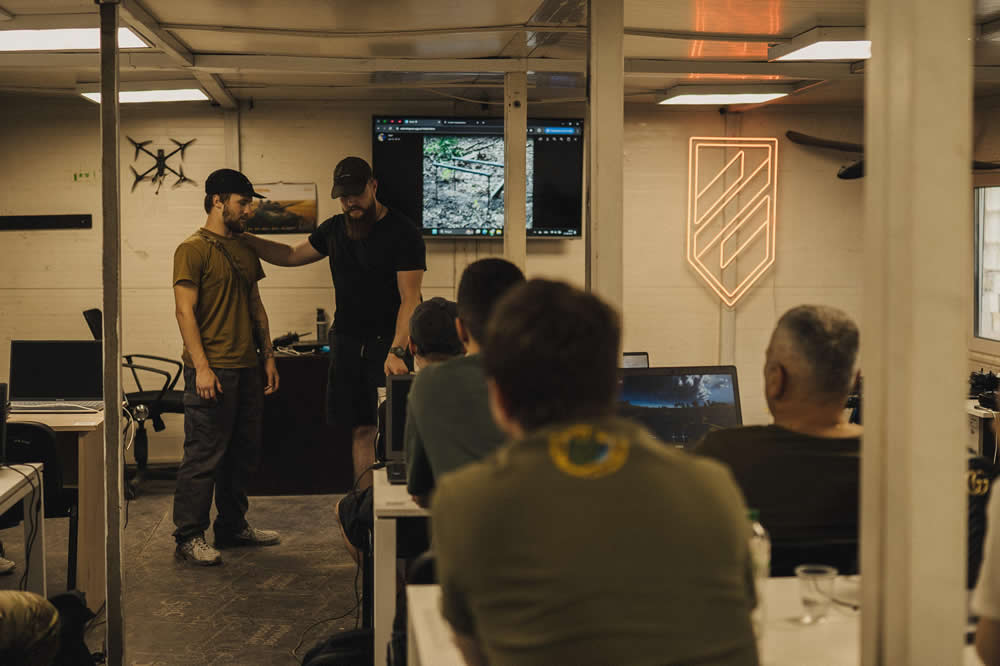
Initially the Academy was created with the goal of recruitment and it worked: about a quarter of the people who take the course then enlist in the army. But it’s a personal choice by the students, the Academy doesn’t ask for it. “The civilians we teach here might enlist in the future and thanks to our courses they arrive already with training,” says Shark. In two years, five thousand civilians have already been trained: 80 percent are men, the rest women. The majority, about 70 percent, are in the age range between 20 and 35 years. “Once a 70-year-old man came,” says Shark with a smile: defending Ukraine has no age limit.
“A good pilot must have such precise control that he can land the drone on a bottle like this,” continues the instructor holding a half-liter plastic bottle in his hand. But students in the basic course aren’t assigned such complex tasks, this bottle thing is professional stuff. At the back of the hangar there’s a car, and if the instructor sees that a student is doing well, he assigns the task of flying his drone through the open car window and making it exit through the other one. Other obstacles have also been created in the course: the drone must pass through circular and square structures following a specific path. The more difficult the conditions, the greater the experience and practice must be. When the student “takes off,” that is, lifts his drone into the air, the instructor is beside him and helps him orient himself, remain calm and focused: “This is a real flight with a drone and very often students panic,” recounts Shark always with his patient tone, while he leads us toward another shed at the entrance of the hangar, which “is the emergency room for drones”: if the drone breaks during practice, and it happens often, engineers fix it here, on a table full of tools and some wounded drones.
The basic daytime course, which usually has 20-30 participants, lasts six days, from 11 to 5 pm, while the evening one lasts nine days from 6 to 9 pm and is designed for civilians who work or go to school during the day. In addition to the Academy in Kyiv, there are similar ones in Lviv, Odesa, and Cherkasy, and there’s also a traveling Academy, the FPV bus, which travels to various Ukrainian cities: theory is done on the bus and municipalities help find spaces for flights, like soccer fields. Isn’t it dangerous? “In a week the enemy isn’t able to locate us,” Shark reassures us.
In real war, the crew operating an FPV drone consists of at least three people: the pilot, the navigator who helps him correct the flight, and a sapper who handles the munitions. Often there’s also an engineer, because the engineering component is fundamental. From the front, Fil explained to us that four people are essential, also because someone is needed to drive the pickup to the place where the drone must then be launched into the air. The sky, over that war line, is full of reconnaissance drones, armed drones, bombers: you’re no longer invisible on the ground, because it’s not only the Ukrainians who “see,” the Russians see too. “The dead zone, the extremely dangerous one you can’t approach,” says Fil, “begins about ten kilometers from the front”: what we call “distance,” because with drones a distance has been created between the two armies at war, soldiers at the front call it the “dead zone,” the zone of death and dying. There is also a terminological abyss between those who, here among us, discuss drone warfare and those who, there in eastern Ukraine, fight it.
 Fil says the logistics part is crucial and dangerous precisely because no one is invisible: “You have to supply soldiers on the front line, you have to evacuate the wounded or recover casualties.” Robots have also been introduced for logistics activities: the Russians use them too, but in different ways, because “we supply the front line at any cost, there’s no way soldiers are left without food or equipment. The Russians don’t have the same care for their soldiers.” This is the fundamental difference between the army of a democratic and free people and that of a dictatorial regime: for Ukrainians every life counts. And innovation happens on the battlefield, engineers dismantle, adapt, fix, “we are more decentralized,” Fil continues, “and we are more flexible in technical solutions, because, again, we have a distributed production network: we have a large number of independent units made up of qualified volunteer engineers who invent all the time. The Russians don’t: first, they don’t have volunteers, and then they can’t produce any innovation from the front line, they don’t have engineers there.” Again: it’s mass production that sustains the Russian army.
At the Academy there’s also an engineering course to learn how to assemble drones. At the exam, the student must assemble his drone from scratch and configure it: “If his drone flies at the end and everything goes well, it’s a point in favor of passing the exam,” Shark explains. Outside the hangar there’s a building with other classrooms. In one, the conditions of a trench have been recreated: the walls are covered with camouflage netting – it’s a small, closed, dark space. Here the advanced courses take place, where not only is the front environment recreated, but where a weight is attached to the drone to simulate warheads. There’s also separate training for controlling unmanned aircraft of the airplane type: the theory is done in a classroom here at the Academy, but not the exercises, which take place at a range outside the city, because these wings need more space.
For civilians, basic training at the Academy costs about 160 euros, for military personnel it’s free. “Drones get destroyed one after another during training, so we can’t provide completely free courses,” says Shark. But students don’t lack, there’s always someone who wants to learn, word of mouth works. The courses are designed to provide information and training, courage and solidarity, but also – it’s strange to say it – a kind of enthusiasm, which is built with stories, anecdotes, and the unfailing, astonishing ability to cure fear with irony.
If after graduation a student decides to enlist in the army, he will then receive additional training. In March 2025, the Third Assault Brigade, which implemented the idea of the drone school for civilians (other brigades have done so subsequently), together with other units became part of the Third Army Corps, whose bridgehead is the last line of defense of northern Donbas and the Kharkiv region. The Corps controls about 150 kilometers – 12 percent of the entire length of the front. Fil says with a breath of voice, while we explain to him that in European countries the idea persists that “light warfare” with drones is somehow less dangerous than traditional warfare, that it’s not at all so. Operating drones can be, is lethal, more than in other units.
Leaving the Kill House, under the blue sky of Kyiv that the previous night had filled with Russian drones and ballistic missiles, you feel more strength than fear. This people of engineers and fighters, of volunteers who abandoned their previous lives to defend their independence and freedom with everything they have, ingenuity and courage, invariably cures melancholy, with its tireless lesson of salvation, of victory, of life.