Lukashivka (Mykolaïv region), from our correspondent
When one of the most secretive places in the world becomes a museum, it often means that the nation revealing its own secrets has lost a war, lost a struggle, or has changed and no longer needs hidden places — that it has settled into peace. That’s not the case with Ukraine’s Museum of Strategic Missile Forces, built on the site of the unified command post from which nuclear strikes could once be launched — one of the country’s most secret locations when it was part of the Soviet Union, and one that might have remained so had Kyiv not been deceived. Today the museum is the site of a past war stripped of all pretense, and of an ongoing war that could have been avoided starting right here. The Museum of Strategic Missile Forces tells the story of Kyiv before the Budapest Memorandum, when on December 5, 1994, Ukraine handed over to Russia 1,900 nuclear warheads, receiving in exchange a guarantee that its borders would be respected and its sovereignty preserved — a promise guaranteed by Moscow, Washington and London. Kyiv held roughly a third of the Soviet Union’s nuclear arsenal; trusting the Memorandum and its signatories, it agreed to give it all up. At Lukashivka, on the bare ground of the museum, there are enormous missiles, tunnels with no secrets left, control panels both original and reconstructed, a half-open launcher, maps that show the past, and faded photographs. The story of the Memorandum that was supposed to preserve Ukraine’s borders, of a promise turned into a lie, is concentrated in this space full of relics once threatening but now harmless. And amid this pile of metal exposed to the elements, standing tall and enormous as if to remind us that Ukraine was this too, wanders Viktor, who has known the place since the days when a single button could have changed humanity’s fate — and the finger ready to press it was his. He still wears his fatigues, almost as if keeping himself ready in case Lukashivka were to become the unified command post it once was again. Viktor smokes, stubs out one cigarette and lights another; he’s a nicotine centrifuge. He doesn’t believe a word of what Ukrainian authorities say about the war with Russia: “We Ukrainians were deceived, we should do what Trump does with Mexico: build a wall on our borders,” he says, with a bitterness that will seep out like poison through nearly the whole visit. One might naively think Viktor wants a wall along the 1,576-kilometer border, a hard, impassable, high, unbreakable frontier that could have stopped the Russian invasion. “It’s you we should build a border with — yes, with you Europeans, to keep you away.” There he is, Viktor, revealing himself, summing himself up in a single sentence right from the start of the conversation: the problem is us, Germans especially. While his country loses lives to missiles coming from the east, he looks west, and it seems as though, from this space buried by the Budapest Memorandum, he has never truly emerged. He’s the museum’s most experienced guide, he’s written its history, he promises not to talk about politics, but wants to talk about nothing else. Sometimes he apologizes, only to start up again; he takes offense when another guide, Nazar, steps in to replace him — perhaps sent by the museum’s curators, who seem to have little patience for Viktor’s outbursts but consider him indispensable for explaining this place lost in time. Nazar is also a veteran, and he doesn’t share Viktor’s views, but he admits: “No one can tell this story better than he can.” To everyone here, Viktor is himself a relic, not unlike the enormous Satan missile that grabs your attention the moment you enter the park surrounding the museum. The Satan is a Soviet intercontinental ballistic missile whose job would have been to destroy hardened American underground silos: “There’s no missile this heavy anymore, or this big — stand it upright and it’s like a building at least ten stories tall.” Lying inert, the Satan looks so ancient it barely seems frightening, yet it was among the missiles tasked with starting the Third World War. For Viktor it represented a life insurance policy — for Ukraine’s greatness, its strength. After the Budapest Memorandum, the site at Lukashivka and the nearby town of Pervomaisk went from being among the most protected places in Ukraine to among the most forgotten. The agreement left Kyiv not only with the burden of handing its warheads to Moscow and granting the Kremlin sole inheritance of Soviet nuclear power, but also with the difficulty of having to destroy and dispose of material that couldn’t be transferred to Moscow. Some missiles were dismantled, some silos were blown up — and between transfers and explosions, Ukraine lost a security guarantee.
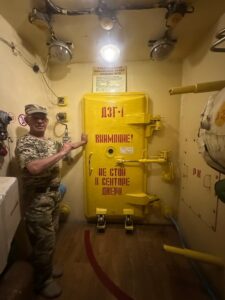
The museum is full of visitors, mostly young families; Ukrainians come here almost on pilgrimage, to imagine what might have happened. They look at the missiles, the era’s computers, the way one looks at a fork in the road. “Do you think there’d be a war if we hadn’t shut this place down?” Viktor asks. He’s convinced, as Moscow teaches, that Ukrainians are mistreated around the world, used as pawns, and in what remains of his old workplace he sees his country’s dignity slapped in the face. His tone softens as we go underground, into the corridors hidden inside a cylinder three meters wide and thirty-three meters deep. Viktor transforms. “Every day the secret password to access the command post changed — it was a city paired with a number.” He picks up the phone, as he did for a lifetime, lifts the receiver, mimes the conversation. “We’ve been given clearance, we can proceed,” he says, and starts walking, then turns back: “If you got it wrong, you risked your life.” The Viktor moving through the underground remains of his past is a serious, rigorous man. We take the elevator and descend even deeper, to a cramped little room with two beds. We’re at the heart of the earth; Viktor points out the tea kettle, the cups from that era, and recounts: “During shift change, whoever arrived had to have tea ready for whoever was leaving. We’d wait here for them” — he sits on the blue felt blanket, cup in hand — “we’d say goodbye and then go to our post.” He sets down the cup and climbs a ladder. He’s in his own world, in his own past. You have to follow him, without asking questions. He’s already taken his seat at the control panel, absorbed among the buttons, with a smile that looks like a scratch across his face, a grimace of sadness disguised as tenderness. He gives up the chair with a warning that demands respect: “This,” he says, pointing to the panel, “was my bread and butter.” He’s in short sleeves in the freezing, bare room, artificial light beating down on him. He was the first officer; it was he who gave orders to his second-in-command. He begins issuing orders the way he once did, showing how to push the buttons and pull the levers that could have launched a nuclear attack. He’s living that moment; you have to play along — for him it was real life, for others it can’t become a game. Viktor’s days used to go like this: the phone would ring, and the drill would begin. Endlessly, six hours straight, every day, he would repeat, as if it were really happening, convulsively, the start of the Third World War. Every time the phone rang, he’d listen to the codes and not know whether it was still a drill or an order, whether he would ever leave that cylinder planted in the heart of Ukrainian soil, or whether the world outside would be forever out of reach. One gets the impression he didn’t care about leaving — that tiny room was enough for him. He lived like this for years, never knowing what would come of each button pressed, each order received or given. Every day, several times a day, he lived through the simulation of disaster, the atomic theater, thinking it might be real. Charged with a heavy task, today he is the keeper of what remains after the Budapest Memorandum: a display case of betrayal. That’s how the world’s most terrifying security guarantee works — it remains a guarantee only until it becomes reality. Viktor walks fast, he’s remarkably nimble. “I’m not a guide, I’m telling you my life,” he insists. It’s in the repetition of the fiction that he wants to go on living.