Next April, Hungarians will head to the polls while the war is still raging next door. The election is shaping up as a key moment, with a new opposition candidate seen as having the first realistic chance of challenging Orbán’s grip on power and helping the country back on a path towards democracy. At the same time, Europe faces pressures from Russia’s aggression, constantly changing signals from Donald Trump, and within the bloc.
Hungary’s far-right Prime Minister Viktor Orban has been in power for 15 consecutive years, until last year, without a real challenger. His position is unique in Europe since he has won with a supermajority four times now. Last February, the ex-husband of former justice minister Judit Varga went on Hungary’s most popular political YouTube channel, Partizan, and spoke about corruption in the ruling party, Fidesz, with unfiltered honesty. After the live interview (that garnered over 2,4 million views), the whole country knew Peter Magyar’s name, and within a few months, he was able to bring tens of thousands of people to the streets. His party, Tisza, which stands for Respect and Freedom, is now the largest opposition party, leading the latest polls ahead of Orban’s Fidesz. But will Magyar be able to beat Orban next April?
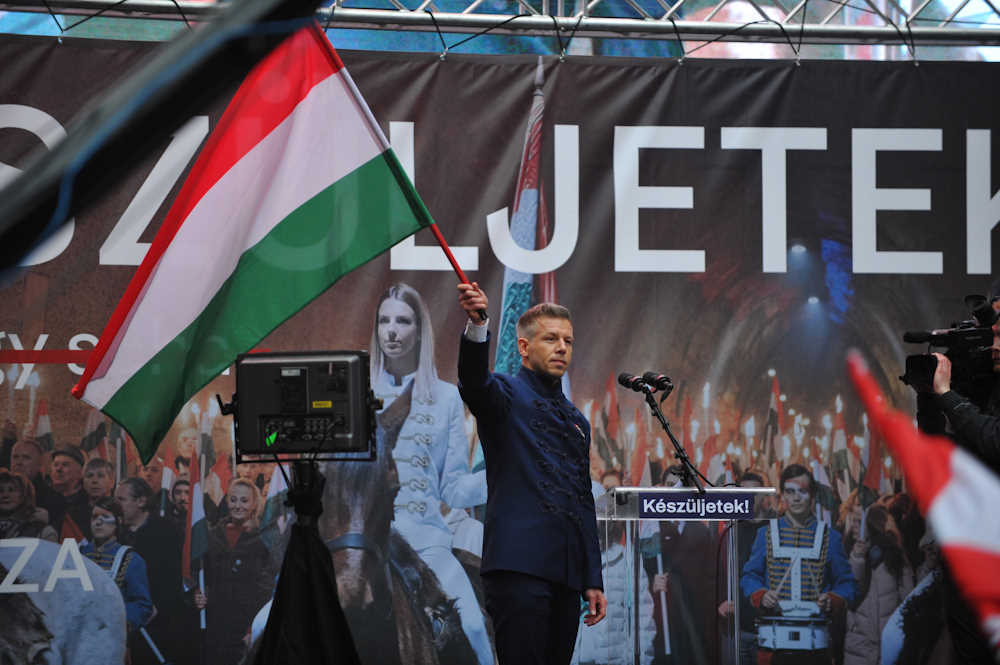
If we’re looking at Magyar’s social media or visit one of his rallies, the visuals and certain rhetorical elements of him are not that different from Orban: a massive amount of red-white-green flags, simple, classic meals, and traditional outfits. An image Orban has tried to master over these past years, that he is an “ordinary man”, “one of us”. Magyar’s politics is also not that different from how Fidesz started: as a centre-right party. Orban’s previous challenger, Péter Márki-Zay, a provincial mayor, also tried to take down with a conservative message, so what makes Magyar so different?
According to Peter Kreko, director of the Budapest-based think-tank, Political Capital, Magyar is challenging Orban without the support of other opposition parties. He created a whole political world around him. “He does not rely on any of the existing opposition parties from the far-right to the center-left. In contrast [to what has come before], he offers an alternative. And it does not include the opposition’s 15 years of political failure,” Kreko told Il Foglio. “Peter Magyar comes from Fidesz. And that’s why he’s somehow immune to the smear campaigns against him. Somehow they don’t work on him,” he added. Kreko also highlighted Magyar’s great communication skills, that he fights “fire with fire” and described the politician as a charismatic figure who can beat Orban at his own game. By now, Magyar is known for her witty Facebook comments and sharp-toned responses to the pro-government media’s constant propaganda attacks. Botond Feledy, a Brussels-based foreign policy expert, reiterated Kreko’s analysis that part of Magyar’s success is that most previous attempts to win against Orban came from left-wing parties, and there is a shift to the right not just in Hungary but in Europe. “Tisza was able to break into this space and take over of over Fidesz’s vacancy in the European People’s Party,” he said. “And there are domestic political reasons as well: inflation, dissatisfaction among various electoral groups (such as teachers, students, healthcare workers, etc.). Many are choosing to swallow this pill and vote for Tisza,” Feledy added, explaining that a large percentage of liberal voters are also expected to vote for Magyar in the spring.
One issue that plays into Magyar’s hands is the Hungarian public’s growing displeasure with the roaring inflation and the state of the economy. The lavish lifestyle of Fidesz politicians has been well known for over a decade, but Hungarians started paying more attention to these stories when they realized their taxes are funding designer bags and luxury holidays. “If someone knows how Fidesz does it, it is Peter Magyar, because he is a player within the system,” Kreko explained to my question about why Magyar’s corruption claims resonate more with the public. “The luxurious lifestyle is beginning to take its toll on Fidesz. They did not make so many mistakes in the past,” the Kreko added, referring to recently emerged images of Orban on a yacht in Croatia after he did a publicity stunt flying coach on a budget airline. Another scandal that garnered significant attention in Hungary over the past few months is the image of Orbán’s lavish, unfinished mansion in Hatvanpuszta, featuring a palm house and a private zoo with zebras. Fidesz is not used to having a genuine political challenger, and not being able to control the narrative about themselves is uncharted territory for them. “The system is losing its internal balance. As a result, the political entourage is turning into an official ideology, businessmen are becoming corrupt, and corruption is becoming rampant,” Feledy explained.
Orban has not only been in crossfire at home, but in the European Union as well. Hungary has continuously vetoed the neighboring Ukraine’s EU accession talks despite the decision being backed by most European member states. Orban has used his veto power in relation to key EU foreign policy decisions in the context of the war, blocking aid from Ukraine. According to critics, Hungary became Russia’s Trojan horse in the bloc.
The Hungarian Prime Minister is seen as an outlier in Europe; his main international ally is US President Donald Trump, who recently met with European leaders after meeting Russian President Vladimir Putin.” I believe the Washington meeting showed the weakness of European leadership. Inviting Putin to Alaska and disregarding international agreements is the complete opposite of what Europe stands for, “ said Kreko. “If the positions do not converge, then Orbán’s stance is closer to Trump’s than to the EU’s.” Orban has always bet on Trump for the past years, but it can be a risky game because American policy seems to be changing by the hour. According to the political analyst, if the American administration continues to view Europe as an adversary, Orbán will remain an ally to Trump, who can weaken the European Union from within. “Orbán clearly represents Russian interests. Hungary suing the European Union over a decision to grant billions of euros of aid to Ukraine from frozen Russian assets is a prime example of that,”Kreko added.
Orbán’s loyalty to Trump may get him an advantage in this situation at a transatlantic level, but from an EU perspective, things can only get worse from here for him. Whether Péter Magyar can unseat him after 15 years remains uncertain. His rapid rise has stirred up Hungary’s political landscape, but whether it’s enough to win elections is unclear at this point. The stakes probably have never been higher: Europe grapples with the war in Ukraine and Orbán’s vetoes over aid and foreign policy. For Hungary and for the EU, this election will be a decisive moment that can bring a different direction forward.