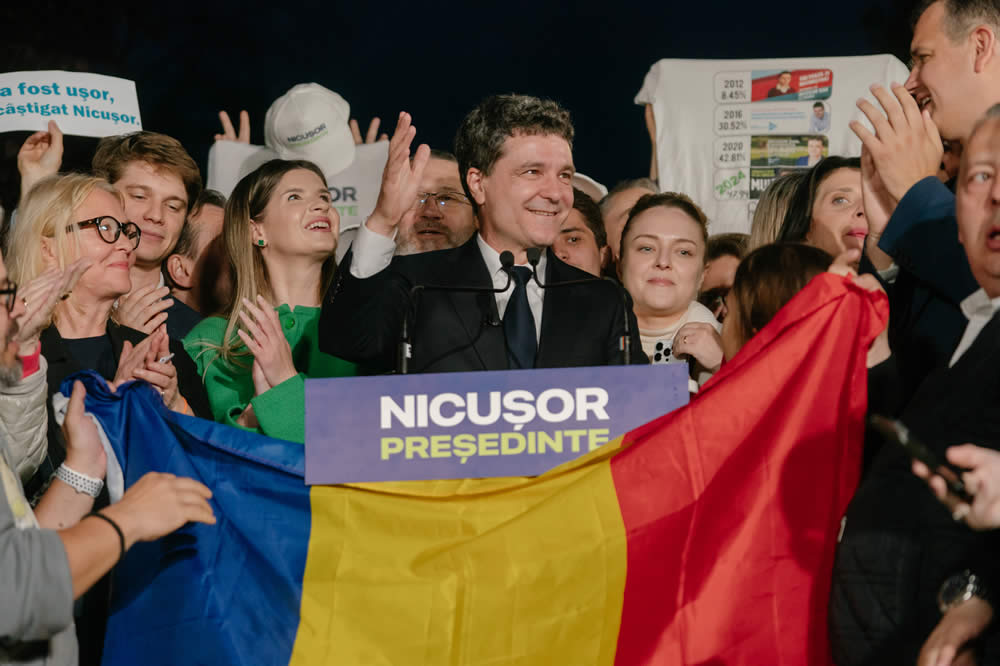
A green archipelago – that’s the image one of Romania’s official electoral maps evokes. Green stands for pro-Europe, pro-Nicusor Dan, the newly elected president: a mathematician who walks his daughter to school and doesn’t seem particularly dazzled by the trappings of power. It’s a pro-European archipelago on the edge of Europe – and on the edge of the country too, as Dan secured victory even in Romania’s border regions. Meanwhile, the country’s heart glowed yellow on the map – the color of George Simion, the anti-European candidate and heir apparent to Calin Georgescu, the same man who, in December 2024, pushed Romania’s Constitutional Court to annul elections marred by serious irregularities, compromising their free and fair nature.
So why is it that Romanians living outside Europe rushed to vote – to keep Romania within the European fold? Is it the timeless allure of faraway ideals that shaped their choice? And on the flip side, has daily life in Europe numbed the desire to preserve it?
Let’s look at the data. Statistically, the largest group of voters falls between 45 and 65 years old – a generation that remembers all too well what authoritarianism meant for Romania, and what a return, even in a modernized form, could entail. Not necessarily the same regime – times have changed – but its ideological twin, just as eager to impose itself through force and coercion. A shadow that fell with Nicolae and Elena Ceausescu, but never quite disappeared.
Women made a difference, too. And for good reason: the idea of mandatory skirts to help “cosmic energy” circulate – as championed on social media by Georgescu’s wife – is more than enough to scare people to the polls. In Romania, the right not to wear a naframa, the traditional headscarf, is still a relatively recent gain. That same naframa was invoked by Simion as a symbol of virility, declaring himself not “some woman in a headscarf.” The people who voted to keep Romania anchored to Europe are also those who have directly experienced the EU’s benefits – not just geographically, but economically and tangibly, day to day.
Take 2018, for instance. Romania contributed around €1.6 billion to the EU budget – about 0.83% of its GDP. That same year, it received €4.77 billion in EU funds for agriculture, regional development, and employment. The net gain? Over €3 billion. (For context: Italy followed a similar pattern in 2023.)
And this wasn’t a one-off. Romania has consistently received more than it contributes – not just in money, but in modernization, infrastructure, standards, and opportunities. From 2021 to 2027, that balance only grows. The numbers are clear: approximately €30 billion are expected for roads, hospitals, digitalization, and education; €14 billion for farmers; nearly €7 billion for post-COVID recovery. A total of around €73 billion.
That’s what the green on the map says: from both outside and inside Romania, being part of Europe means growth, opportunity, and rights that are granted – and respected. But that same map also reveals the darker side: disillusionment, mistrust, and a nostalgia for a nation whose system struggles to keep its promises – not just those made over the last 35 years, but even the recent ones. Remember the wave of hope that accompanied Klaus Iohannis’s 2014 election? The European diaspora queued for hours at consulates to cast their vote. Back then, there were 294 overseas polling stations. In 2025, that number reached 959. And yet, the cry for hope and engagement from Romania feels fainter now – or maybe it’s just gone unheard.
This time, Romania spoke up again. But the European diaspora didn’t answer. They followed instinct, emotion – maybe even fear of ending up, once more, on the wrong side of history. And maybe they were right. Europe, seen from the inside, is less alluring: stuck in indecision or veering into legally shaky territory (see: the rearmament debate), it’s starting to look more like a ship that’s already hit the iceberg. From within, the cracks are clearer – and through them, you can see the shadows that lurk beyond the idea of a united, strong, and stable Europe.
As Elena Paparella writes in her book Il Parlamento europeo dalla sovranazionalità al costituzionalismo (The European Parliament: From Supranationalism to Constitutionalism), there’s a growing disconnect between citizens and what the European Parliament actually does. In countries like Romania, the institution often feels like a gateway to personal advancement in a corrupt political system – one that imposes ideas many feel clash with traditional Romanian values (such as LGBTQ+ anti-discrimination policies). Paparella argues that simply feeling part of a community isn’t enough anymore – we must become one. That requires rebuilding a European identity through transnational parties and encouraging citizens to actively engage in shaping the EU’s institutions.
This time, Romania responded to the fear of isolation and a possible slide eastward by choosing Europe – once again. It chose it as both compass and window: a compass that may not always point to safe shores, since Europe too is in troubled waters; and a window, still open to what’s possible, even if slightly cracked. Romania and Europe resemble each other in their restlessness. With Nicusor Dan’s election, Romania begins a new chapter: a struggle to redefine its identity – not in pursuit of some abstract ideal, but to move closer to Europe’s most tangible, lasting legacy: a tradition of rights that are recognized and protected.