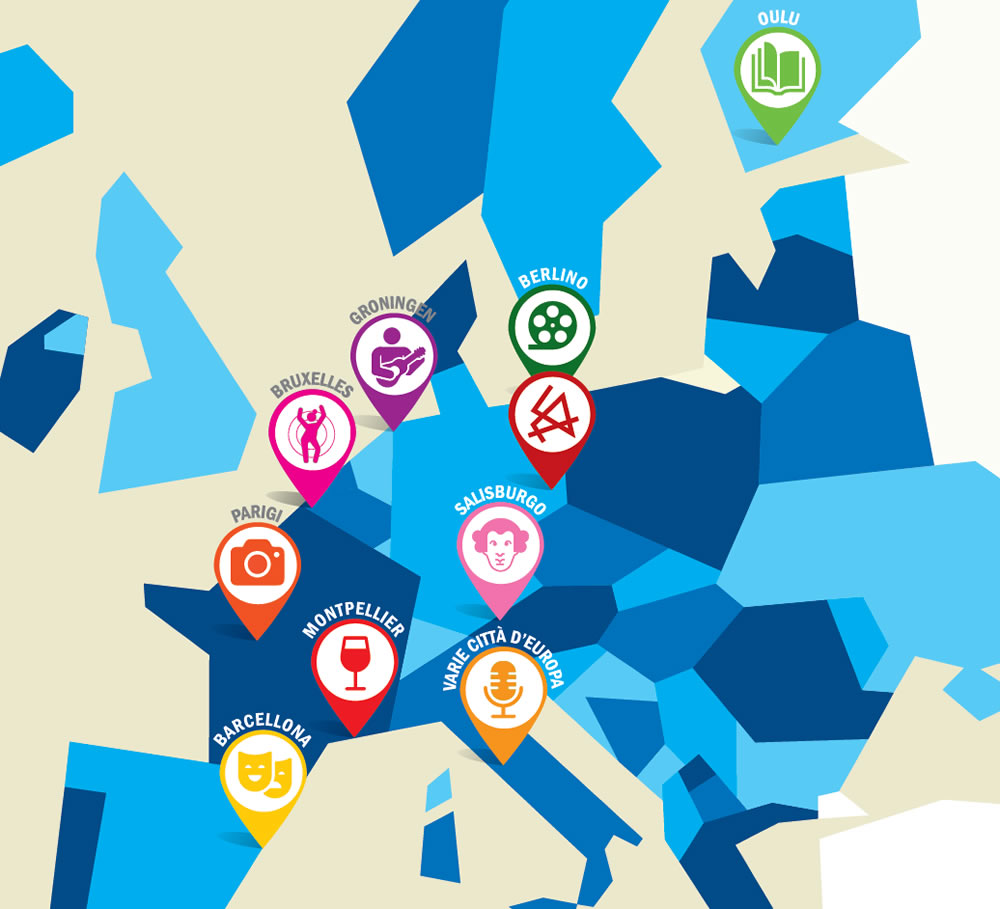
14-17 January. ESNS EUROSONIC NOORDERSLAG / GRONINGEN, THE NETHERLANDS
Eurovision’s indie brother
Paolo Giordano wrote days ago on Corriere della Sera that he hoped Europe could rediscover a new vocation, a current meaning to the word “freedom”: not the wild one of the Wild West, but one in which “we have the courage to regulate what presents itself as unregulatable, to limit what presents itself as unlimited. Where democracy is non-negotiable.” In the same spirit, the fortieth edition of Eurosonic Noorderslag (ESNS) opens, an independent platform that is also a festival bringing the most interesting emerging European music scene to the stage. It is a showcase to make oneself known and celebrate the diversity and richness of European pop culture, a kind of indie and more refined brother of Eurovision, where the Libertines, Stromae, Fontaines D.C., the XX, among others, have performed. This year 320 artists from all countries of our continent will perform; for the curious, there is an official and constantly updated playlist on Spotify. The theme of this edition is “Europe Calling,” expressed in a manifesto that emphasizes the urgency of European unity (United in diversity) to open up and invest in a collective future. Underlining the crucial impact of music in imagining and narrating a society, it closes with an appeal to commit to building a resilient and self-sufficient music industry.
22 January-1 February. MOZART WEEK / SALZBURG, AUSTRIA
For seventy years we’ve all been crazy about Mozart
At Christmas “Amadeus” was released, the new series created by Joe Barton about Mozart’s life, played by Will Sharpe. It’s based on Miloš Forman’s 1984 film of the same name, and the story is told from the point of view of rival Antonio Salieri who, in one scene, exhausted by the grace of Mozart’s music, takes it out on God and tells him: I’ve tried my whole life to make myself your “instrument” through music, with rigor and piety, but he is your voice, and to me you gave only just enough talent to recognize his genius and my mediocrity. Mozart’s music is something that, as human beings, we cannot stop confronting (the pieces were re-recorded especially for the series, under the direction of Benjamin Holder) and that we cannot stop listening to. This is why every year for seventy years Salzburg has held Mozart Week, an event dedicated to Mozart’s music (born 270 years ago) and to classical music: to be listened to, to be discussed. The artistic direction of this edition, “Lux Aeterna,” is entrusted to tenor Rolando Villazón, who made his Salzburg debut in 2005 (at the summer festival for European music lovers) as Alfredo in “La Traviata,” alongside Anna Netrebko. Villazón is also the director of a brand-new production of “The Magic Flute,” perhaps the most popular opera of all time, performed by the Mozarteum Orchestra Salzburg, with conductor Roberto González-Monjas and a great ensemble of soloists. The staging is philologically and historically accurate and perhaps for this reason truly magical.
MONTH OF JANUARY. STAND UP COMEDY IN BROKEN ENGLISH / VARIOUS EUROPEAN CITIES
Traveling the world to make jokes
Romanian comedian Victor Patrascan introduces himself like this: “In the last five years I’ve lived a strange life. I don’t live anywhere, I basically travel from one country to another and make jokes. I don’t have a home. When you go out you take your phone, wallet, and keys: I don’t have keys. And sometimes I have someone else’s wallet, because I left Romania but Romania hasn’t left me.” He grew up in poor, rural Romania – in one sketch he says he has an EU passport, “a white person’s passport,” but Romanian: a bootleg version of a Westerner. He moves to London to do stand-up and from when he starts, the troubles begin. The biggest: in April he was denied entry to Georgia, where he was supposed to perform in Tbilisi, because of a joke about the government and its subservience to Russia. His comedy is uncomfortable and politically incorrect. The only priority is to make people laugh, unmasking the ridiculousness of the world. Since 2020 he’s been on tour, no sponsors or agent, he organizes everything himself – including some charity shows in Kyiv and Beirut. He embodies that wandering, nomadic, and irreverent European spirit to dismantle the harshness of existence – or the geopolitical situation. “I’m going to the four corners of the world just to make jokes.”
7-18 January. BREL / BRUSSELS, BELGIUM
Minimalist choreographies to dance “Brel”
Jacques Brel shakes the heart: the expressiveness of his face, the feverish gestures, the body that vibrates as he sings of love, death, aging, political commitment. Anne Teresa De Keersmaeker, a Flemish choreographer recognized throughout the world, and dancer Solal Mariotte took on the mythological repertoire of the Belgian “chansonnier” in the dance show “Brel,” presented at the Avignon festival and now at the Théâtre National Wallonie-Bruxelles. De Keersmaeker’s choreographies, age 65, are precise, minimalist, geometric. She directs the Rosas company, in which Mariotte dances, a Gen Z dancer who comes from breakdancing. She has already worked with poetry and singer-songwriter music (Rilke and Joan Baez), he discovered Brel on YouTube and, while studying at De Keersmaeker’s academy, presented a solo to Brel’s “Une valse à mille temps.” But how to add something to the visceral intensity of “Quand on n’a que l’amour,” “Ne me quitte pas,” “Les Bourgeois,” “La chanson des vieux amants”? Mariotte himself said it: Brel’s songs are so rich that they make dance seem superfluous. The point of “Brel” is not to visually represent the songs, but rather to explore their poetic images and above all to channel their energy and intensity. The show is touring Europe and in May will be on stage at the Piccolo Teatro Strehler in Milan.
22 January-22 February. MARIA MAGDALENA / BARCELONA, SPAIN
Mrs Dalloway, Madame Bovary, Mary Magdalene
In 2025, director Michael De Cock and artistic director of the Teatre Nacional de Catalunya Carme Portaceli staged an operatic adaptation (and feminist revisitation) of “Madame Bovary” at the Théâtre National Wallonie-Bruxelles. The collaboration between the two theaters is thriving; they had already produced a prose “Madame Bovary” and, in 2019, a theatrical adaptation of “Mrs Dalloway.” They return to work together at the Teatre Nacional de Catalunya to tell the story of Mary Magdalene, “the symbol of the erasure of women from history.” Little is yet known about the play, almost only the plot: Miriam, a teacher, arrives in Barcelona from Brussels to give a lecture on Mary Magdalene, after choosing to divorce her husband and leave her daughter at home. At Barcelona airport, the taxi driver is Jesus.
PREMIERE 16 January. OVLLÁ / OULU, FINLAND
The world’s first opera in Sámi
Oulu has just become a European Capital of Culture and is already debuting at its city theater with a grand production. “Ovllá” is the first opera entirely in Northern Sámi language. The opera tells the story of the assimilation policies suffered by the Sámi, an indigenous people of the European Arctic: Ovllá is torn from his parents and sent to boarding school to grow up as a Finnish citizen. As an adult, he has severed his own roots and forgotten who he is. At the center is shame, transmitted from generation to generation: the mother tongue, a reason for discrimination, is silenced, until silence and shame transform into identity. The opera speaks of how the loss of a language can have consequences on identity and how one’s roots can be reconstituted through language and songs. The tension between identities is in fact healed by music: on one hand the free flow of nature, on the other the more rigid structures of the orchestral music of the Oulu Sinfonia, at the center the voices of the joikers, the Sámi folk singers, who reclaim the voice that was taken from them. A polyphonic opera that is an attempt to address the disintegration caused by colonialism in the integrity of a person as well as a country.
17 January. EUROPEAN FILM AWARD / BERLIN, GERMANY
The sparkling night of European cinema
On January 17 in Berlin, at the House of World Cultures, European filmmakers and beyond will gather for the European Film Awards, the biennial awards night organized by the European Film Academy. The nominations are a map for navigating the best films already released or coming to theaters – for the four survivors who still go to the cinema. Among the nominated documentaries is “Afternoons of Solitude” by Albert Serra, a portrait of Peruvian bullfighter Roca Rey, already best film of the year for Cahiers du Cinéma, “Songs of Slow Burning Earth” by Olha Zhurba on the normalization of war in Ukraine, and finally “With Hasan in Gaza” by Kamal Aljafari. Among the nominees for best film: “A Simple Event” by Jafar Panahi, “Sentimental Value” by Joachim Trier – again with actress Renate Reinsve after “The Worst Person in the World,” released in January – and “Sirat” by Oliver Laxé. In this binge-watching of trailers of films not yet in theaters, the animated film “L’Olívia i el terratrèmol invisible” by Irene Iborra Rizo deserves attention, the story of a twelve-year-old girl evicted along with her family and forced to start over in a new neighborhood. The comparison with the Oscars seems kitsch in this climate of transatlantic divorce, and to seal the European genius loci of the event, Alice Rohrwacher will receive the “European Achievement in World Cinema.”
23 January-1 February. CTM FESTIVAL / BERLIN, GERMANY
Finding meaning in dissonance
Raise your hand if you’ve never been to the Berghain in Berlin – it doesn’t count if you’ve seen it in “Los años nuevos” or in the anecdotes of party-loving friends who tell of entering the club on Friday and leaving on Sunday, in an eternal loop of sounds, lights, and drugs. Berghain is one of the venues of the CTM festival, pure distillate of Berlin culture, with a program, theme, and lineup untranslatable for those who don’t frequent the aesthetic and existential universe of electronic music. Online it is described as a festival of “adventurous music and art,” the theme of the 2026 edition, the twenty-seventh, is “dissonate < > resonate” – so it seems from the interpretation of the super cool fonts (hieroglyphics) of the website. It alludes to dissonance, not chaos or disturbance, but generative force capable of producing movement, energy, and coexistence of even contradictory differences. It’s not about resolving it, but inhabiting it, until it begins to resonate. The program spans techno sets, American folk, and artists like Vv Pete, an Australian rapper of Sudanese origin. Alongside concerts, theoretical conferences, masterclasses, and workshops on music production and mixer use, sponsored by the electronic music production software Ableton and the spatial mixer brand (we still need to understand what that means) Ambrio Sound.
30 January-24 May. EN CES LIEUX – JO RATCLIFFE / PARIS, FRANCE
Two visual journeys at opposite poles
The Jeu de Paume in Paris was one of the first repurposed spaces in the Western world. Born as a gym for proto-tennis in 1862, after hosting the Expo and the Olympic Games, already from the 1910s it became an art space, exhibiting the Impressionists until the opening of the Musée d’Orsay. Today it is an art center dedicated to images from the 19th, 20th, and 21st centuries, also with a cinema. At the end of January it opens “En ces lieux,” a monographic exhibition by South African photographer Jo Ratcliffe, who has long investigated the apartheid regime and the consequences of the civil war in Angola. Yet her work, primarily in black and white, is more intimate than political. Her photos lyrically interrogate the landscape and evoke absence, desolation, the invisible traces of history. The exhibition develops around the concept of place, central to Ratcliffe’s work, and the path concludes with an unpublished work. In an interview some time ago she spoke precisely about her relationship with the territories she photographs: she frequents them for a long time, often reaching them on long solo car journeys. Her imagery is very permeably nourished by other languages such as cinema and literature (Wenders, Coetzee, Kapuscinski) more than by journalism. At the Jeu de Paume, alongside this discreet photography, capable of reflecting and restoring the invisible, the same day also opens a noisy, ironic, saturated photography: the retrospective “Global Warning” by Martin Parr, for a chromatic journey at opposite poles.
24-26 January. LA PARCELLE / MONTPELLIER, FRANCE
The women’s natural wine festival
In Montpellier the winter is mild and you have aperitifs in a T-shirt on the terrasse of a bar, with coquillages from Sète. It’s the Mediterranean belle-vie, even though the city is an elegant medieval town with one of the oldest universities in Europe and doesn’t directly overlook the sea. Montpellier is also home to two natural wine salons, both at the end of January: “Les Affranchis,” the oldest, dedicated exclusively to industry professionals, and “La Parcelle” (which means plot of land, lot), which offers an overview of organic, biodynamic, and natural wine producers run by women. Gender quotas in natural wine? Let’s discuss it over a glass of crémant from Jura.