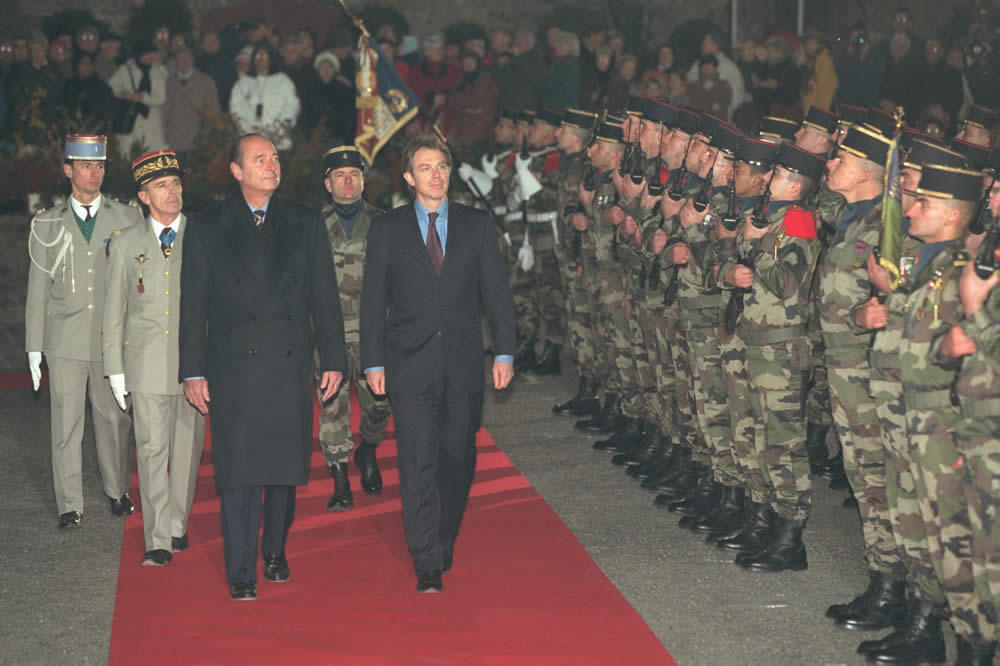
In December 1998, as Serbia’s president Slobodan Milošević was waging a brutal war in Kosovo, British Prime Minister Tony Blair and French President Jacques Chirac met in Saint-Malo and issued a joint declaration that would shape the European Union’s Common Security and Defence Policy. The declaration opened with a blunt statement: “The European Union needs to be in a position to play its full role on the international stage.” It went further, arguing that the Union must have the capacity for autonomous action, credible military forces, and the political readiness to use them in response to international crises.
The wars of the breakup of Yugoslavia were central to this realisation. They exposed two fundamental weaknesses of the EU at the time. First, its inability to speak with one voice, a persistent challenge, and secondly, its lack of capacity to act decisively. Without these two elements, EU’s influence in managing or resolving crises on its own continent diminished sharply. In the 1990s, the EU was often a bystander while other actors determined outcomes in its courtyard.
The war in Bosnia and Herzegovina, which culminated in the genocide of Srebrenica, ended only after direct US intervention and the Dayton Agreement. But Kosovo followed a different trajectory. The Rambouillet talks, in France, were meant to signal that EU was beginning to assume responsibility for conflicts on its territory. The lesson drawn from the wars was of the breakup of Yugoslavia were clear, that fragmentation within the EU creates strategic vulnerability, and appeasement does not work with authoritarian leaders willing to use force.
Yet, as we see today in retrospective, these lessons were gradually diluted. The EU’s return to inward-looking politics and narrow national interests came at a high cost, most visibly in Ukraine. EU misread Russian intentions for years. The scale of this failure perhaps is best illustrated when the head of Germany’s foreign intelligence service had to be evacuated from Kyiv by special forces as Russia launched its full-scale invasion, reportedly as they did not believe Russia was going to do that. Before February 2022, attention in the Western Balkans was already focused on the risk of renewed instability in Bosnia and Herzegovina.
Russia’s full scale invasion of Ukraine has created a new momentum for EU enlargement and saved the Western Balkans. What had been a stagnant process was suddenly reframed as a geopolitical necessity, with the European Council President Charles Michel urging the EU and aspirant countries to be “ready by 2030” for new members. From the Western Balkans, this window of opportunity has been used most effectively by Albania and Montenegro, which aim to conclude accession negotiations, at least technically, by 2026 and 2027, with membership hopes tied to the end of the decade.
But this momentum still remains fragile. While EU institutions speak openly about enlargement by 2030, it is far less clear whether all member states share the same commitment. In the Western Balkans, we have started to hear about “second-class membership”, with restricted voting rights, no commissioner, or transitional limitations that undermine the political logic of accession. Berlin is one of the strongest supporters of enlargement, but enthusiasm is uneven across other capitals.
The erosion of EU’s political centre is perhaps the culprit, and this not just an internal EU issue. As recent analysis has shown, mainstream parties increasingly rely on far-right support to govern. This weakens cohesion inside the EU and can send ambiguous signals to candidate countries. As a result, the idea of a second-class membership, is also about how to bypass, potential referendums or votes in parliaments in EU member states on acceptance of new members.
Russia stands to gain the most from a re-stalled or diluted enlargement process. It is already deeply embedded in Serbia’s security sector and in Republika Srpska in Bosnia and Herzegovina. What unites Moscow, Beijing and far-right movements in parts of EU is a shared interest in weakening European integration. In the Western Balkans, a fading EU perspective translates directly into greater Russian and Chinese influence and extreme nationalism with renewed ideas about redrawing borders.
The September 2023 Banjska attack in northern Kosovo illustrates these risks. Armed militants from Serbia attacked Kosovo police in what both the European Parliament and the European Commission later described as a terrorist act. The operation aimed to trigger a broader rebellion among Kosovo Serbs and create conditions similar to eastern Ukraine in 2014 — a localised crisis that could justify external intervention. Serbia subsequently amassed troops near the Kosovo border, and it took public pressure from the US National Security Council for President Aleksandar Vučić to step back. Later disclosures from US officials confirmed serious concerns about a possible military incursion.
Kosovo is formally under NATO protection, yet the Banjska episode exposed potential gaps in deterrence. Militants were confident enough to act, and Serbia was willing to test limits. Still today, the leader of the Banjska attack, despite having publicly accepted responsibility is a free citizen. Serbian security doctrine continues to frame Kosovo as occupied territory, and military options are not explicitly ruled out. Plans to strengthen special operations forces add to regional concern. Russia’s war in Ukraine has further radicalised this environment.
Hundreds of Serbs have travelled to Ukraine to fight on Russia’s side, driven by narratives that portray Moscow as a future guarantor of Serbian territorial ambitions, including Kosovo. Veterans of earlier Balkan wars are actively recruiting younger fighters through social media, glorifying violence and reinforcing nationalist myths. Russian intelligence operatives with experience from the Yugoslav wars have reportedly facilitated recruitment through front companies, while Russian-owned businesses in Serbia and Bosnia and Herzegovina provide economic incentives. These activities often benefit from political tolerance, if not direct cover, from local authorities.
Beyond fighters, the Western Balkans are increasingly used as a platform for Russian hybrid operations. In Moldova, authorities recently dismantled a network linked to Moscow that was involved in disinformation campaigns, vote-buying, and plans to organise mass unrest to derail European integration. Some operatives were reportedly trained in Serbia, highlighting how regional instability can be leveraged against both the EU and its candidates.
Russia’s media footprint in the Western Balkans reinforces these dynamics. Sputnik Srbija and RT Balkan operate openly from Serbia, producing Serbian-language content that circulates widely across the region. Research shows systematic promotion of narratives portraying the Balkans as inherently unstable and as a battleground between East and West. The EU is framed as hypocritical and unreliable, NATO as aggressive and divided, and enlargement as a broken promise. The aim is not persuasion alone, but erosion of trust and normalisation of instability.
This sustained information environment undermines democratic reform and weakens public support for Euro-Atlantic integration. It also amplifies the role of Serbia as a regional spoiler. While recent student protests against authoritarian governance in Serbia suggest potential for democratic renewal, their messages on Kosovo remain mixed. Large protests are never ideologically uniform, and democratization a full alignment of Sebria with EU’s Common Foreign and Security Policy is without a doubt in the interest of the entire region and should be supported. Under President Vucic however, Serbia continues to balance between Brussels, Beijing and Moscow while benefiting from EU concessions, and will limit pressure to make a choice out of the juncture it finds itself.
The Western Balkans have changed since the wars of the 1990s, yet the EU’s 2003 commitment at Thessaloniki to integrate the region has gradually lost credibility. Complacency created space for ethno-nationalist politics to return. North Macedonia is an example. After changing the name of the country to join NATO, it saw its EU path repeatedly blocked, weakening pro-compromise political forces and reviving identity-based confrontation. Today, the country is also moving towards ethno-politics.
Enlargement of the EU has always been a political process, not a technocratic one. The EU is stronger today because it made difficult political decisions in past enlargement rounds. The Western Balkans are asking for predictable objectives, an end to shifting benchmarks, and leadership willing to confront destabilising actors, without ambiguity and with determination.
Nowhere is this more evident than in the Kosovo–Serbia normalisation dialogue — the only process where the EU institutions hold a clear mandate to lead mediation. Since 2011, progress has been real but undermined by the EU’s inability to speak with one voice, especially in setting clear objectives of the process (e.g. mutual recognition), which is clearly spelled out by the US. If the EU cannot deliver here, its credibility will suffer heavily. For actors like China and Russia, failure in Kosovo–Serbia relations would set a useful precedent
For the Western Balkans, stability and Euro-Atlantic integration are inseparable.