

Conversation with Ariane Chemin
The great journey of Volodymyr Zelensky
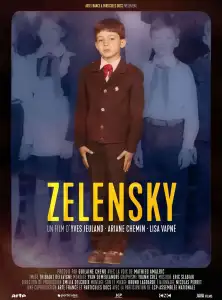
It’s the story of Volodia – a boy born in the late 1970s in Kryvyi Rih, a mining town in the former Soviet Union – who rose to fame as a TV star in Russia and later Ukraine, before becoming president of his country and the embodiment of its resistance against Vladimir Putin’s invasion. We thought we knew everything about Volodymyr Zelensky, the Ukrainian leader who, since February 2022, has taken on the role of the wartime commander, defending not just Ukraine, but all of Europe. Yet it’s a different man that veteran Le Monde journalist Ariane Chemin brings to life in a new documentary directed with filmmaker Yves Jeuland and Soviet historian Lisa Vapné. Simply titled Zelensky, the film is co-produced by Franco-German broadcaster Arte and was screened at the most recent Cannes Film Festival. The documentary takes us back to a pre-presidential Zelensky, with rare footage of him competing in rock contests, performing stand-up, and starring in some of Ukraine’s most popular TV shows. It includes an exclusive interview, and features those who knew him before the limelight: neighbors, childhood friends, and early collaborators – some of whom remain by his side in the presidential palace today. “The film started with a conversation with Arte,” Chemin told Il Foglio. “We were discussing a series of pieces I had written in 2023 for Le Monde, Les cinq vies de Volodymyr Zelensky. I wanted to immerse myself in his story — we all knew the man in military green, always on screen since February 24, 2022, but we knew very little about his private life, his childhood, his teenage years, or his life before politics.” Her aim wasn’t to make a geopolitical documentary, but something more intimate.
“Zelensky, as few people know, has a deep admiration for Charlie Chaplin”, she said. “At Cannes in 2022, he even cited The Great Dictator in reference to Putin. And Yves Jeuland had just made a documentary on Chaplin – Charlie Chaplin: The Genius of Liberty – so he felt like the perfect partner for this project”. Chemin met Zelensky on the final day of her third trip to Ukraine, after nearly giving up hope of interviewing him. “Zelensky is far too smart – and media-savvy – not to understand the risks of opening up in the middle of a war, while Ukrainians are dying at the front,” she said. “What’s the point of reminiscing about life in early 2000s Moscow, or his comedy collective Kvartal 95, when the country is in mourning? But I think he realized that by telling his story, we would be telling Ukraine’s story – and the story of a country and the generation fighting to shape its future.” The interview became a momentary pause in the chaos, “a suspended time”, she says, “before returning to the frontlines”. “What struck me most was Zelensky’s openness. As seen in the film, he hands his phone to his bodyguard at the start of the interview and doesn’t retrieve it until it’s over – after 90 uninterrupted minutes of questions and answers. Even when we showed him painful archival footage, he never asked us to skip anything. He never said, ‘No, I won’t comment on that.’ He was fully committed to talking about Ukraine’s past”.
But how has Ukraine changed under his presidency? “Zelensky was elected in 2019 with a staggering 73 percent of the vote – even more than his fictional alter ego, Vasyl Holoborodko, the high school teacher he played on Servant of the People”, Chemin notes. “A landslide, almost Soviet-style, you might say with a grin. But the early years were rocky, and his popularity dropped. Then came the invasion. And since then, even Ukrainians who didn’t vote for him – especially the elite – have rallied around him. Whenever someone tries to undermine him, like Donald Trump did during that infamous Oval Office meeting, Ukrainians close ranks”.
The war has changed Ukraine not just politically, but geographically and demographically. “It’s the east that suffers most”, says Chemin. “Kharkiv, Kramatorsk, Kryvyi Rih, Dnipro – these cities are under relentless bombardment. They’re so close to the border that missiles and drones often strike before the air raid sirens can even go off. The landscape has changed, and so has the population. So many have been lost”. “It’s a hybrid war”, she adds. “It’s trench warfare that looks straight out of World War I – like the Battle of the Somme. But it’s also a drone war. A war of real-time social media. That’s the bitter paradox of this war: both ancient and unnervingly modern”.
And how has the perception of Europe changed in Ukraine? “As the documentary shows, Europe appears in Zelensky’s comedy sketches as early as 2014, during the Maidan revolution. That’s when Europe truly became real for Ukrainians – when they said: ‘No, we don’t want to face east toward Russia. We want to face west.’ But Europe hasn’t always been there for Ukraine, especially during the first year of the war”. Regarding France, Chemin points out that it took the exposure of Russian massacres for President Emmanuel Macron to fully grasp the nature of the Kremlin’s leadership. Europe’s real awakening, she says, came only in 2025 – sparked by Donald Trump’s return to the White House and his failed attempt to publicly humiliate Zelensky. That led to the formation of the “coalition of the willing,” spearheaded by Macron and British Prime Minister Keir Starmer. Their train ride to Kyiv in solidarity with Zelensky became a turning point, a symbol of Europe’s reckoning. Chemin closes with a haunting image. “I remember a photo from the early days of the war in 2022”, she says. “It showed a keychain with the EU flag, lying just inches from the outstretched hand of a woman in Irpin – she had been trying to flee her home and was killed by a Russian missile. In that heartbreaking image – in that tiny keychain – you can see what Europe means to Ukrainians: not a place on a map, but a promise: of dignity, freedom, and a future worth fleeing toward”.