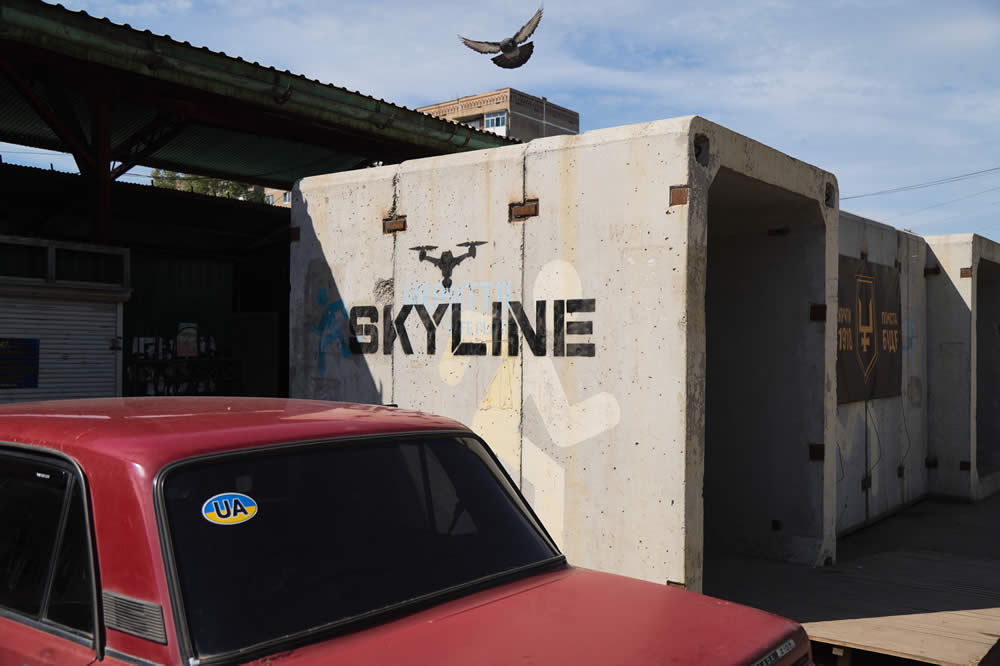
“Warning. Three motorbikes are flying towards Dnipro.” This is a message from the Telegram channel of the local news service in the city of Dnipro, in south-eastern Ukraine. Anyone unfamiliar with the reality of this country might think that two-wheeled vehicles are racing towards the city at high speed. In reality, it is a warning of an attack by Shahed drones.
Ever since 2022, when Russia began deploying Iranian drones on a massive scale against Ukraine, Ukrainians have nicknamed them ‘scooters’, because the sound these drones make in flight closely resembles that of a scooter passing on the road. Since 2022, the term has become synonymous with Shahed. For a time, people also called them ‘balalaikas’, due to the Shahed’s resemblance to the Russian musical instrument. But after a few years, the term ‘balalaika’ disappeared from Ukrainian conversation in its reference to drones. The ‘scooters’, however, have stuck and remained.
The long-range Ukrainian drones, which fly to bomb military and energy targets in Russia, are affectionately called “little birds”. “The little birds have penetrated deep into the territory of the Russian Federation: images of powerful attacks on Russian targets”: this is the title of an article published on 6 December 2025 on the Ukrainian website Glavred. “Any new experience influences language,” explains Evgenia Kuznetsova, a well-known Ukrainian writer: “For example, when you become a parent, you start using different constructions, simplifying your language for the child.” When, however, a disruption as severe as war occurs, it is a huge trauma both for those who speak the language and for the language itself. People search for words and expressions to name what they see around them. “If we can give a name to reality, that reality is easier to accept,” says the writer and translator Ostap Ukrainets.
Over the last four years, many neologisms have appeared in the Ukrainian language. Most often, they are linked precisely to the war and the battlefield. But given that the Ukrainian army comprises a huge number of people – around 900,000 – and that every soldier has family and friends, the new words are often used elsewhere too, not just at the front. English terms are also finding their way into the Ukrainian language, quickly becoming understandable to everyone and requiring no translation. A common example is ‘kill zone’: this is the name given to the area where there is no clear line of contact between the opposing sides and which is entirely exposed to drones. Ostap Ukrainets does not know who first introduced this term in the context of the Russian war against Ukraine, but he speculates that many military terms are borrowed from American military doctrines and even from pop culture: from first-person shooter video games and films.
There are also expressions that have entered the Ukrainian language from the Russian media sphere. For example: “Kyiv in three days”. On Russian propaganda television channels in February 2022, even before the start of the large-scale invasion, presenters and experts were competing to make predictions, claiming that Kyiv would fall within a few days. “In the Russian formulation, it was effectively a literal translation of the idea of the Blitzkrieg,” says Ukrainets. After the Russian army failed to take Kyiv in three days, Ukrainians began using this phrase to illustrate the unattainability and absurdity of the enemy’s grand ambitions. Today, “Kyiv in three days” is used in Ukraine ironically and illustrates Russian incompetence in general.
Evgenia Kuznetsova highlights the linguistic changes that have also taken place in Russia, where a process of euphemisation is underway: Russians resort to clichés and speak cautiously, avoiding calling things by their proper names. Even the large-scale war in Russia continues to be called a ‘special military operation’. Furthermore, Kuznetsova adds, dictatorial regimes are always rife with emphatic and solemn expressions, such as: ‘he fell for the motherland’, ‘he will remain in our hearts forever’. In Ukraine, by contrast, language is becoming increasingly direct. All taboos surrounding death have fallen. Before the war, if a loved one died, people would often say: “he is no longer with us”, “he is already in another world”. Over the last four years, there have been so many deaths that people no longer speak of them in figurative terms, but directly: “he was killed by a drone”, “he died in the bombing”, “he died from his injuries”.
At the same time, new words have appeared in the Ukrainian language to refer to the enemy. ‘Orcs’ is used as a derogatory term for Russian soldiers, by analogy with the humanoid monsters in John Ronald Reuel Tolkien’s fantasy novel The Lord of the Rings. Or ‘Ruscists’, meaning people who support ‘Ruscism’ (as the ideology and criminal practices of the current Russian government are called in Ukraine). There are also obscene expressions directed at the occupiers. Mocking the enemy is one way of not being so afraid to face them, explains Kuznetsova: “Because it is one thing to say that poorly trained orcs are descending on Ukraine, and quite another to say that a nuclear state is waging war against us.”
The foul language is spreading, becoming more imaginative, with new memes and jokes appearing. “The ability to laugh at a threat gives us symbolic power over it,” says Ostap Ukrainets. Black humour, in his view, is a defence mechanism and allows Ukrainians to deal psychologically with very heavy issues in a much lighter way. It is widely used by soldiers, combat medics and civilians.
War involves a great deal of negative experiences, and language seeks new ways to express the negative emotions felt by the population. This is why, among other things, new words are emerging to describe the problems linked to the internal workings of Ukrainian society. “Busyfikatsiya” is the term used on social media for the forced mobilisation of men on the streets, after which they are transported to recruitment offices in minibuses (busy in Ukrainian). And “ukhilyant”, meaning a draft dodger, is the colloquial term for those who evade military service. There are also foreign expressions used predominantly abroad to discuss this war and to describe the reaction of Western partners to each new bombardment: peace deal, deeply concerned. But in Ukraine, these are often viewed with irony, because diplomacy is not bringing the war any closer to an end.
Even the word ‘resilience’ provokes varied reactions, sometimes quite critical, in Ukraine, although it is repeated very often by foreign media: it is, however, also used in official Ukrainian communications; the government has called the assistance centres where people can recharge their phones and shelter from the cold ‘resilience points’.
The longer the war lasts, the more new words will appear, experts are certain. “We need to learn to name new things in order to make them our own, master them and feel more at ease with them,” says Ukrainets.