Ursula von der Leyen’s State of the Union speech
It’s the traditional appointment that marks the return after the European Union’s summer holidays. On Wednesday, September 10, in Strasbourg, Ursula von der Leyen will deliver the State of the Union speech before the European Parliament. But for the Commission President, this year’s speech promises to be the most difficult State of the Union address yet. After a first mandate marked by crises (Covid, Russian war in Ukraine, energy prices) that von der Leyen managed effectively, the choices of her second mandate are becoming increasingly contested and controversial. The “Ursula majority” formed by the European People’s Party, Socialists & Democrats, and Renew liberals is becoming increasingly unstable due to Ursula von der Leyen and her Commission’s shift to the right. The backtracking on the Green Deal initiated with the “Omnibus” simplification packages and the hardening of migration policy with approval for the Rwanda model have pushed socialists and liberals to make the State of the Union speech the key moment for continuing to support von der Leyen. If the Commission President doesn’t shift the balance of her policies toward the center, the “Ursula majority” could break apart.
The summer break hasn’t helped Ursula von der Leyen. The proposal for a multiannual financial framework – the European Union’s 2028-34 budget – that she presented on July 16 has been contested by EPP, socialists, liberals, greens, and sovereignists. Her choice not to consult the European Parliament and other institutions beforehand on cuts to the Common Agricultural Policy and Cohesion Policy, as well as keeping her own commissioners in the dark, has fueled discontent among political families. The agreement reached by von der Leyen on July 28 in Scotland with Donald Trump on tariffs has been criticized from multiple quarters, including by EPP members, who denounce a submission to the interests of the MAGA president. Her defense in the name of “stability” and “predictability” for European economic actors is unconvincing. The fact that she hasn’t responded to Trump’s new tariff threats against countries that have regulation and taxes for the digital sector has further irritated parliamentarians in her majority. More and more deputies are impatient with the delay in which the Commission is implementing Mario Draghi’s recommendations.
In the State of the Union speech, von der Leyen will boast of her most recent successes. The Safe lending instrument of 150 billion euros for the rearmament plan has already exhausted its resources. The community executive is negotiating several trade agreements to diversify relations after American tariffs. The Commission President will invite deputies to get to work for Europe’s good, recalling the existential threat represented by Russia and the dangers represented by the Trump presidency. Will the emergency be enough to calm the air of revolt against von der Leyen that has been brewing for several months?
*****
António Costa’s tour of capitals
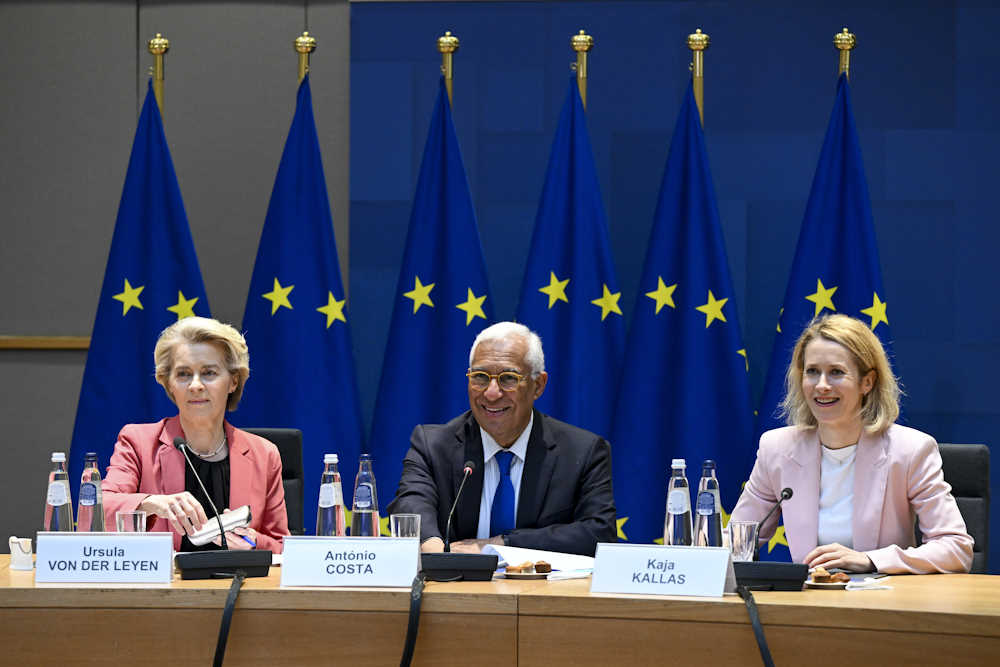
Since early September, the President of the European Council, António Costa, has been engaged in a “tour of capitals” to consult heads of state and government and seek “consensus” among the twenty-seven leaders on autumn and winter challenges. “We have a habit of saying that the world is changing. We can say that the world has changed,” explains a European Council official: “Perhaps we don’t know exactly how it will be and when it will stabilize again, but we are in a world where coercion, military force, economic pressure are much more present.” Costa intends to “hear from leaders how we will continue to manage” this new world. At the top of the agenda is Ukraine. Dependent on Donald Trump’s moods, the EU has many tasks to accomplish to offer security guarantees in case of a peace agreement with Russia. Costa hopes to convince Viktor Orbán to remove his veto on the next steps of Kyiv’s accession negotiations, perhaps thanks to pressure from the American president. The second priority is Trump himself. The European Council President is aware that the tariff agreement concluded by von der Leyen “is not perfect,” but also believes that the outcome is “rational and intelligent” in light of the EU’s “vulnerabilities,” because it allowed keeping Trump engaged in Europe and Ukraine’s security. The third urgency is Gaza, the only dossier on which Costa has made his voice heard in dissent from von der Leyen. The European Council President will try to convince leaders to take a tougher approach toward Israel.
*****
Vote of Confidence in France, elections in Moldova and Czech Republic
Over the next thirty days, national politics could have strong repercussions on the European Union. On September 8 in France, the National Assembly will vote confidence in François Bayrou’s government, after the centrist Prime Minister decided to stake his future to try to save a budget maneuver worth over 40 billion. Without a majority, with all opposition parties having announced their vote against, Bayrou seems destined to fall, opening a new period of instability in France. Will Emmanuel Macron, primarily responsible for the crisis with his choice to call snap elections in June 2024, appoint a new Prime Minister after the failure of Michel Barnier and Bayrou? Or will he proceed to a new dissolution and snap elections, opening the doors of power to the far-right Rassemblement National? The President has said he will not resign, but could find himself facing an impeachment motion. With agitated markets, the EU remains holding its breath.
Two legislative elections to be held in the coming weeks frighten Brussels. Moldova, a candidate country for accession that Vladimir Putin wants to bring back under his control, goes to vote on September 28. Pro-European President Maia Sandu risks losing her majority, compromising the reform efforts necessary to advance toward the EU. On August 27, Emmanuel Macron, Friedrich Merz, and Donald Tusk made an unprecedented joint visit to Chisinau to support Maia Sandu and the pro-European camp. But Russia is investing huge resources to influence the outcome of the Moldovan elections. The Czech Republic goes to the polls on October 3 and 4, when former Premier Andrej Babiš could return to power. The outgoing government of conservative Premier Petr Fiala has been among the strongest supporters of Ukraine since the beginning of Russia’s war of aggression. A former liberal converted to populism, in case of success Babiš would join Hungarian Viktor Orbán and Slovak Robert Fico in the group of pro-Russian leaders sitting in the European Council.