We are often amazed by the strength of the Ukrainian people, who have been able to resist, on a large scale, the largest, most painful, and bloodiest military invasion on the European continent since the end of World War II for more than three years. One of the sources of this difficult opposition to the enemy, for Ukrainians, remains laughter.
Deeply rooted in Ukrainian cultural history, laughter becomes a tool of strength, unity, and defeat of fear. Just think of the first text of modern Ukrainian literature, Eneide, written by Ivan Kotlyarevsky in 1798: a burlesque reworking of Virgil’s Aeneid with Ukrainian Cossacks as the protagonists. Or the poem Son (1844) by the great Ukrainian poet Taras Shevchenko, a satirical picture of the rotten Russian empire, for which Shevchenko was sentenced to military service in the far reaches of the empire for 25 years – a sentence that at the time was equivalent to a life sentence.
Without going too far back in time, consider the current Ukrainian president Volodymyr Zelensky, a former comedian, who with his jokes in the past – but sometimes even today – helps Ukrainians get through dark times, and Ukrainian stand-up comedy, which, with the large-scale invasion, has exploded with a power never seen before.
At the beginning of the great war in 2022, reflecting the surrounding reality in the form of jokes had become a kind of therapy, both for those who wrote the jokes and for the audience for whom they were intended.
The great advantage of stand-up comedy is its speed of reaction: what happened in the morning became a fresh joke in the evening, helping to relieve tension and play down the heavy reality of Ukraine.
Going to a stand-up evening, often organized in air-raid shelters, is like group therapy, which foreign comedians such as David Letterman, Doug Stanhope, and Stephen Fry have also willingly participated in.
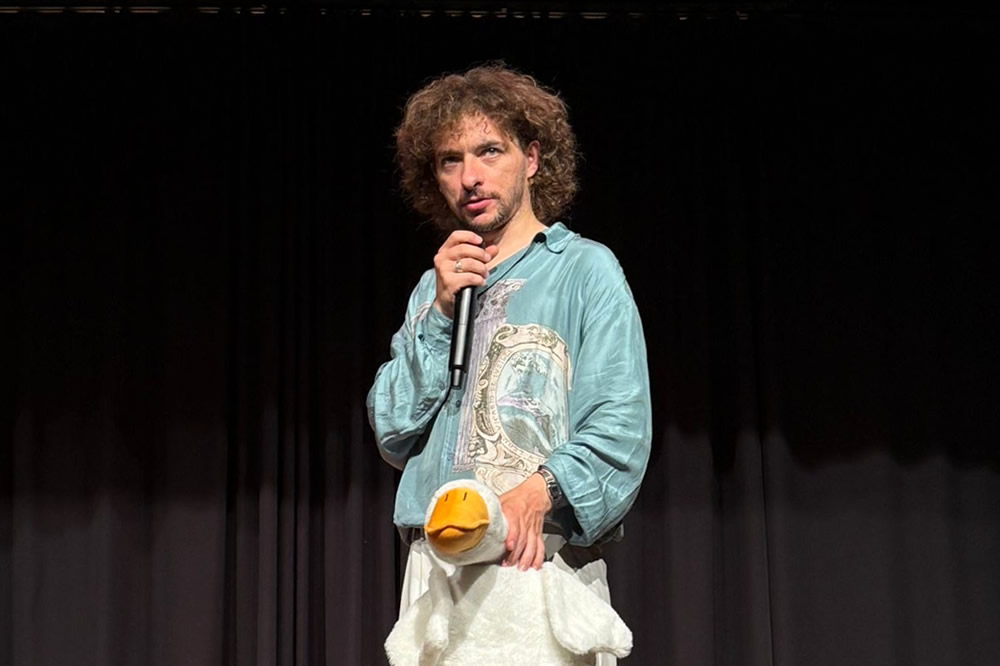
“Humor in Ukrainian history served to strengthen resistance. Ukrainian humor always mocked someone stronger – the enemy, the empire, the party, one’s own flaws – but never someone weaker or smaller. We don’t laugh to humiliate. We laugh to make ourselves stronger”, says Vasyl Baydak, a Ukrainian comedian touring European cities and beyond, including Milan.
Twenty-seven cities in thirty days, from Krakow to Tel Aviv, via Milan and Reykjavík. The aim of Vasyl Baydak’s tour is not only to present a new program, but also to raise funds to support the resistance of the Ukrainian army. The moral resistance of laughter merges with the concrete resistance of helping the young people who are holding the front lines open in various parts of the country.
Today in Ukraine, every artist, whether singer, actor, or comedian, has become a volunteer, seeking to put not only their art but also their popularity at the service of their people, helping to raise funds and respond to requests coming from all over Ukraine.
Baydak devoted himself to volunteering in the early days of the large-scale invasion. Today, he is one of the most followed and trusted volunteers by the public, with some of the most successful fundraising campaigns. “Fundraising has become a mass phenomenon in Ukraine”, says Vasyl. “Ukrainians have managed to adapt tools that are not designed to raise money, such as Instagram, to their needs”.
In fact, the campaigns are not spread on traditional crowdfunding platforms, but on social media, such as Instagram, an app designed for images and video content.
Ukrainian artists have thus begun to create content that draws attention to the needs of the military and civilians; in the case of comedians, this content is entertaining.
Vasyl himself dressed up as old Ukrainian artists, re-singing their songs with lyrics encouraging people to donate – or “he would go and drown himself in the deep river”. He became the fifth member of the group BADstreet Boys alongside three other comedians: Oleh Svishch, Anton Tymoshenko, and Slava Kedr, and professional singer Volodymyr Dantes. The parody band reinterpreted songs by the Backstreet Boys, Britney Spears, and Wham!, going viral and managing to raise millions of hryvnia in just a few hours.
In a fundraising campaign, Vasyl auctioned off his thick curly hair, opening two different accounts: one in favor of the cut, and one against. With 1.8 million hryvnia – equivalent to approximately $37,500 – those who wanted to see Vasyl with a shaved head won. And so that haircut, he says laughing, “became the most expensive haircut in human history”. It took months for his hair to grow back.
Baydak was the first comedian to organize a tour of European cities with the aim of raising funds among Ukrainians living abroad. “Today, going on tour is easier: there are local organizers who help, there are other comedians who have explored new routes and new cities, not only in Europe”, says Vasyl before his performance in Milan, the first Italian city to host a Ukrainian stand-up comedy show. “I travel with my wife Lisa, who takes care of the practical side of the tour. I don’t have any special requirements, except that the venue hosting us must not collaborate with Russian artists”.
An hour and a half of Vasyl’s show becomes a group therapy session, during which Ukrainians feel a little at home, without having to translate their emotions into the language of the country where they live. The only sound you hear is laughter, not bombs.
Every Baydak show ends with a charity auction. In Milan, he brought tennis balls signed by Ukrainian tennis player Elina Svitolina, a national team jersey autographed by Ukrainian soccer players, key rings made from a downed Russian plane, and pieces of missiles turned into bracelets. Vasyl can even sell a packet of instant coffee, a candy, or the wrapper of a Ukrainian candy, because it doesn’t matter what you win in the end, what matters is your participation in the resistance, which can save lives.
Baydak thanks everyone for this first Italian experience, promising to return to Milan and close the next show with applause and maybe an encore, and not with a charity – which would mean that the war is over. From the audience, someone promises to return to Ukraine with him after such a show, and he replies that he would be ready to drive the bus full of Ukrainians returning home. And everyone, after chasing away their fear with laughter, feels stronger again.