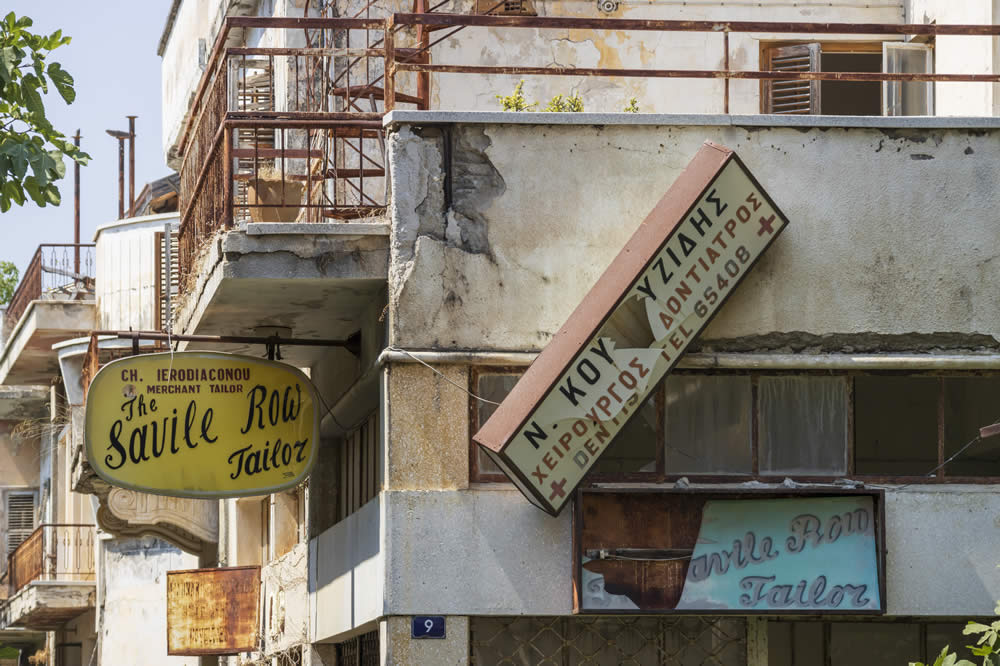
“Disco,” reads the faded banner above a doorway in Varosha, the abandoned southern district of Famagusta. Once a glamorous Mediterranean hotspot that drew Brigitte Bardot and Elizabeth Taylor, Varosha today is a concrete graveyard.
When war divided the island in 1974 and Turkish forces took control of Famagusta, Greek Cypriot residents fled. The district was sealed off. The conflict began after a Greek-backed coup sought to unite the formerly British-ruled island with Athens, prompting a Turkish invasion that split Cyprus in two: the internationally recognized Republic of Cyprus in the south and the Turkish-controlled north, recognized only by Ankara.
Today, Varosha, frozen in time, sits at the center of a half-century-long deadlock over Cyprus’s fate Its once-grand Art Deco hotels from the 1950s and ’60s now crumble under vines as trees grow through their roofs.
Backed by Ankara, Turkish Cypriots have grown more willing to upend the stalemate, reopening of Varosha is part of that effort meant to signal that the status quo will no longer be accepted.
“I call this a comfortable conflict,” said Ahmet Sözen, chair of the political science department at Eastern Mediterranean University in Famagusta. “It’s not urgent. Nobody’s killing one another.”
To reach Varosha, whose name means “suburb” in Turkish, you cross a checkpoint dividing the Republic of Cyprus from the Turkish-controlled north. The road is lined with barbed wire and “Forbidden Zone” signs, flanked by rows of abandoned homes swallowed by weeds. Nearby sits one of the island’s two Turkish military bases, with roughly 40,000 Turkish soldiers stationed across the north.
“Varosha carried half of Cyprus’s tourism capacity. A lot of foreign money and property was there,” Sözen said. “Turkey kept Varosha as a trump card in negotiations… but then the Cyprus problem was left unresolved and it came to what it is today.”
After 46 years of closure under Turkish military control, the city partially reopened to visitors in October 2020. The move, backed by Ankara and led by Turkish Cypriot authorities, was condemned by the Republic of Cyprus, the EU and the United Nations as a violation of Security Council resolutions calling for Varosha to be placed under U.N. administration and returned to its rightful inhabitants.
“Turkish logic was: let’s create some discomfort to nudge the Greek Cypriots out of their comfort zone,” said Sertac Sonan, professor at the Cyprus International University.
At a café in the U.N. controlled Ledra Palace crossing in Nicosia, Turkish Cypriot analyst Mete Hatay called the reopening a darkly ironic gesture. “This is the most stupid museum you could see,” he said. “Usually, museums expose the perpetrators. But here, the perpetrators are exposing themselves. Why would you do it? Stupidity.”
On newly paved roads, U.N. jeep passes crumbling hotels and ivy coverred walls. Only a narrow section of the city is open, surrounded by concrete ruins. It feels like the movie set of a war that never ended, watched over by peacekeepers with nothing left to protect.
“This is one of the oldest peacekeeping missions, sixty years. And for what? Our Ministry of Foreign Affairs calls U.N. peacekeepers beach keepers,” Sonan said.
Today, the reopened zone, only 2% of the whole district, empty and silent, suspended between paradise and purgatory, has become something between a dark tourist stop and a political message.
“Varosha has a psychological effect; nobody must leave for you to go back”, said Greek Cypriot analyst Sotiris Themistokleous of the Cyprus-based Center for Social Innovation. “Turkey is saying that if we don’t get a solution, we’ll bring people there to live, and it’s over.”
For now, it’s just a threat but one that could become reality. On Varosha’s once-exclusive beach, Turkish tourists now swim and sunbathe in waters untouched for decades, beneath an apocalyptic skyline of empty high-rises.
Turkish Cypriot authorities claim more than 2 million people have visited since reopening. Visitors can rent bikes or scooters to pass by what used to be a Toyota dealership, a tailor’s atelier, a bookstore. The windows are shattered, balconies decaying, façades peeling under the sun.
Turkish Cypriot authorities, with Ankara’s support, continue to reject a federal settlement in favor of a two-state arrangement that would recognize the north as a separate sovereign entity, Varosha included. The position has hardened in recent years, reflecting Turkey’s growing influence and the absence of meaningful negotiations.
The north operates the Immovable Property Commission, which handles restitution and compensation for displaced Greek Cypriot owners. Authorities say it has received over 8,000 applications, handled 2000 and paid about $670 million, including some 600 claims tied to Varosha. They argue the process aligns with international law, while officials in the south and abroad dismiss it as a move that undermines peace efforts.
At the Turkish Cypriot foreign ministry in north Nicosia, Aysan Mullahasan, director for political affairs, described the reopening as pragmatic. “Varosha was always a bargaining chip,” she said. “But there are no more negotiations, so we thought, what can we do with it?” She pointed to the property commission as a solution. But compensating Greek Cypriot owners is no small task, with some estimates €20 billion – a sum that would be financially and politically difficult to shoulder, even for Turkey. “Gradually, we expect the area to develop and contribute to our economy and to the Greek Cypriots as well. They have a chance to come and live here,” she said.
For many displaced Greek Cypriots, such offers ring hollow. Among them is Alexandros Lordos, who fled when Turkish troops entered Famagusta. He later brought his case to the European Court of Human Rights, which ordered Turkey to pay €20 million in damages, a ruling Ankara has ignored.
Decades later, in 2022, Lordos returned to what was left of his childhood home, slipping past restrictions with his wife and children. “The desire to go in was stronger than the fear,” he said. Inside, the house was in ruins with graffiti covering the walls. “Only books were left on the floor, and only Greek books, because even the English ones were taken and sold on the black market.” As he stepped outside, a Turkish Cypriot policeman stopped him. “He asked, ‘Where are you from?’ so he could write it in his report,” Lordos recalled. “I said, ‘From here,’ and pointed to the house. He wanted me to say, ‘from the South.’ Then he asked, ‘What’s your name?’ and my wife pointed at the building and said, ‘You see his name? It’s on the wall – Lordos.’”
Varosha holds deep emotional weight for many displaced families, and political weight for officials in Nicosia who insist that any settlement must include its return. In his office in central Nicosia, near the military fortifications that still mark the city’s division, Greek Cypriot negotiator Menelaos Menelaou called Varosha a “primary incentive” for reunification. Asked whether the north’s actions were meant to pressure his government, he paused before replying, “Maybe it’s to give a final blow to the prospect of a solution, because they know how detrimental it would be if they rebuild.”
The war of words, legal battles and diplomatic maneuvering continue. Yet some diplomats see glimmers of restraint. A senior envoy involved in Cyprus talks said that despite the rhetoric, the north has avoided irreversible steps. “Since 2020, they’ve said, ‘We’re going to develop Varosha, build hotels, open it up.’ But they’ve done absolutely nothing,” he said. “They paved a few roads, put up some signs, umbrellas on the beach, hot dog stands, nothing that can’t be undone.”
In the north, the October election of pro-solution Tufan Erhürman, who replaced his hardline predecessor may signal a new openness to talks, a cautious shift after years of stalemate. Yet, optimism is in short supply.
“No one is happy with the status quo,” Lordos told me. “But most people lost hope.”
The earlier version of this article misattributed quote from Sertac Sonan to Giorgios Kentas.