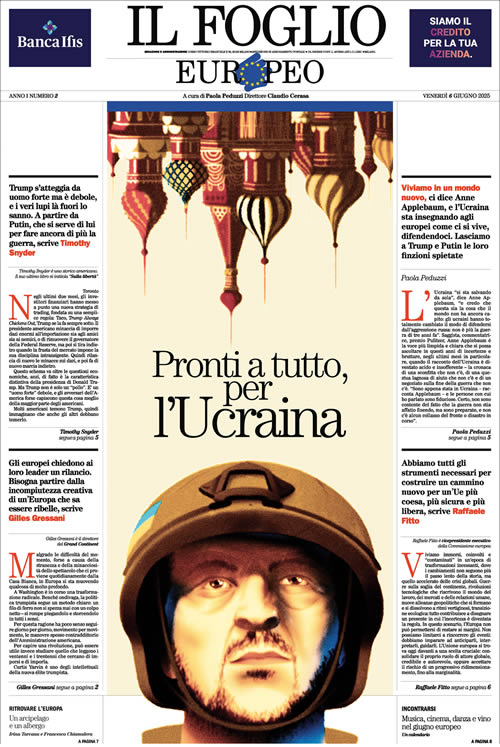
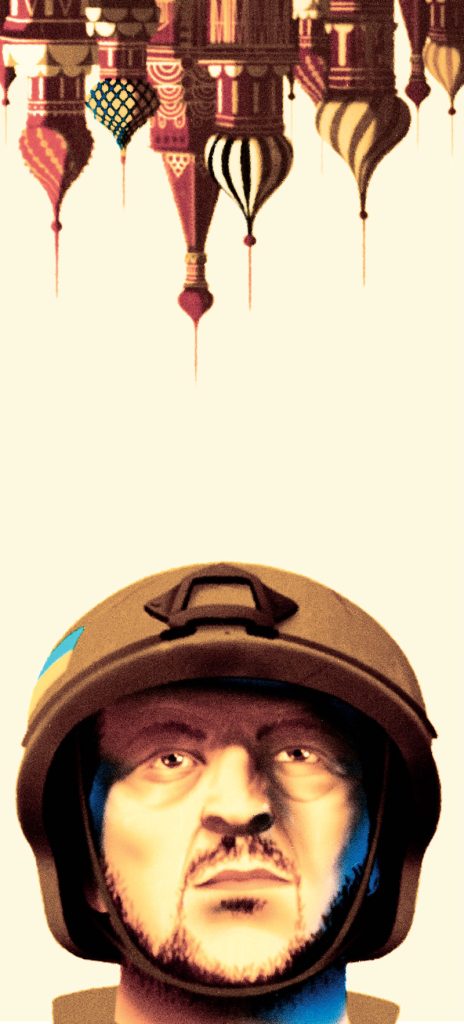
 “Ukraine is saving itself,” says Anne Applebaum, “and I think that’s what the world hasn’t fully grasped yet: the Ukrainians have completely transformed their approach to defending against Russian aggression—this isn’t the same war as three years ago.” Essayist, commentator, and Pulitzer Prize winner Anne Applebaum stands out as one of the clearest and most insightful voices amid these years of uncertainty and turmoil. Especially in recent months, as the narrative around Ukraine has turned sour and impatient—portraying a defeat that hasn’t occurred, a plaintive plea for help that doesn’t exist, and negotiations to end the war that aren’t happening. “I’ve just returned from Ukraine,” Applebaum shares, “and the people I spoke with are confident. Of course, they’re not happy that the war shows no signs of ending, but they’re prepared, and there’s no collapse of the front or ongoing disaster.”
Certainly, “it’s frustrating for Ukrainians to see Americans and Europeans buying into conspiracy theories about them and their president, Volodymyr Zelensky, and to witness the initial solidarity fracturing. But they won’t stop. For them, this is an existential war: they can’t afford to lose. If they cease defending themselves, they know what awaits. The Russians occupy their country; they are killed or subjugated. This has already happened; it’s happening in eastern Ukraine, where independent mayors have been kidnapped and disappeared. The same fate has befallen teachers, journalists, and artists—they’ve been killed or vanished. Twenty thousand Ukrainian children have been deported to Russia and given to new parents with new identities. This is the destiny awaiting all Ukrainians if they stop fighting. That’s why they won’t stop.”
In recent days, Ukrainians have demonstrated to the world – especially to the Russians – how much they’ve changed: the extraordinary Operation Spiderweb on Russian territory has decimated Russia’s available bombers and shattered Vladimir Putin’s propaganda. “The Russians believe they will win this war by continuing to attack,” says Applebaum. “That’s why they have no intention of stopping or negotiating. It’s important not to get bogged down in the idea of negotiations – it’s a myth, a fiction. The Russians have never said, not even once, that they want to end this war. I’d like to repeat that endlessly: Putin has never said he wants to end the war. Never. He has never accepted the possibility that Ukraine could continue to exist. He has never taken a single step in that direction, and he has never stopped making sure that Ukrainians are aware of this – and indeed, if you ask them, they know that the war is far from over.”
That’s why they’ve changed their way of fighting – not just now; they started some time ago. Operation Spiderweb was organized over a year and a half, and the incursion into Russia’s Kursk region last August was part of a new strategy, preceding Donald Trump’s re-election and the upheaval of the world as we’ve known it. “Today, the war is fought with drones,” says Applebaum. “And it’s very sophisticated. Ukrainians produced two million drones last year; they’ll produce four million this year, and they’ve reinvented how to use them. It’s a complex topic, but essentially, not all drones are the same: some monitor the front line, others strike designated targets, some can deploy mines, and others serve different purposes. So drones are used to spy on Russian activities and to strike them, making everything on the front line visible. Movement is no longer possible without being seen – everything is visible: troop movements, tank movements, and so on. But the Russians continue to use their initial tactic: sending thousands of soldiers to the front, because they have no qualms about losing thousands upon thousands of lives. It’s a deliberate choice: the Russians sacrifice their men so that, in the meantime, Ukrainians are forced to use their drones and ammunition. But it’s a losing strategy: today, I received a statistic indicating that Russia has lost four thousand tanks, because even when these vehicles became visible – they’re large, easily seen –the Russians didn’t stop using them, and now they’re running out. Throwing men and tanks to the front isn’t something you can do indefinitely.” So when Putin says he’ll win this war and makes no mention of any kind of truce, he’s not actually relying on military superiority: “The Russians are counting on Donald Trump giving them some concessions and on the Europeans resigning themselves, reducing their support for Ukraine.”
In these 1,200 days of war, we’ve forgotten many things, especially what we celebrated constantly at the beginning: the Ukrainian character. We were all surprised in February 2024 by the courage and defense strategy of the Ukrainians: we admitted to ourselves with guilt that we hadn’t understood Putin – we hadn’t wanted to understand him, even though he couldn’t have been clearer in his intent to erase the Ukrainian people – but in truth, we hadn’t understood Ukraine. Even today, we continue to see it through a “Russian filter,” the distortion that led many leaders, back in 2014 during the first Russian invasion of Ukraine, to claim that ultimately it was the Ukrainians themselves who didn’t want to sever ties with Russia. During Euromaidan, Ukrainians were killed by regime snipers shooting at chest height, while waving European flags that we had tucked away in drawers, because saying “Europe” would lose you elections, and we insisted on believing in a phantom pan-Russian brotherhood, which hadn’t existed for a long time and was being kept artificially alive by propaganda and Russian bullets.
The Russian filter is still there, and yet today the extraordinary Ukrainian resilience – resistant to complaints and despair – shines even brighter, because “Ukrainians now take it for granted that they won’t get much more from the United States,” Applebaum says. And even though they ask for air defense and ammunition for Patriot batteries, even though they still depend greatly on American intelligence (and NATO generals are fully aware of this and make every effort, quietly, to keep the support flowing), they’ve invented another way to fight a war they cannot lose.
When I ask Anne Applebaum whether Europe will manage to save Ukraine, she replies that the question is wrong. “The issue isn’t whether Europe will save Ukraine,” she says. “Ukraine is saving itself. In the end, it might be Ukraine that saves Europe – because it’s the Ukrainians who now know better than anyone how to fight a war. It will be the European armies that have to take lessons from the Ukrainians on how to fight in this new world. Some countries are already doing it. We have to stop thinking of Ukrainians as poor souls who need to be saved. We live in a new world, where the Ukrainians know things we don’t. Of course, they need money and ammunition and a Europe capable of rebuilding their industries and intelligence-gathering capacities, but that doesn’t just help Ukraine; it helps Europeans too.”
Europeans must help Ukrainians win this war to prevent Russian aggression from spreading to the rest of Europe – a possibility that is far from unlikely – so it’s worth learning from Ukrainians how to defend ourselves seriously. This is a rule of the new world we live in, because “the liberal order is already over,” says Applebaum. “We need to start living in reality and acknowledge what no longer works. I don’t know if America will be able to rebuild a sense of trust, a sense of unity, a sense of leadership among global democracies: once you’ve undermined trust, once you have a predatory idea of the nation with a twentieth-century imperialist instinct. I don’t know if there’s a way back.”
Trump wages trade wars against his allies, wages war on knowledge by rejecting foreign talent, dismantles the balance of powers, and of Russian aggression he says: not my problem. Who knows what that even means, says Applebaum – it’s unclear, but deciphering Trump isn’t one of her priorities. It all seems rather clear already.
The world of the past eighty years is gone. We have to prepare for the one we have now, learning from the Ukrainians not just how to defend ourselves, but also how to innovate, how to change the playbook, how to strengthen our democracies while they’re under attack – from Putin and from nationalism within.
“I count on the good faith of Europeans and on the awareness that we are in a new world.” Let’s not allow it to crush us. The Ukrainians shout it to us every day: it’s possible to save ourselves.