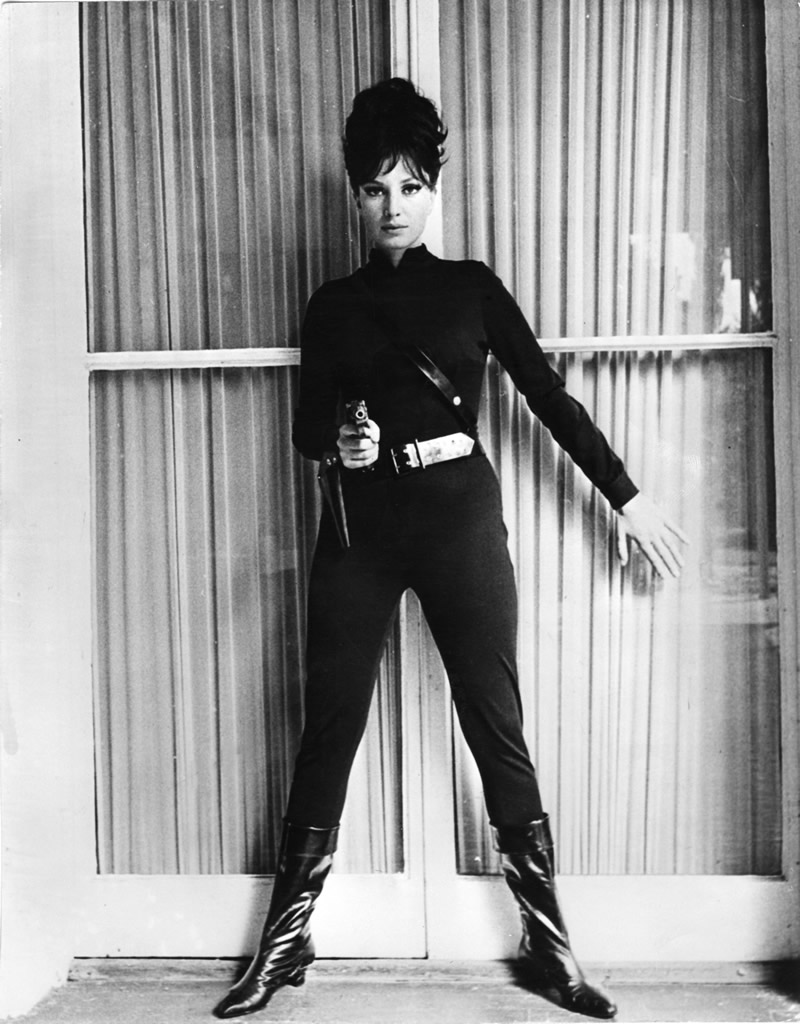
 With her husky voice and languid gaze, Modesty Blaise has nothing to envy James Bond in terms of gadgets and elegance. Except that she is a woman – played by Monica Vitti, following the success of Peter O’Donnell’s comic books and novels – and this makes her even more extraordinary for an era, the 1960s, when women’s roles in the secret service were mainly limited to shorthand, cups of tea, and well-kept secrets.
Today, there is a new, very real Blaise at the head of MI6. She is almost 48 years old and very little was known about her, except that until recently she was head of the technology department – Q, as all Ian Fleming fans know – and that she has worked in the field in the Middle East and Europe. Then the Daily Mail broke the scoop: Metreweli is a Georgian surname, but Blaise’s real grandfather was called Constantine Dowbrowolski, a Ukrainian deserter from the Red Army who went to work for the Nazis and was known as ‘the butcher’ for the ruthlessness with which he killed Jews and Ukrainian dissidents, plundered corpses, laughed during rapes, and signed letters to his Wehrmacht superiors with heartfelt “Heil Hitler”. She knew nothing about it, according to the Foreign Office, partly because her grandmother Barbara, who fled in 1943 (nothing more was heard of Constantine), declared herself a widow and remarried in England to David Metreweli, from whom her son took his surname. It is a story from the East, “characterized by conflict and division”, in which a man sees his wealthy landowning family killed during the October Revolution and takes revenge by becoming the worst of murderers. “It is precisely this complex legacy that has contributed to his commitment to preventing conflict and protecting British citizens from today’s threats such as hostile states”, a ministry spokesman said. Except that these hostile states are rubbing their hands with glee, observes the Mail, which has pored over hundreds of pages of documents to find the mysterious origins of Blaise’s father, a soldier who became a respected radiologist in Hong Kong, where he raised his children. And it justified its operation, journalistically impeccable, by saying that the strange surname had already raised alarm bells among historians in Georgia, Ukraine, and especially Russia, and that, given that the new head of MI6 is exceptional, it is best to prevent the inevitable manipulation of a well-documented, irrefutable story.
But back to her: she speaks Arabic, her official photo shows her blonde, with short hair and blue eyes, and from next October she will be ‘C’, referring to the way the first head, Mansfield Smith-Cumming, chose to sign his name, using only green ink. Even from her computer, Metreweli will only produce green communications, as per tradition, and will be the only MI6 employee with a public identity. She will report only to Foreign Secretary David Lammy in these times which, as everyone has pointed out, could not be more difficult. Apart from her Nazi grandfather, she is perfect: she rowed during her years at Cambridge, Pembroke College, and who knows if that is where she received the famous ‘pat on the shoulder’ reserved for the brightest students. She certainly liked espionage as a child, as she herself recounted, using the name Ada, in a beautiful piece on female agents in the Financial Times a few years ago. There and in other anonymous interviews, she explained a couple of other important things: “Throughout my career, I have lived in countries where democratic principles and freedoms sometimes disappear overnight, or where the free press is crushed, and that makes you think how special the UK is, how rare, and how it deserves to be protected”. This does not prevent her from having had “difficult experiences, both professional and personal,” or “traumatic periods” from which she has emerged, because you can recover from trauma, freedom can be defended, and the beauty of her absurd job is “trying to understand, from morning to night, where we can intervene to prevent evil”, doing “extraordinary things” under a cloak of absolute normality. Then, armed with her anthropological studies – she is a geek, one of the best technological minds in the country according to her predecessor Sir Richard Moore, but she has no scientific training – she said she was “really fascinated by human behavior”, partly because “it is not states that do certain things, but individuals”. Between representations of man-eaters such as Mata Hari or Nikita and those of fragile yet strong heroines such as Carrie Mathison in Homeland, the secret agent lends herself to stereotypes. So much the better, they all say, because it is easier to go unnoticed and make contacts. And if a certain ambiguity should ever arise, Metreweli – speaking as Ada – has some good advice: it’s amazing how a “I feel like your sister” or “I respect you like a father” can change the temperature in a room.
Blaise is the first woman at MI6, but the internal secret service, MI5, opened its doors to women some time ago, in 1992, with Stella Rimington, who shocked everyone by writing a memoir and inspired the character of M played by Judi Dench in James Bond. Then came Eliza Manningham-Buller, and they all talked about the stellar misogyny they had to deal with and the many female colleagues who deserved to lead the Services. No self-pity, it’s not part of the job. It’s time to enjoy the moment when reality is catching up with popular imagination, as in the beautiful series Slow Horses, where the head and deputy head of MI5 are women, but where the character of Catherine Standish shines above all, the devoted, slightly gray-haired secretary who has nothing to envy the operatives, as she proves every time she finds herself in trouble. Blaise Metreweli is athletic, she disappeared from social media and the world 25 years ago, we know she gave birth, perhaps she continues to row, and she also has fantastic friends who tell the newspapers: we don’t remember anything about her.