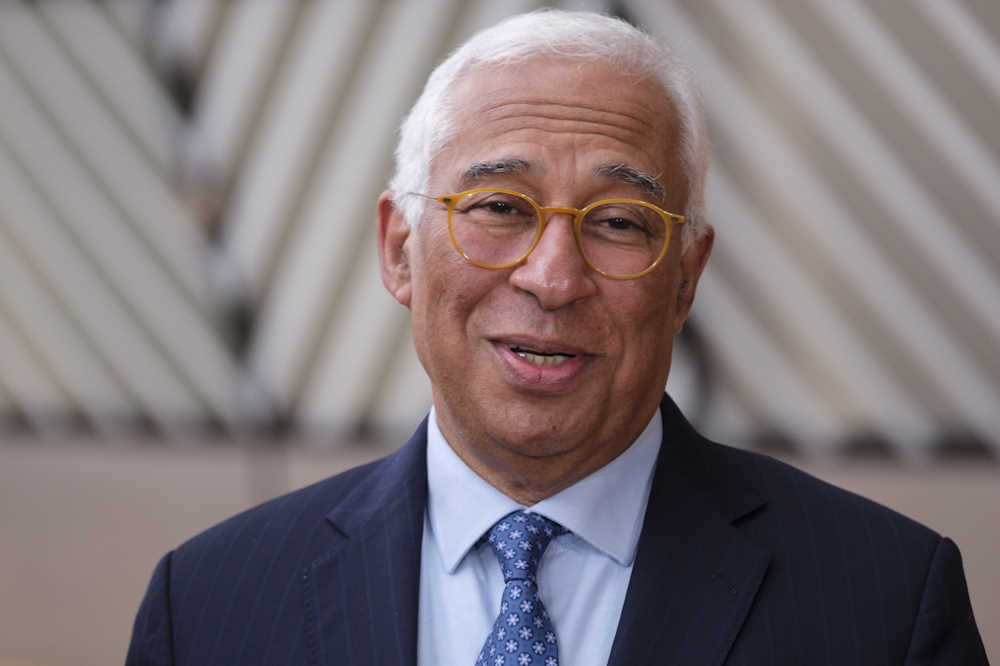
Pragmatism and vision. Rules and moderation. Ambition and seduction. Much can be associated with António Costa, President of the European Council since December 1, 2024. Among the Union’s leaders, caught between President Ursula von der Leyen and High Representative for Foreign Affairs and Security Policy Kaja Kallas, Costa always seems to stay one step behind. Less conspicuous, less talkative. So much so that at times people have wondered: where has António Costa gone? The president is there, he’s a tireless worker cultivating his own small European revolution, yet it sometimes happens that his absences are noticed more than his presence. One above all: on August 18, the heads of state and government of Italy, France, Germany, Finland, and the United Kingdom accompanied Ukrainian President Volodymyr Zelensky to Washington to discuss security guarantees with White House chief Donald Trump. Together with this group determined to capture Trump’s attention and de-Putinize his mind after the meeting in Alaska with the Kremlin chief, were NATO Secretary General Mark Rutte and von der Leyen. And Costa?
All the Roles of One Man
How can a politician be suited to Lisbon’s challenges as well as Brussels’ palaces? Costa seems to chew through all of Europe, seems to move within it, traverse it from every side and still always feel at ease. He administered his native city, Lisbon, managed his country while it brushed against bankruptcy, weathered scandals worthy of a comedy of errors, taught his team – not Benfica, which he supports, but his government team – the art of compromise, and now opens the work of the European Council, the same one he participated in many times as premier during his tenure from 2015 to 2024. But before becoming premier, he was already flitting between the palaces of European institutions. A dean, above all a Europeanist, who never gave up his Portuguese style to be understood in Brussels. He’s the man of balance and also of a certain type of political innovation.
From Mayor to Prime Minister
António Costa built his fame managing his city, his Lisbon, of which he was mayor from 2007 to 2015, then moved on, or rather returned, to national politics. Portugal was devastated by the economic crisis and was trying to recover with the international financial assistance program. Costa followed the path of austerity, with a compromise between commitments agreed with the EU and the need to keep most social spending intact, as promised as leader of the Socialist Party. The results were evident: the public deficit was reduced, the labor market was energized. It wasn’t a path without sacrifices, and the need to guarantee revenue pushed the government to measures that were criticized for increasing fiscal pressure. But the Portuguese promoted Costa in the next two elections, and no one can know what direction national politics would have taken if the premier hadn’t decided to resign over a case of mistaken identity.
The Compromise
Costa, a lawyer who also holds overseas Indian citizenship due to his origins, has made compromise into a manifesto. He has blended three levels of identity within himself: Lisbon, Portugal, and Europe, and at every level of his career, he has always expressed a preference, a method for resolving issues: European consensus. Nothing is questioned more than this consensus, so laborious and often inadequate for times of crisis. Yet Costa is a supporter of it. On December 1, 2024, when he saw his predecessor at the European Council, Charles Michel, hand him the traditional bell, Costa understood that he would have to find a way to embody his new role with a different approach. He went to shake hands with everyone present and said: “Only together can we ensure peace, stability, and prosperity for our continent.” It’s a predictable phrase, even somewhat lackluster for an EU that has reached the moment of hard choices and truths. But Costa was praising compromise and promising that he would perform his role differently. That promise was directed at everyone, particularly at von der Leyen.
The Costa Method
As a regular attendee of the European Council, other leaders had had the opportunity to observe Costa, to notice his propensity to get everyone to agree, skillfully. Not as a good-timer, not as a generic mediator, but as a seducer. Now he has made his decisions: he wants summits to be swift, no more than twenty-four hours; he asks that conclusions come quickly, without squabbling over details that block work. When he speaks of “European consensus,” he interprets it in his own way, as a mechanism to be oiled. He has promised informal retreats for discussion and to be extended to other allies, almost like a coach ready to organize institutional picnics for team building. He hasn’t promised deadlines, hasn’t said that by a certain date European revolutions will be ready. He has outlined his objectives: defense, autonomy, security, enlargement. But he has a method: appear, without excess. This is perhaps the reason why sometimes among Brussels observers the question lingers: where is Costa?
Let’s return to Washington, to August 18. In international contexts, the Commission President and Council President often go as a pair. Instead, in Washington, von der Leyen was alone. And here we return to Charles Michel, the specter that Costa wants to avoid in the name of unity and pragmatism. The relationship between the Commission President and Michel was terrible, so much so that territorial disputes between the two often proved to be a problem of method and confusion. Costa is not Michel; the united front, as he has declared, is among his priorities, but he still chooses to be careful not to irritate the president. The Sofagate – when in 2021 von der Leyen, visiting Turkey, was left without a chair and had to settle, at a distance from the central position reserved for Turkish President Recep Tayyip Erdogan and Michel, on a sofa – shook relations between the heads of the Commission and Council, which were already not serene. This was followed by improvised solo visits to play at who was more powerful, with results that were both comic and jarring.
The Simplest Solution
Costa seems to have found the way not to create cracks in the united front, but this attitude is producing by inertia a change in the mechanism of the institutions. According to Article 15(6) of the TEU (Treaty on European Union), representation of the Union in foreign affairs and security matters pertains to the President of the Council. But careful, Costa shouldn’t be taken for a politician who cares little about the EU’s future, nor for a leader uninterested in the Ukrainian dossier. He didn’t go to the White House, but in the days preceding the Alaska summit, he tried to weave together a joint declaration among all leaders to send a message to Trump about Ukraine. To explain Costa’s absence in Washington, it was said that the delegation was small and von der Leyen already had an open channel with Trump for tariff negotiations. Moreover, the White House chief doesn’t understand how the EU works; Costa’s presence would have confused or irritated him. However, the President of the European Council cannot afford to seem subjugated and weak, “a sleepwalker,” as Politico writes, which also reports the question of an EU official who, when he saw von der Leyen return to Turkey after Sofagate, alone and without Costa, wondered: “Is this perhaps the first sign that she’ll eat him alive?”
THE RELATIONSHIP WITH TRUMP
During Donald Trump’s first term, Costa was Prime Minister in Portugal. The two didn’t meet often, and indeed there seems to be a certain reluctance on Costa’s part, who perhaps wasn’t even keen on going to Washington. When he arrived at the European Council and Trump’s presidency loomed, Costa said the EU would have to learn to be more creative. He never pushed for trips to Trump to obtain his benevolence, but there’s suspicion that he also tries to avoid him, so as not to highlight the great differences in style and thought. Costa prefers French to English, and this too is seen as an obstacle between him and the American president.
António Costa left the Portuguese government over a misunderstanding. In November 2023, he resigned: in a phone wiretap on a corruption case, a name came up – his. The António Costa of the investigations, however, wasn’t him, but rather his Economy Minister António Costa Silva, who due to a transcription error had ended up in the records with only his first name and surname. The rather serious misunderstanding was only discovered later when the real Costa had made the decision that led to a new season of Portuguese politics and him toward a new chapter of European history.