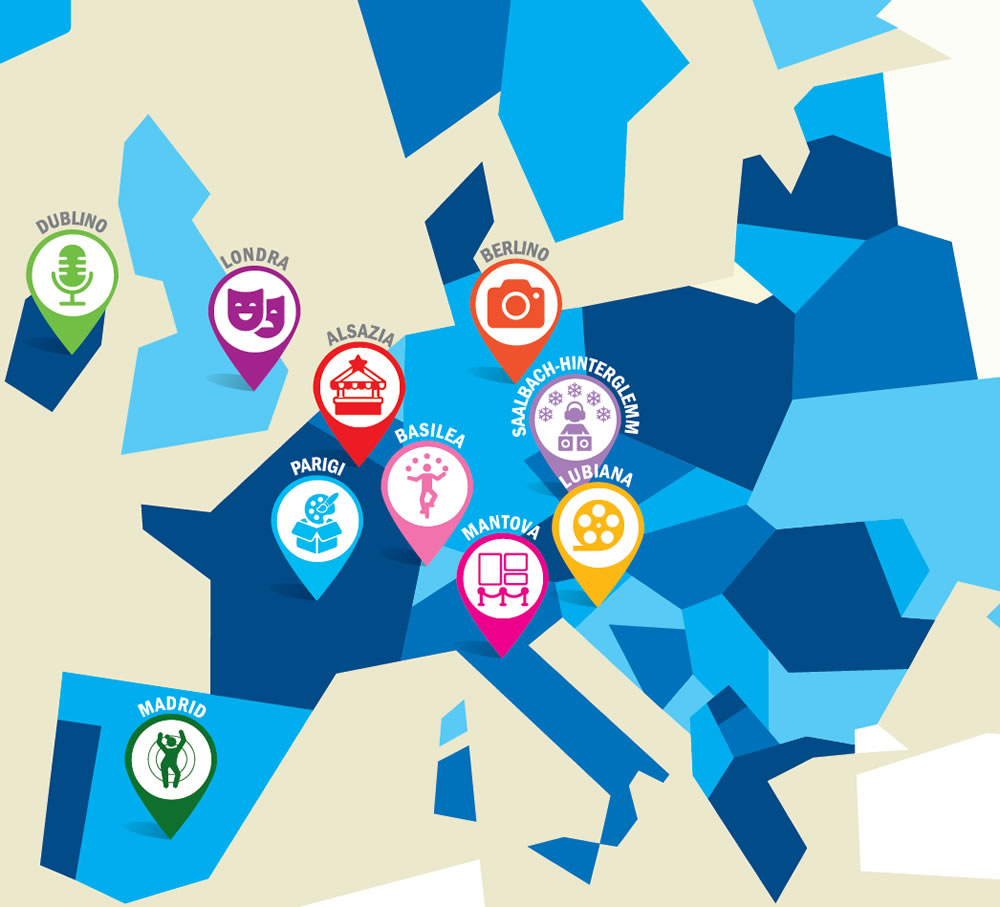
MONTH OF DECEMBER. CHRISTMAS MARKETS / ALSACE, FRANCE
In the Capital of Christmas, Among Vines in the Streets
Alsace is an industrious region. On one side there’s Strasbourg with the Union’s institutions, on the other a countryside where bells toll at 6 a.m. and wake drowsy villages. A food and wine destination, one can stroll among vineyards on hillsides, stop at a domaine for a glass of Riesling (or pay to experience the harvest), and then lunch with sauerkraut and meat in medieval villages where vines grow between the streets. The villages are impeccably ordered: low surrounding walls, half-timbered houses in pastel colors, balconies and gardens displaying flower pots and fairytale sculptures, views so perfect they’re unsettling. With this perpetually Disney-like setting, Alsace is the perfect place where Christmas magic can happen. The other great tourist peak, besides the harvest season, is indeed in December, for the Christmas markets. Strasbourg, as well as being a European capital, is also the Capital of Christmas, holding the longevity record for Christmas markets, active since 1570—and for ten years with a Marché Off entirely dedicated to fair trade. And then the many villages, the region’s fabric, emanating Christmas energy: Ribeauvillé with its medieval market, Bergheim, Riquewihr, the Kaysersberg valley, and of course Colmar, the epitome of this atmosphere, perhaps snow-covered, all canals, tarte flambée and vin chaud.
FROM NOVEMBER 29. SONNABEND COLLECTION MANTOVA / MANTUA, ITALY
Ileana, the Gallerist Who Changed Art
Faced with a particularly explicit exhibition by the duo Gilbert & George, a collector asked Ileana Sonnabend, patron and gallery owner, if she didn’t fear for her reputation. She replied, laughing: “It’s been compromised for so long.” The life and trajectory as a gallerist of this brilliant woman can be discovered at the Palazzo della Ragione in Mantua, which hosts the Sonnabend Collection Mantova, a selection of works from the private collection curated by her adopted son Antonio Homem and Mario Codognato. Displayed in the high frescoed medieval nave, the exhibition is a stunning look at twentieth-century art, filtered through Ileana’s insights, who knew how to identify, understand and present to the world new artists and revolutionary new languages. Born Schapira in 1914 into a wealthy and cosmopolitan Jewish family in Bucharest, Ileana received a European aesthetic education. She married Leo Castelli, they opened a gallery in Paris but then fled to New York during the war, where they met, discovered and supported young artists like Jasper Johns and Robert Rauschenberg. In ’61 she married Michael Sonnabend and returned to Europe with the idea of introducing Pop Art, Warhol and Lichtenstein. They opened Galleria Sonnabend, both in Paris and New York, this time importing European currents, like Arte povera, to America. The exhibition traces Ileana’s sensitivity and patronage courage (it opens with the aforementioned, and closes with Jeff Koons), and the spirit with which she inaugurated and nurtured a dense exchange between the two shores of the Atlantic.
DECEMBER 17, 2025-APRIL 26, 2026. HU/DANCE AS IF NO ONE WERE WATCHING YOU / MADRID, SPAIN
A spiritual journey to find a missing sister
In Arabic, “hu” is the primordial sonic manifestation of the divine, the first breath that sets creation in motion—somewhat like the “big song” that Father Guidalberto Bormolini prefers to the big bang. “Hu. Dance as if No One Were Watching You” is an installation by Spanish director Oliver Laxe designed for the Reina Sofía in Madrid. The subtitle comes from a verse by the Sufi mystic poet Rumi, whose spiritual practice concerns contact with the divine through music, dance, prayer and poetry. Laxe started from his film “Sirat” (produced by Pedro Almodóvar, Grand Prix at Cannes, in theater in Italy next January), a spiritual odyssey of a father and son who undertake a journey into the Moroccan desert in search of their missing daughter/sister during a rave. A monolith of rave speakers emits an almost initiatory vibration into the immersive environment of the installation, where a desert panorama interspersed with profiles of Zoroastrian and Muslim temples (filmed in Iran by Laxe) is projected, within a soundscape of ancestral sounds and the music of Kangding Ray. In classic arabic, “Sirat” is the bridge that can lead toward hell or paradise; according to Laxe, the spiritual role that an artist must play is precisely that of a bridge.
NOVEMBER 27-DECEMBER 13. PORN PLAY / LONDON, UNITED KINGDOM
Bringing Addiction and Desire to the Stage
Sophia Chetin-Leuner, a 31-year-old English playwright, wanted to do something provocative—so British Vogue quotes. And while this somewhat edgy declaration of intent isn’t among the best premises, the plot of “Porn Play,” her piece on stage at the Royal Court Theatre directed by Josie Rourke until December 13, is worth reading. The protagonist Ani, played by Ambika Mod, already seen in the series “One Day” and “This Is Going to Hurt,” is a promising university lecturer in English literature, and has two obsessions: John Milton and violent pornography. A secret addiction no longer so secret because she can’t refrain from masturbating in the presence of her boyfriend and best friend, disgusted, and her father, disturbed. “Porn Play” brings to the stage (as well as a woman’s self-pleasure, uncommon in theater) female desire and its inseparable double, shame, with humor and grotesque scenes. The audience witnesses the protagonist’s progressive isolation, consumed by addiction, immersed in Yimei Zhao’s scenography. On stage, an enormous bed resembles a vulva, and all the theater’s surfaces, from stage to auditorium, are covered with a layer of flesh-colored cushions—at the entrance they distribute plastic shoe covers, to avoid ruining the scenography and compromising a safe environment where delicate issues are addressed.
DECEMBER 7. WINTER GRAND SLAM 2025 / DUBLIN, IRELAND
Open Mic at the Abbey Theatre
You know that friend who entertains (or bores) dinner tables with their anecdotes? In Dublin, a city where shows spring up in every pub, that storytelling friend (who knows how to nail the right pauses) would find a microphone and a real stage even at the city’s national theater, the Abbey Theatre, founded by Yeats in 1904. The evening is called Winter Grand Slam 2025 and the stage will alternate “champions” from the open mic editions of the Dublin Story Slam, where to participate you just need to sign up or show up and tell a good story on the evening’s theme. For the December 7 finale the theme will be “strangers,” perfect to inspire those slightly saccharine but consoling parables about the kindness of strangers that at Christmas melt the hearts of even the most cynical.
DECEMBER 8-15. LGBT FILM FESTIVAL LJUBLJANA / LJUBLJANA, SLOVENIA
Europe’s Oldest LGBT Film Festival
The LGBTQ+ movement has existed in Slovenia since it was part of Yugoslavia. In 1984 in Ljubljana, the gay section of ŠKUC (Student Cultural Center) organized the first edition of the LGBT Film Ljubljana Festival, Europe’s oldest queer film festival. From December 8 to 15 it returns with screenings of films and documentaries, meetings and workshops. The program opened with a preview of “Des preuves d’amour” by Frenchwoman Alice Douard, about a couple of women facing a surrogacy pregnancy. “Io non sono nessuno” by Geraldine Ottier will also be screened, on the life of Mariasilvia Spolato, among the founders of the Homosexual Liberation Front and the first woman to publicly declare herself lesbian in Italy—persecuted for this—and many stories that tell of divergent identities in societies where one is still persecuted today or has been, with so-called queer period dramas. The movement from which the festival was born is also pioneering in Eastern Europe with its sexual education and HIV prevention program, with a shelter for victims of discrimination and with its club, where tomorrow the opening party will be held, which Google Translate describes as “a litter of bohemian intoxication, madness and sweet film decadence.”
DECEMBER 11-14. RAVE ON SNOW / SAALBACH-HINTERGLEMM, AUSTRIA
Dancing in Bright Colors on the Alpine Peak
The webcams placed on the summit of Mount Schattberg, in Austria, transmit blizzards and thick snow. There’s still a week, but no adverse weather will stop Rave on Snow, the Christmas party at the ski resort of Saalbach-Hinterglemm, which for thirty years has opened, along with the sports season, the winter party season of German-speaking club culture. Born in 1993 from the idea of a group of friends, today it offers three days of music with over 70 DJs from the international techno and house scene on twelve different stages distributed between the village, the mountain huts and the summit. The attendees, mostly from Austria, Germany and Switzerland—hardened both by rave culture and outdoor sports—gather on the snow to dance all night and all day and, between sets, ski in the Alps. The tacit dress code calls for jackets and hats in bright colors scavenged from some uncle’s attic or overpriced in thrift shops, and sports glasses (“fast,” in rave fashion) useful both for dancing and party lights and for descents on the slopes. Every now and then you need a tacky experience too (though it must be said, not exactly sustainable) and, if the sky is clear, for those not accustomed to the festive après-ski culture there’s always the quieter Vanzini alternative: sun and whisky, in pole position.
NOVEMBER 21, 2025-APRIL 19, 2026. FATHER, DIANA MARKOSIAN / BERLIN, GERMANY
Why Did It Take You So Long?
When Diana Markosian meets her father again after fifteen years, he asks her: why did it take you so long? The last time they saw each other was in 1996, in Moscow. Markosian was seven years old and lived there with her mother, father and brother. One night her mother wakes the children, drags them sleepily from home with suitcases, and gets them on a plane to California. Without warning the father, whom she decides to erase from the children’s existence, even with the symbolic and concrete gesture of cutting his figure out of all family photos. Diana grows up with this burdensome absence, disorientation and uprooting. As an adult, having meanwhile become a photographer, she manages to track him down in Armenia, and discovers that he and her grandfather had searched for her and her brother in vain for years. “Father,” now at Fotografiska in Berlin, is an intimate exhibition through which Markosian processes her father’s absence and his rediscovery. Through the photographs taken, films shot and objects (like letters returned to sender) collected over the ten years in which Markosian and her father, two strangers, began to spend time together during her trips to Armenia, the photographer records without judgment this attempt to find each other again, a therapeutic artistic process to heal a separation that seems irreparable.
DECEMBER 16, 2025-MARCH 14, 2026. THE HOUSE ON UTOPIA PARKWAY / PARIS, FRANCE
Wes Anderson in Service of Joseph Cornell
Joseph Cornell (1903-1972) had a fixation with Paris. He knew every café, every view. That’s why Marcel Duchamp was shocked the first time they spoke to discover that the American artist had practically never left New York. Today Cornell returns to his beloved city with the exhibition “The House on Utopia Parkway,” at Gagosian’s Paris location, curated by Wes Anderson with Jasper Sharp, in which Anderson reimagines Cornell’s studio in the basement of the family home on Utopia Parkway, in Queens. Cornell hadn’t gone to art school; he worked as a laborer to support his mother and disabled brother. Yet his imagination was alive and sensitive, and his studio frequented by New York intellectuals. In shoe boxes and tin boxes he built small display cases with objects recovered by rummaging through junk shops and dime stores in Manhattan. His “reliquaries of memory and imagination” (or “shadow boxes”) were heterogeneous compositions of maps, collages, feathers, prints, shells, thimbles, marbles, clippings. Wes Anderson, another master of tableaux curated to obsessive detail, recreates Cornell’s marvelous cabinet in Paris, arranging hundreds of trinkets and his best-known display cases, like “Pharmacy,” an altar of ampoules and bottles filled with objects and medicines for a mystical cure. The gallery itself becomes a wunderkammer visible from the street window, in a nesting doll game so dear to the director. Deliberately Wes Anderson in service of Joseph Cornell.
DECEMBER 27 2025-JANUARY 11 2026. ELEFANT / BASEL, SWITZERLAND
Everyone Watching the Elephant in the Tent
Acrobats, clowns, jugglers, live music alternate on stage—all circus disciplines. The audience’s attention is captured by the artists, but everyone awaits the announced entrance of an elephant. “Elefant” by Circus FahrAway, a traveling company based in Basel, builds on the anticipation of this phantom animal, and is a piece of considerable weight: metal, wood and wool. With a delicate and entertaining show (it makes you laugh, but also reflect), the company brings freshness to a classic and controversial symbol of circus imagery. At Station Circus in Basel, a space dedicated to promoting circus arts, in the former industrial area of Dreispitz.