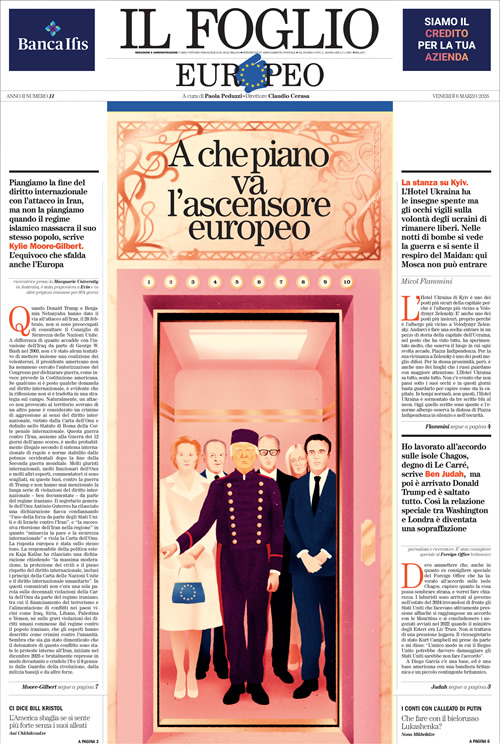
For eight decades, the transatlantic alliance under the US leadership, has served as the backbone of Western security. Built in the aftermath of World War II and reinforced through the Cold War, NATO bound the United States and Europe together through shared interests, shared values, and a shared understanding that collective defense was preferable to the alternative. Today, however, the rhetoric and steps taken by the President Donald Trump has led to debates across the two sides of the Atlantic if the relationship has entered a process of inevitable divorce.
In an interview, Bill Kristol, one of the most prominent foreign policy voices in the United States and a longtime champion of the Atlantic alliance, offered a critical assessment. “I think we’re in a new stage of the relationship and it’s not a good one,” he said. “Whatever the ups and downs of the traditional transatlantic relationship, here was a basic bond of common interest and common values, a sense that we needed to keep the post-World War II order together and that the US and Europe had to work together. The US was the anchor of that order, but Europe was an important partner: different nations and different times and different ways. That fundamental agreement is broken down because of the US,” he says.
Kristol belongs to the Never Trump movement, a faction of Republicans who broke with the party over Donald Trump’s rise and governing style. Kristol’s critique of U.S. policy toward Europe therefore flows from a rejection of Trumpism itself, which he views as a departure from traditional Republican foreign policy. “I don’t really call myself a conservative much anymore,” he admitted. “American conservatism I would defend was anti-Nazi and anti-Putin.”
Kristol’s take captures both an internal split within the Republican Party and a parallel strain in the transatlantic relationship, as Europe confronts an American administration shaped by a political current that some in the Republican party no longer recognize as their own.
Since returning to office, President Donald Trump floated the prospect of acquiring Greenland, threatened tariffs against the allies, senior figures in Trump’s orbit have spoken about Europe’s civilization decline and some have expressed public sympathy for Alternative for Germany (AfD), a far right party whose leadership has drawn condemnation for whitewashing German history, maintaining ties to Moscow and exposing Anti-American views. And on the war in Ukraine, the administration has signaled a willingness to negotiate with Russia in terms that many European leaders fear could amount to capitulation and leave them exposed to the future of Russian aggression.
For Kristol, these are unacceptable steps. “The degree to which the U.S. regards European allies as nations to be bullied as opposed to nations to be worked with is very startling to me,” he said. “The Greenland thing should not be ignored or passed over. Threatening an ally? That’s not treating someone as an ally. One of Trump’s biggest mistakes is he wildly overestimates America’s power without allies, without Europe. He removed Maduro. We’ll see what effect that all has. And now he thinks the U.S. can do whatever it wants, wherever it wants. And I think that’s just not true. We’re not that strong, and the American public is not in favor of interventions everywhere. You could, I suppose, try to be a world bully, but then you really need to be powerful. We are powerful. But We’re not that powerful”.
The debate over the transatlantic alliance is also, in part, a debate within American right what America’s role in the world should be. The interventionist, or what is called the “Neoconservative tradition” that Kristol represented for decades now competes with a populist nationalism that treats traditional, post-Cold war alliances with suspicion. That dispute has real consequences for European governments trying to gauge whether American policy reflects a temporary electoral cycle or a durable ideological realignment. It also echoes across the continent itself, where mainstream center-right parties have watched their own lines desert over similar questions of sovereignty, identity and the value of European Union.
This prompted a question whether the issue is Trump himself, which will disappear once he leave office or if this is a long-term shift in American foreign policy?
“I don’t think we can go back to normal, at least very easily,” he argues. “It will require defeating Trump and real sense that America is not subject to falling back into Trump and Trumpism in the future. That will take a lot of work. It’s a big shock to the system, and it’s a very unfortunate one, because at the end of the day it’s very hard to preserve these alliances. The idea of having a coherent defense without the U.S. as the anchor is very difficult” he notes.
Kristol’s career spans the arc of the order he now mourns. He served as chief of staff to Vice President Dan Quayle during the George H. W. Bush administration, at a moment when the collapse of the Soviet Union appeared to settle the question of European security for good. He later co-founded The Weekly Standard, which for more than two decades shaped conservative thinking on NATO expansion, democracy promotion and American global leadership.
For roughly three decades after the Cold War, the arrangement he championed held. There was widespread believe that war was thing of the past, and even when Russian invaded Georgia in 2008 and Ukraine in 2014, decision makers on both side of Atlantic treated it as one-time departure from otherwise fundamentally different world. In that time, the United States retained its role as guarantor on European continent while European countries channeled money freed up from peace dividends in their economies and defense budgets fell dramatically. That illusion of peace began to dissolve in 2022, when Russia launched a full-scale invasion of Ukraine and conventional warfare, along with history, returned to Europe.
“Ironically, since the full-scale invasion of Ukraine, I would say Europe has moved in the direction of strengthening NATO and strengthening the alliance and working together in a pretty impressive way,” Kristol argued. “Europe has stepped up more than I expected, honestly, and so it’s particularly tragic that the U.S. is turning its back on Europe and really turning away from the fundamental relationship that’s been so important for the last 80 years and is now behaving as a bully.”
The administration and its supporters see the picture very differently from Kristol. For them, Washington has shouldered a disproportionate share of the collective burden and took granted American protection. Multiple American presidents pressed Europeans to spend more, and progress was slow.
For Kristol, who acknowledges that continent needs to take its defense seriously, the form in which administration deals with the allies, is unacceptable. “Everyone thinks that you would, that Europe was a free rider on the US in terms of defense. And there’s some truth to that,” he admits. “But Trump wildly underestimates how much we benefited from the post-1945 world order. What happens when people stop trusting that order in terms of security, but also in terms of finances, in terms of the dollar?” he maintains.
Administration meanwhile contends that Trump’s pressure has produced the very European mobilization that Kristol praises, and that decades of polite diplomacy failed to achieve results.They credit President Trump with the commitment at the NATO summit in The Hague in June 2025, where allies agreed to raising defense spending to five percent of GDP by 2035. It was the single largest increase in NATO’s spending commitments since the alliance’s founding. The White House described it as a “monumental victory” with the supporters arguing that this outcome is enabling Europeans to take primary responsibility for their conventional defense while freeing American resources for the Indo-Pacific, calling it realignment rather than a retreat. They also point to Trump’s first term, when NATO expanded to include Montenegro and North Macedonia, and the administration authorized Javelin anti-tank missiles for Ukraine, a step the Obama administration had declined to take.
For Kristol however, ends don’t justify the means. “I’m happy that Europe is increasing its defense spending. Trump might have played some small role in that, but at what cost?” Kristol asks. “From a European perspective, it’s still useful to keep whatever parts of the alliance are functioning as long as possible. I understand why Europeans are doing that and why NATO is doing that, and that’s fine. But Europe really needs to think through its own position, needs to step up as a body and the intra-European efforts need to be as strong as possible. Then Europe needs to deal with the United States as equals to the degree possible.”
One of the biggest challenges facing Europe is the uneven perception of threat across the continent. For Poland and the Baltic states, the danger from Russia is immediate. For countries like Italy or Spain, the calculus is less obvious, and public opinion remains resistant to significant increases in military spending. Spain’s refusal to endorse the five percent target, capping its commitment at 2.1 percent of GDP, illustrated the difficulty of building consensus. Kristol argued that the threat extends beyond geography. “Europeans should not want to live in a world in which Putin can conquer neighbors,” he said. “Italy is not under immediate threat in such a world, but it’s not going to be a pleasant world. It’s not going to be a world friendly to liberal democracy. Ultimately, we’ve learned in the 20th century, these threats can spread faster than you think.”
So, is the transatlantic relationship headed for divorce? Kristol chose his words carefully. “I’d say somewhere in between an aberration and a divorce, at least a separation,” he said, “a real separation where people need to really think in a fresh way about the relationship and it can’t just be put back the way it was.”