April is normally a quiet month for European institutions. The double Easter — Catholic and Orthodox — imposes an extended pause. Meetings of the Council of the European Union are kept to a minimum, as they are held in Luxembourg. The European Parliament’s plenary session takes place only at the end of the month. This year, Ursula von der Leyen has decided to convene her College of Commissioners to adopt proposals and take decisions only on April 28. At least the Cypriot presidency of the EU has decided to hold an informal summit of heads of state and government on the island on April 23 and 24, with an accompanying meeting with Gulf and Mediterranean leaders, which will prevent an entire month from going to waste. But everything can change at any moment. Because, beyond the official calendar, the EU is at the mercy of the choices Donald Trump will make regarding the war in Iran and the resulting economic and energy repercussions for Europe. The late-April summit in Cyprus with regional leaders could become an opportunity for the EU to carve out a role in the Middle East and the Gulf, if the war is over by then. But what if it is not? What if Iran continues to keep the Strait of Hormuz closed? Soaring oil and gas prices, the risk of stagflation, inflation already trending upward again, lifestyle adjustments to reduce energy consumption: April 2026 could come to resemble the economic crisis triggered by Covid in 2020 and the energy crisis that followed Russia’s war in 2022. Emergency summits and ministerial meetings held via videoconference at short notice cannot be ruled out. What is certain is that the meeting of the Governing Council of the European Central Bank will take place on April 30. Some central bankers are already calling for an interest rate hike.
The Most Important Elections of 2026 for the EU
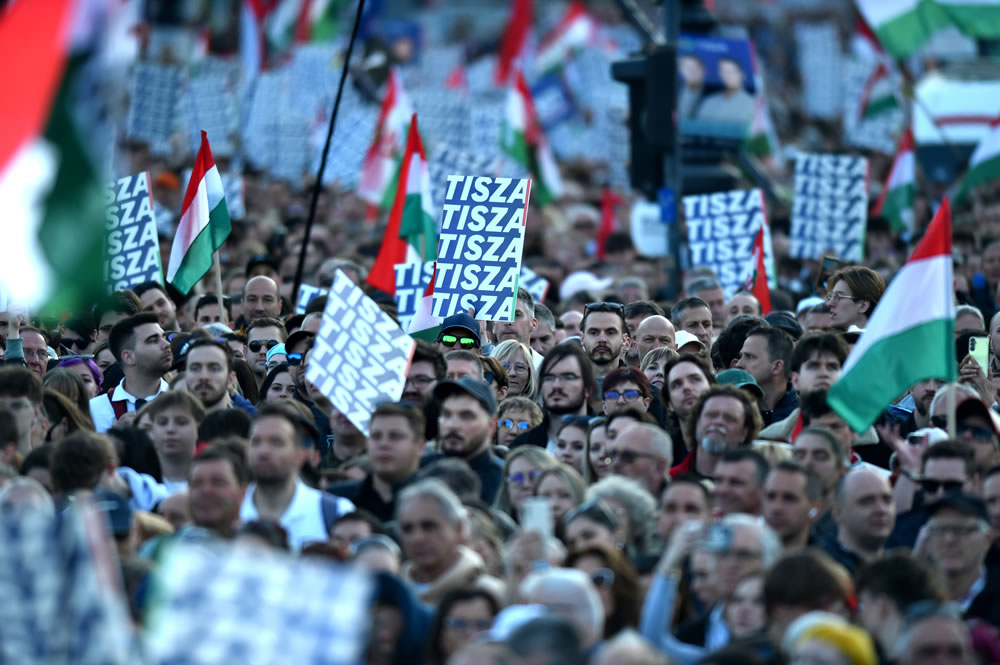
Will April 12 mark the end of Viktor Orbán’s long reign in Hungary? According to polls, for the first time since he returned to power in 2010, there is a realistic chance that the Hungarian prime minister and his Fidesz party could lose the election that day. Péter Magyar, with his Tisza party, holds a clear lead in voting intentions recorded by independent surveys. There are many unknowns, including the tricks Orbán has used to stay in power. Single-member constituencies have been redrawn to favor Fidesz. Tisza will need a five-percentage-point lead to secure an absolute majority in parliament. A change of regime in Budapest is the outcome desired by much of the European Union. Orbán is not only blocking with his veto the €90 billion loan to Ukraine — agreed upon in December by EU leaders, including the Hungarian prime minister himself — which is vital for Kyiv. Hungary has become an electoral autocracy in the service of hostile foreign powers — Russia, China, and Trump’s United States — one that no longer respects the fundamental values and basic rules of the EU. In the event of defeat, Orbán could subject the EU to a further test if he were to attempt to remain in power by contesting the results or annulling the election, perhaps under the pretext of foreign interference. Brussels is unprepared for this scenario, just as it is unprepared to resolve the Orbán problem should he win. In the meantime, following Slovakia’s Robert Fico and the Czech Republic’s Andrej Babiš, other imitators of the Hungarian prime minister could be entering the European Council. On April 19, Bulgaria will go to early elections. The frontrunner is Rumen Radev, the country’s pro-Russian former president, whose party, Progressive Bulgaria, holds a commanding lead in the polls.
What to Do About Xi Jinping’s China?
Ursula von der Leyen has decided to interrupt her commissioners’ extended recess on April 13 for a College meeting devoted to a strategic debate on China. In all likelihood, it will also be an occasion to discuss Hungary and the election results. But there is an urgent need to update the EU’s doctrine on relations with Beijing. Officially, von der Leyen’s strategy remains “de-risking.” But the conflicts Donald Trump has picked with Europe — tariffs, Ukraine, NATO, Greenland, plus the fallout from the war in Iran — have pushed the issue of Chinese economic coercion into the background. Some leaders — such as Spain’s Pedro Sánchez — are actively promoting a rapprochement with China in order to “de-risk” from Trump’s United States. Emmanuel Macron and Friedrich Merz have both visited Beijing in an attempt to rebalance relations. Yet Chinese President Xi Jinping has so far remained deaf to all European requests: reducing support for Russia, cutting exports of Chinese overcapacity to the EU, opening the Chinese market, and guaranteeing stable supplies of critical raw materials and semiconductors. As with Trump, the Commission has been very cautious when faced with the prospect of entering into a confrontation with Xi. Two recent reports — from the European Union Institute for Security Studies and the European Council on Foreign Relations — argue that the EU should adopt a more assertive approach. China is fragile internally, including economically. Europe has “leverage” and “cards” to play. It also has instruments at its disposal, such as the anti-coercion instrument — provided it is willing to use them.
Russia at the Biennale Discussed by Foreign Ministers
On April 21, European Union foreign ministers will meet in Luxembourg for a Foreign Affairs Council dedicated to Ukraine and the Middle East. But the Cypriot presidency has decided to add another item to the agenda: the decision by the Venice Biennale Foundation to allow Russia to reopen its pavilion for the 2026 edition, despite the ongoing war of aggression against Ukraine. The request to discuss the matter among foreign ministers was put forward by Latvia and supported by several member states. The Commission has already threatened to cut EU funding to the Biennale Foundation if Russia is indeed allowed to participate.