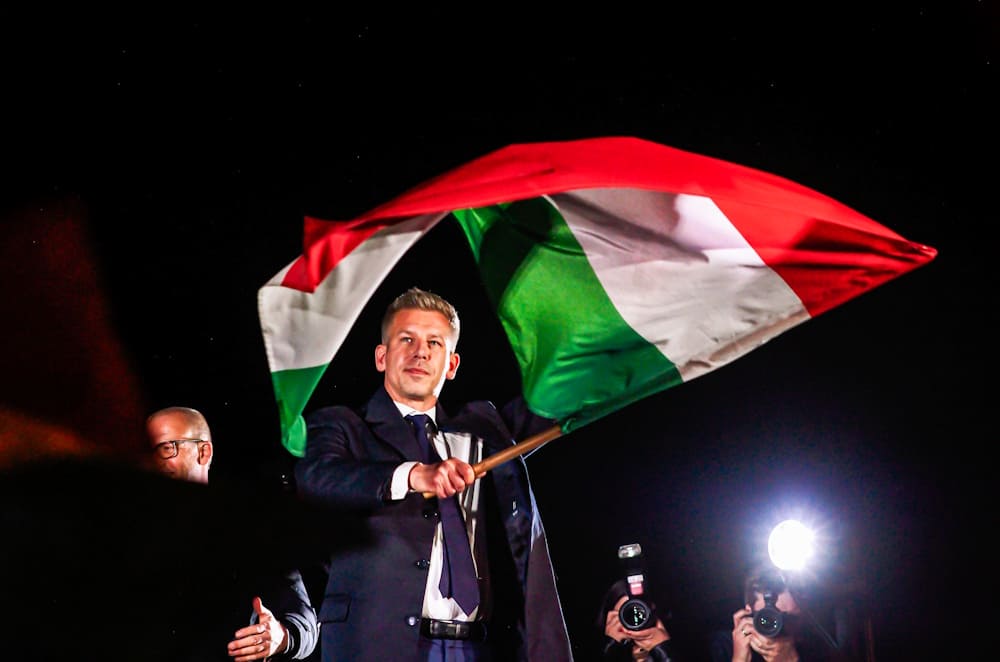
Nearly a month after the vote and on the eve of the inauguration of the government led by Péter Magyar, Hungary is a hotbed of ideas and an emotional rollercoaster. The defeated are licking their wounds and eagerly awaiting the start of a Hungarian Tangentopoli. Among the victors, there is scarcely a corner of civil society that is not putting forward plans for the future or a cahier de doléances of the discrimination endured over the past fifteen years.
On a formal level, the handover is proceeding without any particular hitches. Magyar requested — and obtained — that the inauguration of the tenth democratic legislature since 1989 and the swearing-in of the new executive take place not on a weekday but on a Saturday. The incoming prime minister decided to mark the arrival of a new political season over the weekend, so as to give his voters a street celebration that falls, not coincidentally, on 9 May, Europe Day. Hungary is symbolically rejoining that European Union it had entered on 1 May 2004, at the end of a decade of effort and sacrifice, and from which Viktor Orbán had gradually distanced it. As a Hungarian source within the Permanent Representation to the European Union recounts, in recent months Budapest’s diplomats had been excluded from numerous consultations. And it is no secret that the reason for this marginalisation was the veto Orbán had placed on a €90 billion loan to Ukraine — in the middle of an election campaign in which his apparent opponent seemed to be Volodymyr Zelensky rather than Magyar. “If Orbán had won, they would have suspended our voting rights,” the same source confides.
The awareness of having narrowly avoided a geopolitical and economic catastrophe is fuelling relief and optimism among Hungary’s elites and financial markets. In recent weeks the forint has appreciated by nearly 10 percent against the euro. Meanwhile, the ministers of the new cabinet — in particular the Economy Minister, former Shell senior executive István Kapitány, and the Finance Minister, András Kármán — are already at work, in coordination with the Permanent Representation to the EU, to enable the new government to reach an agreement with the European Commission by the end of May to unlock more than €10 billion in development funds that have been frozen for years.
Péter Magyar knows that time is of the essence. The European Commission has extended to his government what those in the know describe as almost “unlimited” trust — trust that Brussels justifies both by the exceptional nature of Hungary’s situation and by the universal significance of a message about the possibility of reversing illiberal trends and steering an autocracy back onto a democratic path. Honeymoons do not last long, however, and Magyar must reckon with the burden of a weighty past. What happened on 12 April was not a transfer of power in an ordinary democracy. It was rather an “electoral revolution,” as Hungarian political scientists have called it — a kind of last call to arms, driven by the authoritarian drift of Orbán’s system, which many had come to regard as irreversible.
Behind what appears to be a smooth and peaceful handover lies a climate of tension running through every fibre of the state apparatus, and through those sectors of the economy dominated by oligarchs on whose payroll hundreds of thousands of Hungarians depend. The political, social, and judicial earthquake set to begin on 11 May — when the new government takes possession of the strongholds of Orbán’s power — thus combines elements of Eastern Europe’s 1989 (an unarmed revolution in the name of freedom and dignity) with the appetite for judicial reckoning that gripped Italy in 1992–93. The political defeat of Orbánism inevitably reverberates through the machinery of a kleptocracy that has siphoned tens of billions of euros from the public budget and funnelled them towards a dozen oligarchs and a multitude of hangers-on.
The call of handcuffs is deafening — and not so much in Budapest as in the provinces, where the Orbán system had constructed mechanisms of neo-feudal domination. A study just published by the doyen of Hungarian pollsters, Endre Hann, identifies corruption and the coarsening of social relations as the main factors behind Orbán’s electoral defeat — not some abstract “hunger for democracy,” nor the government’s betrayal of Western values, but rather outrage at a kleptocratic and economically ruinous system.
Péter Magyar has won a sweeping popular mandate on a platform centred on the fight against corruption, and the ministerial appointments to key positions in the hard-power apparatus — the chancellery, the Interior, and Justice — confirm the impression that wide-ranging investigations against the leading political and economic figures of Orbán’s system are about to be unleashed.
What future, then, for the outgoing prime minister? After 36 years, Orbán has relinquished his parliamentary seat, and rumours are circulating of an imminent temporary move to the United States to attend the football World Cup. His eldest daughter, Ráhel, whose husband István Tiborcz is also one of the most reviled oligarchs of the former regime, has been living in the United States for nearly a year. Should Orbán face criminal charges and their attendant consequences, a prolonged stay in the United States — with the backing of Trump and the Republican Party — would appear to be one scenario in store for him. As political scientist Ivan Krastev has recently argued, however, Orbán’s electoral defeat and the collapse of his system of power represent a reputational blow and a logistical, financial, and structural blow to the entire illiberal international that has been built over the past decade, in no small part thanks to Budapest’s good offices and generous financial contributions.