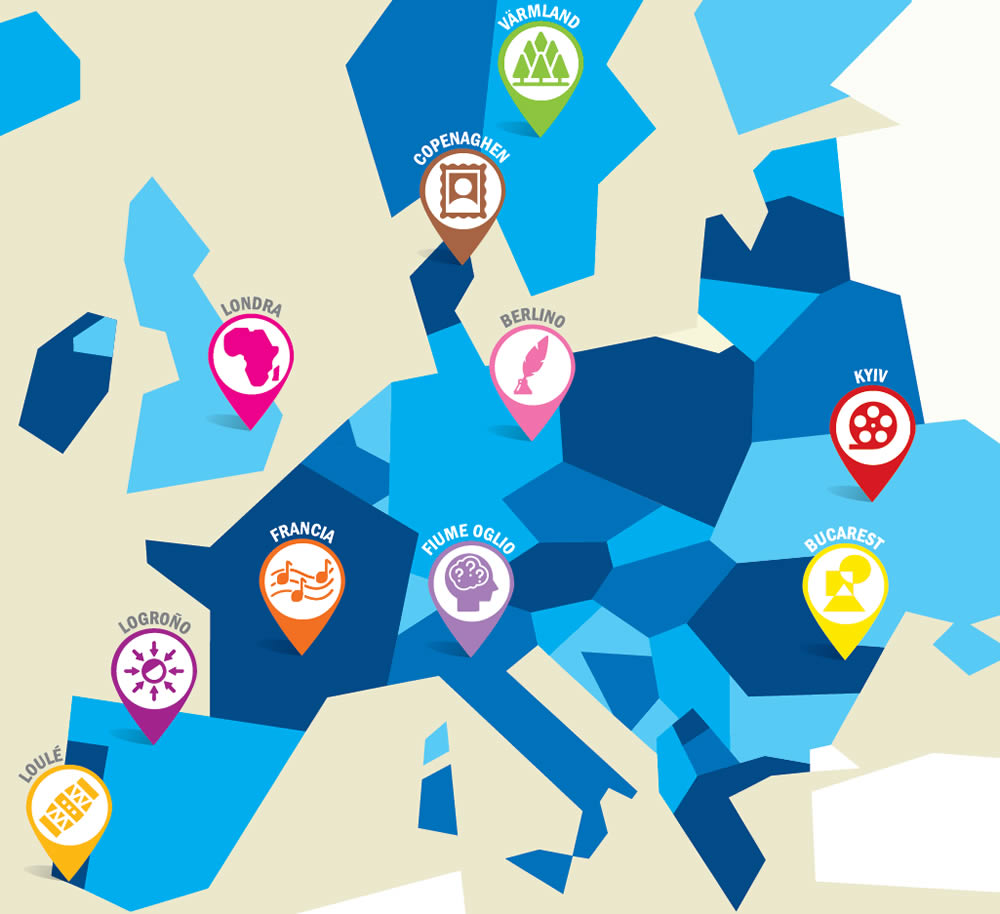
21 JUNE. FÊTE DE LA MUSIQUE / FRANCE
Play, people, play — for the solstice
The story of the Fête de la Musique is the kind told in French culture courses at Alliance Française centres around the world. The godfather of the event is said to be American musician Joël Cohen, who in 1976 was working for the broadcaster France Musique and proposed a musical programme for the night of 21 June to celebrate the summer solstice. In 1982, composer Maurice Fleuret took up the idea together with Culture Minister Jack Lang: free concerts to mark the beginning of summer. The festival began at 8:30 pm, after the end of radio broadcasts, and at its heart was the idea of giving space to amateur musicians. The very name played on the double meaning between “Fête de la Musique” and “Faites de la musique” — make music. The invitation was to take to the streets with your instrument and play. The idea was simple and political: to make music free, accessible, and popular. Since then the festival has spread across the world, and every 21 June thousands of concerts take place. From school rock recitals to harp performances, Japanese drums, samba rodas, electronic sets, Beatles cover bands — these are village-fair moments, amateur, but full of togetherness and celebration, of community. And of course there are the fanfares, with the accordion, which as Dalida once sang: “smells of France, and what a good smell it is.”
5–12 JUNE. DOCUDAYS / KYIV, UKRAINE
Ukraine is teaching us how to make cinema too
Today the new edition of the International Human Rights Documentary Film Festival opens in Kyiv. Setting aside the outstanding selection of international documentaries and looking at the Ukrainian films, a dynamic vitality emerges — and a unique phenomenon: the urgency of Ukrainian documentary filmmaking to interrogate reality as it unfolds. A new generation of directors is finding languages that speak not only of the war, but of life in wartime. This is not mere reportage, but testimony that becomes artistic gesture. Many of the films are made by filmmaker-soldiers, such as “Don’t Ask Me If I Killed” by Helena Maksyom — the diary of an enlisted director who reflects on what remains of the human spirit after loss, and how to preserve its fragility — and “Where Everything Disappears” by Oleksandr Tkachenko, shot by cinematographer and soldier Dmitro Dokunov, a pacifist from Odessa forced to rethink the meaning of defence and violence. On of the heaviest missile attack on Kyiv since the start of the full-scale invasion took place on the night of 24 May: Russia launched ninety missiles and six hundred drones against the capital. Of these, 549 and 55 respectively were intercepted. In recent years Ukraine has given Europe — and the world — many lessons: in technological and engineering innovation, in drones, in defence, in the capacity to adapt. But above all in resilience, in the love for life, and in the value of freedom. Now it is teaching us documentary cinema too — which distils all of these values.
25–27 JUNE. FESTIVAL MED / LOULÉ, PORTUGAL
Same music, same food — but not forever
David Byrne, frontman of Talking Heads, once wrote an essay in the New York Times entitled “I Hate World Music.” He was taking aim at the label coined around a table by a handful of London record executives to create a market for all music not in the English language. He argued that listening only to pop in English — or in Italian — was like eating the same meal for the rest of your life. For those who don’t want to eat the same meal their whole lives, there is a small town in Portugal that offers a varied menu, to stay with the metaphor. Loulé is a village in the Algarve of stone houses and a strong craft tradition, which twenty years ago invented a festival to celebrate the cultures and music of the Mediterranean basin and promote its own tourism. Today the horizon of Festival Med has broadened, and it welcomes traditional and contemporary music from around the world: artists from Africa to Eastern Europe, including Angolan musician Bonga, Seun Kuti — son of Nigerian musical genius Fela Kuti — Ukrainian artist Ganna Gryniva, Senegalese-French duo Ablaye Cissoko & Cyrille Brotto, Portuguese singer-songwriter Sérgio Godinho, the Moroccan-Brazilian sounds of Lala Tamar, and the traditional North African chaâbi mixed with flamenco and gypsy rumba of Labess.
5 JUNE – 6 SEPTEMBER. PROJECT A BLACK PLANET / LONDON, UNITED KINGDOM
A deep dive into Pan-Africanism
The exhibition “Project a Black Planet: The Art and Culture of Panafrica,” opening on 11 June, has given the Barbican the opportunity to take — as they themselves write on their website — a “deep dive” into Pan-Africanism, with over fifty events spanning art, music, film, and talks. Organised by the Art Institute of Chicago and the MACBA in Barcelona together with the Barbican and the Kanal – Centre Pompidou in Brussels, it explores how Pan-Africanism — that is, the anti-colonial political and philosophical movements and transnational solidarity among peoples indigenous to the continent — has influenced artistic production from the 1920s to the present day. With over 300 works in painting, graphics, film, and installations from Africa, Brazil, the Caribbean, and the United States, it is the first exhibition to systematically investigate Pan-Africanism as a cultural and imaginative force, shedding light on the role of artists in shaping the Pan-African horizon itself. The programme also includes the Cesaria Évora Orchestra with Mayra Andrade, a tribute to the great Cape Verdean morna musician; a screening of “Abolição” by Zózimo Bulbul, a 1988 documentary on the history of slavery among Afro-Brazilians; and activities organised by Earth Tenders — a Black-led organisation working to strengthen local food production communities — teaching people how to grow their own food.
18–23 JUNE. CONCÉNTRICO / LOGROÑO, SPAIN
City-specific interventions for shared space
Logroño is a small city in La Rioja that takes site-specific interventions very seriously. With the Concéntrico Festival — now in its twelfth edition, running from 18 to 23 June — it transforms the city into a full-scale laboratory of architecture, design, and urban experimentation, inviting architects, designers, artists, and researchers from around the world to interact directly with public urban space, with the aim of activating unused urban areas, squares, streets, and the riverfront. Three curatorial themes frame the programme: Identity and Fiction, Urban Ecologies, and Ephemeral Agents. Among the city-specific interventions, Matilde Cassani Studio has dressed the historic Arco de San Bernabé in a giant skirt typical of La Rioja’s dancers, while the collective Noof Group has created an installation that produces shade and fine mist to address the thermal vulnerability of public space.
3–7 JUNE. MoBU ART BUCHAREST / BUCHAREST, ROMANIA
Not just security — there is also the art of the young
A few days ago a Russian drone crossed into Romanian airspace during an attack on Ukraine and crashed into a residential building in Galați, in Romanian Moldavia. In recent years we have come to look eastward mainly on matters of security and defence — but we have since discovered that we have much to learn from the region. Bucharest, for instance, is one of the culturally most dynamic cities in Eastern Europe, a laboratory where museums, galleries, and independent spaces coexist, such as MARe, the first museum entirely dedicated to contemporary Romanian art, and the RAD Art Fair, which supports a new generation of gallerists, collectors, curators, and patrons. Until Sunday the city also hosts MoBU, the country’s first contemporary art fair and one of the most forward-looking and vibrant cultural initiatives in Central and Eastern Europe. Founded to bring together artists, galleries, curators, and collectors on a single platform, the event pairs the market with a programme of talks and conferences, including one dedicated to the ruins of communism and the memory of the transition period, and another on how to build an art collection. The fair also gives significant visibility to young graduates from the academies of Bucharest, Timișoara, and Cluj-Napoca.
11 JUNE – 27 SEPTEMBER. LUCIAN FREUD – EVERYTHING IS A PORTRAIT / COPENHAGEN, DENMARK
The Freuds’ obsession with the study of the human
The reason why so many of Lucian Freud’s subjects are depicted lying down is simple: the artist needed them to pose for many hours, several times a week, for months. He had them lie down so they could easily doze off — and for this reason, his subjects were often people from his own life: friends, family members, lovers, colleagues. They are the protagonists of the exhibition “Lucian Freud – Everything is a Portrait,” organised by the National Portrait Gallery in London at the Louisiana Museum of Modern Art in Copenhagen. It is a show devoted to one of the constants of his artistic inquiry: the human face. Freud was obsessed with the human figure, which he observed with an almost clinical intensity, depicting it frequently in a supine or seated position — sleeping, dreamy, absorbed, alone. He once said that “a painter’s obsession with his subject is all that drives him to work. People are not moved to make works of art by familiarity with the creative process, but by the need to communicate their feelings towards the object of their choice with such intensity as to make them contagious.” The exploration of the human, after all, seems to be a family affair — from grandfather Sigmund to his daughters Bella Freud, designer and host of the podcast “Fashion Neurosis,” and Susie Boyt, novelist.
18–20 JUNE. MIDSUMMER FESTIVAL / VÄRMLAND, SWEDEN
Into the Swedish forests, without scepticism
Nestled among the conifer, birch, maple, and oak forests of the province of Värmland, Sweden, Ängsbacka is an international centre and community that for thirty years has hosted festivals, courses, and retreats dedicated to inner growth, ecology, and the art of living together. Around the time of the summer solstice, the Midsummer Festival renews the pagan Nordic tradition of celebrating the longest day of the year — once accompanied by offerings to the earth, to natural elements (water is abundant in this lake-rich region), and to the creatures of the forest, to mark the central turning point of the solar cycle. A line-up of yoga teachers, storytellers, earth priestesses, shamans, musicians, and artists will animate a programme devoted to gratitude, growth, togetherness, and respect for the planet’s resources. Alongside workshops for all ages — families are welcome — visitors can share vegetarian dishes inspired by Nordic tradition (not Ikea meatballs). The festival is drug and alcohol free: presence and attention require sobriety. The programme continues throughout the summer; among the upcoming events is a festival dedicated to tantra, conscious connection, and love — interesting enough to pique the curiosity of even the most sceptical and rational among us.
4 JUNE – 28 JULY. FILOSOFI LUNGO L’OGLIO / LOMBARDY, ITALY
Philosophy lessons along the river
“The Reveries of a Solitary Walker” by Jean-Jacques Rousseau, The Walk by Robert Walser, Nietzsche’s strolls along Lake Sils — and then the flâneurs who come to know the city on foot. And at the origin, of course, the Peripatetics, who reasoned and philosophised while walking beneath the colonnades. Philosophy has always been a discipline in motion. The Filosofi lungo l’Oglio festival renews this tradition with 32 events — talks, conferences, philosophical and intellectual debates — in 24 municipalities along the River Oglio, between Brescia, Bergamo, and Cremona. The festival’s distinctive character lies precisely in its itinerant vocation, bringing philosophical thought to villages, castles, cloisters, and parks. The theme of the twenty-first edition, curated once again by Francesca Nodari, is “Listening.” Among the guests, Gustavo Zagrebelsky will speak on the Constitution, Stefano Mancuso on the “Canticle of the Creatures,” and there will also be appearances by Michela Marzano, Guidalberto Bormolini, musicologist, philosopher, and scholar of Judaism Danielle Cohen-Levinas, Massimo Cacciari, and Massimo Recalcati. The festival also organises a programme of philosophical walks — slow, meditative journeys in the spirit of the walking meditations of Vietnamese monk Thich Nhat Hanh, capable of awakening the maieutics of things in dialogue with the landscape and nature along the river. The routes are guided by local experts and intellectuals. One never steps into the same river twice — but every summer one returns to walk along the Oglio.
UNTIL 14 JUNE. POESIEFESTIVAL / BERLIN, GERMANY
Myth, pain, and the European canon in poetry
The poetry festival of Berlin’s Haus für Poesie, launched in mid-May with events spread across the city, moves in June to Silent Green, in the Wedding district. In addition to readings, the programme revolves around three themes: myth; pain as an experience inscribed in the language of the body; and the critical rewriting of the European canon — predominantly white and male. In an evening dedicated to this theme, Jamaican poet Lorna Goodison will read the opening verses of the Commedia as translated — or rather rewritten — by her in patois, Jamaican Creole (in keeping with how Dante wrote in the vernacular rather than in Latin), with her Virgil being Jamaican poet Miss Lou.