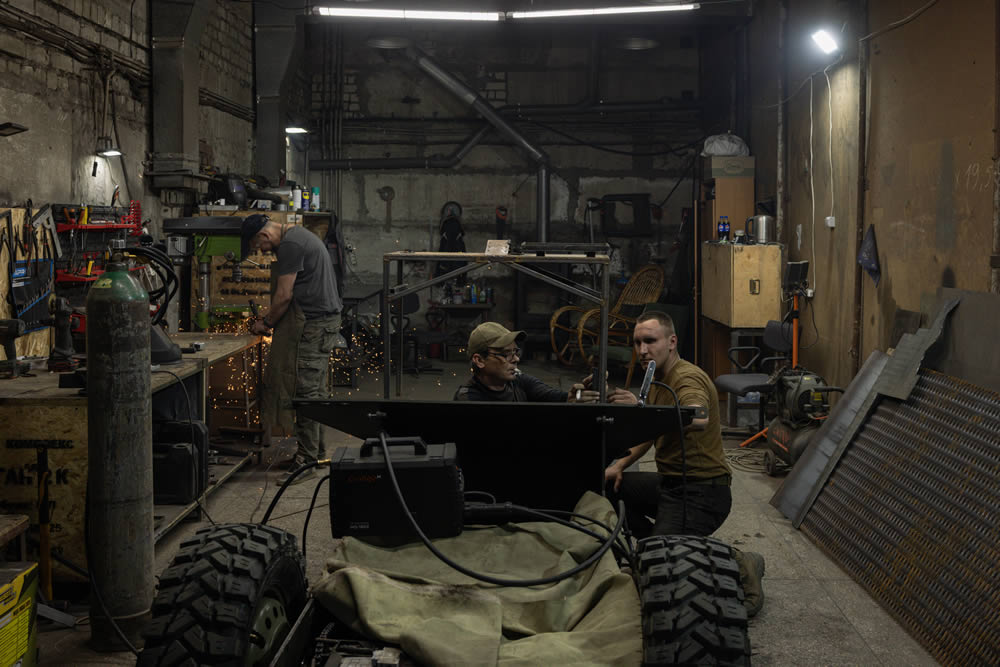
In modern war, territory is no longer the decisive measure. Control of ammunition, casualty evacuation, and supply lines now determines survival under relentless drone surveillance. Lose control of them, and no number of tanks will salvage the fight.
In autumn 2025, a severely wounded Ukrainian soldier lay pinned behind Russian lines for 33 days. Seven UGVs were dispatched to recover him. Six were destroyed by mines, Russian FPV drones, and small arms fire. The seventh, damaged but yet operational, drove 64 kilometres back to Ukrainian position. A Russian drone dropped an explosive on the return route. The soldier survived, protected by an armored capsule designed for exactly this scenario.
By spring 2026, for the first time, Ukrainian unmanned systems (UGVs paired with drones) had seized Russia position without infantry involvement or friendly losses. This is how Ukraine decided to wage war: machines absorb risk, soldiers can endure.
When Western military aid fell short in 2024, Ukraine didn’t pause. It mobilized networks of civilian engineers and volunteers. Drones compensated the gaps in firepower and reconnaissance at minimal cost. Success in the air bred a new problem on the ground. The kill zone stretched from roughly two kilometers (in 2022) to 30-50 kilometres (in 2025-26) in some sectors. Territory is now held by whoever controls the airspace with drones above and robots below. Conventional vehicles cannot operate inside this radius.
The global response to this new reality splits into two paths. The United States and Israel chase “contactless victory” – wars decided by massed precision air strikes and comprehensive surveillance, minimizing losses from ground operations. Ukraine, lacking both Russia’s manpower reserves and the West’s deep-strike arsenal, forged an intermediate path out of necessity: a democratic state unwilling to expend lives transfers mortal risk to machines.
Russia answers attrition with people, indifferent waves of conscripts and a system that ignores human cost. Ukraine built the opposite: a leaner, adaptive force where cheap, repairable UGVs now conduct up to 90 percent of frontline logistics in the most experienced battalions. By mid-2026, Ukrainian forces had run more than 50,000 logistics and evacuation missions since January, an average of 455 per day, using platforms costing $8,000-20,000 each. Expendable by design and improvable in the field, they have been confirmed to have reduced Ukrainian casualties by 30% according to a study by the Central Research Institute of the Armed Forces of Ukraine. Ground robots are not replacing infantry and are unlikely to do so for decades. However, they are replacing ammunition carriers, stretcher bearers, drivers, and other personnel whose exposure to danger adds little combat value. In a war of attrition, that distinction matters.
Ground robots first appeared as delivery vehicles, carrying ammunition and supplies. From there, their role expanded. Today they evacuate wounded soldiers, lay mines, and in some cases support combat operations. In the most advanced units, a single UGV can transport 300 kilograms of cargo, replacing risky supply runs and freeing drones for other missions.
The most dramatic use is casualty evacuation. Some Ukrainian units now rely entirely on robots to retrieve wounded soldiers from the battlefield. Armed UGVs remain marginal (around 2% of missions) yet enabled one unit to hold a position for 45 days without human losses through integrated UGV-UAV kill chains.
For decades Western planning bet on small numbers of exquisite platforms. Ukraine proves resilience now flows from swarms of inexpensive, locally fixable systems that evolve faster than any procurement cycle. A single UGV hauls loads that once tied down several soldiers, shrinking exposure and freeing humans for irreducibly human tasks.
Outside Ukraine, adoption remains hesitant. Defence firms flood the market with new UGVs, yet militaries still wrestle with doctrine, logistics chains, and force design. At this year’s Eurosatory exhibition in Paris, Ukrainian robots drew intense interest not for superior technology – many Western entries were more advanced – but for being cheap, combat-proven, and engineered on the assumption that losses are normal.
For many Europeans, the war might still appear geographically distant. Yet the technologies, doctrines, and institutions being tested in Ukraine are already shaping the future security environment of the continent. Europe’s eastern flank does not face yesterday’s Russian army. If deterrence fails in Estonia or Poland, Europe does not face a far-away problem. Russia has watched Ukrainian innovation unfold. In November 2025, Moscow established its own Unmanned Systems Forces, copying the institutional structure Ukraine created in June 2024. More dangerously, the Kremlin has absorbed operational experience, of how these systems actually behave under fire.
Europe should act in three areas. First, accelerate procurement and certification for autonomous systems: technologies that evolve every few months cannot be acquired through procedures designed for decades-long weapons programmes. Second, build a European-Ukrainian industrial partnership based on joint production, secure component supply, and protection of Ukrainian intellectual property. For NATO’s eastern flank and for Europe’s strategic autonomy, EU-Ukraine security partnership is one of the shortest and most effective paths to building credible defence capabilities in the era of layered remote warfare. Third, invest not only in robots but in the institutions around them: operator training, frontline repair capacity, and data-sharing frameworks that turn battlefield experience into future AI capabilities. The lesson from Ukraine is simple: the advantage lies in the ecosystem that allows them to adapt faster than the battlefield changes.
Lesia Bidochko is a Policy Fellow at the European Policy Institute of Kyiv (EPIC), Professor of Political Science at the Kyiv-Mohyla Academy, and a Non-Resident Research Fellow at the European University Viadrina in Frankfurt (Oder).