Rightly or wrongly, the British Education System seems to be an object of constant fascination to other countries, perhaps due to the endless number of books, plays and films that have been inspired by it.
The variety of scholastic systems offered in the UK is unusually broad; English vs. Scottish; Boarding vs.Day Schools; Private vs State Schools; Confessional vs. non-Denominational Schools; State-controlled Schools vs. “Academies” which are fully autonomous, privately funded, but state-owned schools, a hybrid system invented under the Labour government of Tony Blair in 2000, which have proved exceptionally successful, hence now very popular with parents & pupils alike.
All of which systems have their supporters and their detractors amongst both politicians, educationalists and parents.
But there are above all two major dividing lines in the Great British Education Debate which over the last century have fiercely divided the country and its political exponents, and continue to do so.
Firstly, over the last century, the Political Left have waged an incessant battle against private education, in almost all its forms, and then “Selective Education”, which streams pupils from the age of 11 to 18 according to their abilities.
In the 1960s & 1970s, successive Labour governments fought to abolish Grammar Schools – broadly similar to Italian licei – considering them unfairly advantage for the cleverer students, an disadvantageous towards those less bright pupils in the Secondary schools – much like the Italian scuole tecniche.
Despite the fact that almost all Labour ministers of the last century benefitted from Grammar school education, for ideological reasons, they wished to abolish them in favour of the one-size-fits-all Comprehensive Schools. Conservative politicians and educationalists called this “pushing away the ladder, once you have climbed up it”.
During the 1980s, under Margaret Thatcher’s three successive administrations, she – a proudly educated “Grammar School girl” attempted to restore the previous system, insisting that awarding merit was always a greater virtue than forcing a flat, “level playing field” where all pupils of whatever grade of academic skill would learn in mixed ability classes.
Since the various Trades Unions for teachers, and most of the School Boards of most large British Town and City Councils have traditionally been of a radical Left persuasion, Margaret Thatcher “the Milk Snatcher” (a soubriquet she earnt in the 1970s as Education Minster, for abolishing the free milk bottles offered to all primary schools by her Leftist opponents) had a big fight on her hands.
Realising in the late 1990s that the Comprehensive State school system was badly failing British children, especially those of a less economically & culturally privileged background, the incoming Labour PM Tony Blair, and his highly talented Educational advisor Andrew Adonis, (later Lord Adonis) formulated a clever way of avoiding the Grammar vs Comprehensive dichotomy – autonomous & self-governing Academies, with the right to select their own syllabus, a bold experiment which has worked very well.
Following the Conservative/LibDem coalition victory in 2010, the incoming Education secretary Michael Gove imposed a radical, somewhat traditional fixed syllabus based on competence in Mathematics & English – making enemies of the Leftie Teaching Unions, but with a massive improvement of Britain’s historically poor Maths in Europe wide PISA performance tables; In the baseline 2009/2010 tables, the UK slumped to 27th in the world for Maths. By the major 2022 PISA cycle (the core dataset driving the 2023–2026 baseline), the UK rose to 11th globally, establishing it as one of the highest-performing Western nations.
So if the Conservative mindset regarding a stricter, and less frivolous approach to the subjects to be studied in English schools, a fierce battle still reigns regarding the other, largely unresolved, educational Hot Potato: discipline.
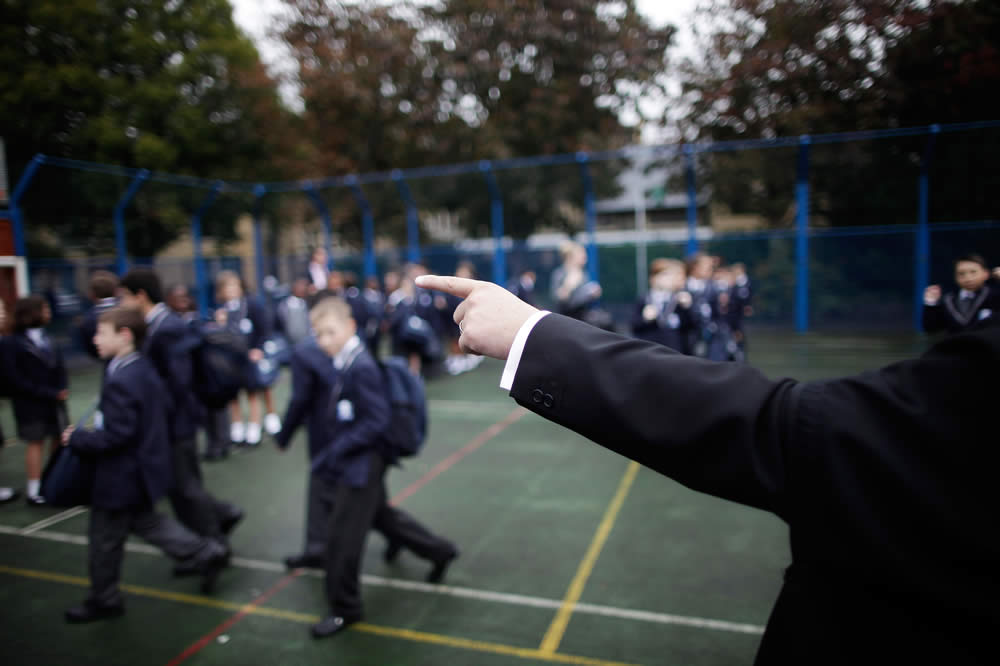
Very few “Public Schools” (ie prestigious historical boarding schools, some dating back to the 15th c. and mostly eye-wateringly costly) employ the strictly regimented rules of the past centuries or even decades, but there is an increasing trend amongst the autonomous “Academies” set up by far sighted teachers or culturally ambitious business people, to return to disciplinary protocols that appear to some as being positively archaic.
After many years of teaching in London state schools, and being frustrated by the lack of support for students wishing to study seriously and to obtain good A- Level results (broadly similar to the German Abitur, or the Italian Maturità), rather than passively accept a widespread regime of poor discipline matched by poor academic results, Katherine Barbalsingh set up her own “Free School” in the rather impoverished Wembley area, called The Michaela Community, trumpeting spectacularly draconian rules of behaviour, including severe punishments for dressing scruffily (the school uniform is mandatory) or chewing gum. Most of the school’s 840 pupils are from disadvantaged ethnic minority families, who are delighted by the improvement in their childrens’ behaviour and even more so, by their excellent academic results.
According to the Times “Almost 70 per cent of its pupils’ A-level grades were A* to A, which is more than double the national average of 28.3 per cent. One in ten students have secured places to study medicine this year and a third of grades were A* compared with a tenth nationally, despite being located in a disadvantaged area where almost 40 per cent of pupils are eligible for free school meals.”
Labour party hacks and Leftist Educationalists are incandescent at the rigorous “boot camp” school rules, and are awkward when trying to explain way the school’s outstanding exam results – better than most of those exclusive “Public Schools” where annual fees can reach £65,000 (€75,000). “There are no “middle class” children at the school because of parents’ “snobbery” smirks Barbalsingh.
Even more extreme was the behaviour of a few “Middle Class” ( ie wealthy metropolitan elite) parents who complained that the Mossbourne Victoria Park Academy in the impoverished area of Hackney, catering for mostly pupils from poor backgrounds, but boasting similarly outstanding academic results, and behaviour codes similar to Barbalsingh’s “highly controversial” Academy in Wembley, leading to an official enquiry into the ethos and practice of the school. The resulting Review, supported also by several Labour Councillors on Hackney Council, was highly critical of the Academy’s “excessive regime of discipline”.
As Matthew Toothe, the Executive Principal at Mossbourne wrote to the parents of his pupils ““I personally do not believe that you will agree with the review’s conclusions because if you did you would not entrust your children to us on a daily basis.”
Toothe adds that he has already spent nearly €500,000 in legal fees defending the school’s honour and its right “to be Strict, but Kind”. But the new Secretary for Education in the Andy Burnham government Lucy Powell, has indicated that she will do all she can to “safeguard school childrens’ human rights and mental health”. Code for clamping down where possible on the New Wave of strictly disciplined schools.