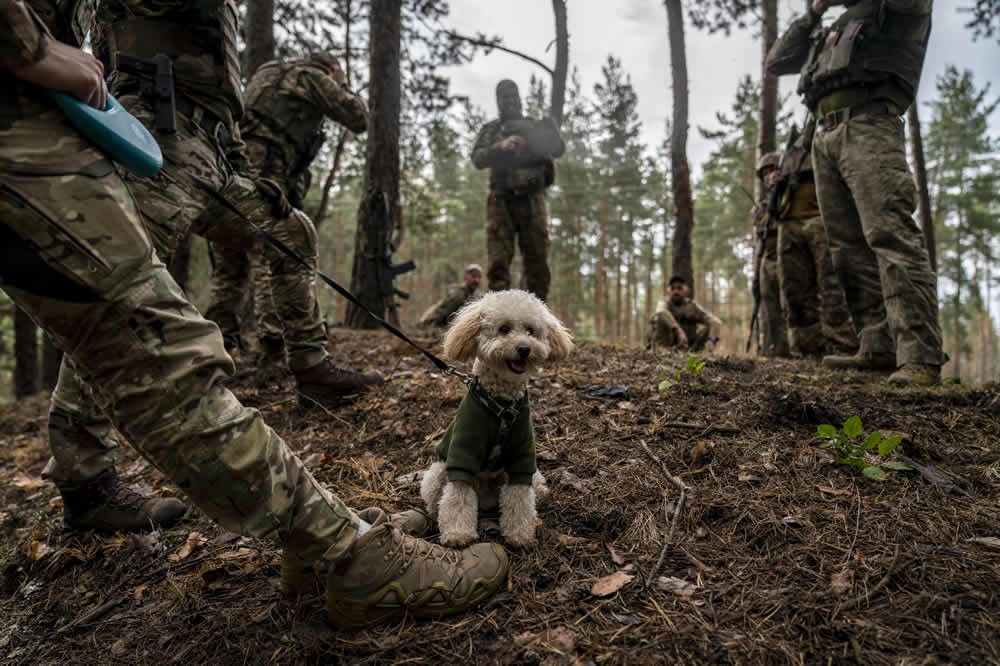
On the evening of August 28, Natalia was calmly walking her golden retriever Rocky in the village of Petrushky, in the Kyiv region, where they live. At that very moment, a Russian drone struck a warehouse in the neighbouring village of Myla. The warehouse held Ukrainian ammunition, which began to detonate. The explosions rang out continuously. As a result of the tragedy, 38 people were killed and 52 injured.
Hearing the loud, terrifying noise nearby, Rocky panicked, tore free of his leash from his owner, and ran off in an unknown direction. The search for him continued throughout September, with many caring people joining in. “He has a scar on his front paw,” reads the notice put out to find Rocky. As of this writing, the dog has still not been found.
Anna Romanovska is one of the volunteers who searched for the animal. She too has a golden retriever, a 10-year-old named Dolya. The young woman didn’t know Rocky’s owners before, but seeing their post online, she couldn’t stay indifferent. Together with a friend, she drove around neighbouring villages putting up flyers on lamp posts. They then set up a chat group to search for Rocky, which 70 people joined. “If someone called about the notice and said they’d seen a similar-looking dog somewhere in the region, one of the volunteers would immediately go check,” Anna, who lives in Kyiv, tells Il Foglio.
Since late August, explosions have been ringing out in the Ukrainian capital at any hour of the day. On a single day there can be more than ten air-raid alerts. Russia has begun making heavy use of fast jet-powered drones, which air defences try to shoot down. But Dolya, Anna’s dog, reacts relatively calmly to the loud noises — she takes her cue from her owner’s behaviour. During night-time shelling, the young woman and her dog move from the bedroom into the hallway of the flat, or into another room with no windows. “When she sees I’m nervous, she starts pressing up against me, as if to calm me down,” Anna says. Normally her dog isn’t fond of cuddles because she gets too warm, but during shelling she lets herself be stroked for as long as Anna wants.
Four-year-old Romeo, a small dog with big eyes, shakes at every explosion, says his owner, 55-year-old Anzhelika Velychko, an advertising project manager. When he hears the air-raid siren outside — if it happens during a walk — he immediately starts trembling and pulling Anzhelika home, even before any explosions actually sound. “It’s a good thing he only weighs 5 kilograms — I can pick him up, stroke him and calm him down a little,” the woman says. Whenever she takes him out, she always makes sure his collar has an ID tag with her contact details on it, in case he gets frightened and runs away.
For the past three years she has been giving Romeo sedative pills prescribed by a vet, but he’s still terribly frightened. His panic attacks got noticeably worse after May 24 this year, when the apartment block where Anzhelika lives with her 83-year-old mother and Romeo was hit during shelling. The windows and doors of the Velychko family’s flat were blown out. “He gets far more agitated than my mother and I do,” she admits. To try to calm her pet down, she not only gives him medication but has also bought a special cap for dogs that muffles the sound of explosions. But Romeo doesn’t like it and quickly shakes it off. So the only thing that works, when they take shelter from the explosions in the hallway or the bathroom, is human affection and a soft blanket the little dog is wrapped in while being held on someone’s lap.
How animals react to loud noises is a subject neighbours now often discuss with each other while walking their dogs in the park, Anzhelika says. The most severe reactions are seen in animals that were taken in from shelters or brought out of occupied territories, away from the war, she adds.
Shelter is another problem. Not everywhere allows people to take shelter with dogs, especially large ones. But in the metro, where during massive attacks up to 50,000 people sometimes spend the night, pets are allowed. The floor of the Politekhnichnyi Instytut metro station recently even had special markings put down reading: “Recommended spots for people with animals.”
On top of that, some cat and dog owners are now stockpiling food for their pets several months in advance, since warehouses holding all kinds of goods keep coming under Russian fire. On September 19, for instance, a large warehouse belonging to the Ukrainian brand Suziria Group, which makes pet food, was destroyed near Kyiv.
Animals, like people, also suffer from Russian attacks — they are killed and wounded. Maria Svirko, head of the “Zviropolis” veterinary centres, says that recently cats with serious burns were brought in from buildings damaged by shelling.
Animals can sense danger a little earlier than people, she explains, because they have sharper hearing and other senses. So, for example, a dog may start running around, whining, looking for a safe spot or hiding under the bed even before the air-raid siren sounds. It’s important that the animal has its own spot with familiar scents, even in the hallway, and that a person stays close by during the explosions. “The main thing is not to leave the animal alone,” Svirko says. Eating disorders in animals are also a stress response. Chronic illnesses can flare up as well. She recommends that people keep an individual first-aid kit for their pets, with medication for various situations, and follow the advice of their family vet.
In Ukraine, people try to help animals, and the animals help them back. Anna Romanovska says that at times she feels deeply low because of the war, and sometimes doesn’t even feel like talking to anyone. But Dolya still needs to be walked, and taken outside several times a day regardless. In her neighbourhood, everyone already knows and loves the golden retriever. “At the café they give her hugs, and treat me to coffee,” Anna says. “And you’re forced to re-engage with life — I’m incredibly grateful to her for that!” Romanovska says.