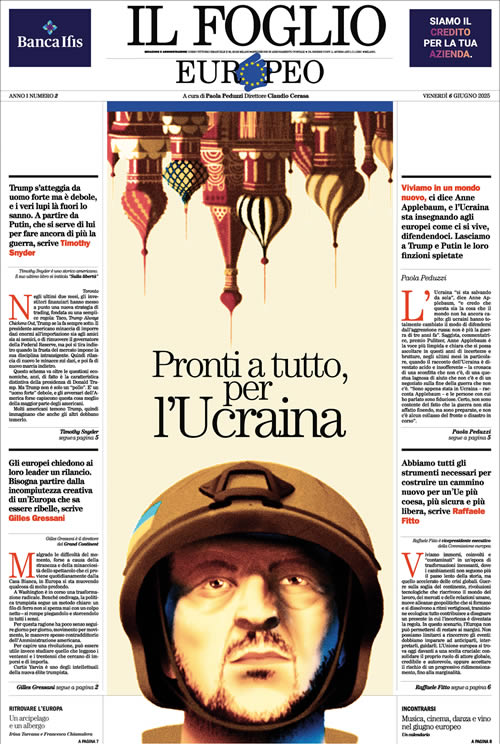
We live immersed, involved, and “contaminated” in an era of unrelenting transformations, where changes no longer follow the slow pace of history but the accelerated rhythm of global crises. Wars at the doorstep of the continent, technological revolutions reshaping the world of work, markets, and human relations, new geopolitical alliances forming and dissolving at dizzying speeds, ecological transition – everything contributes to shaping a present in which uncertainty has become the norm. In this scenario, Europe cannot afford to remain on the sidelines. We cannot merely react to events: we must learn to anticipate, interpret, and lead them.
The European Union now faces a crucial choice: to consolidate its role as a credible and authoritative global actor or to accept the risk of a gradual decline into marginality. And to make this choice – conscious, ambitious, determined – we need a strong political vision, shared among Member States, capable of generating cohesion. A vision that leverages our resources – economic, cultural, industrial – and transforms them into a concrete push toward the future.
The phase we are experiencing is among the most complex in recent history. Russia’s invasion of Ukraine shattered any illusion of lasting peace on our continent. It brutally reminded us that war does not belong solely to the past or distant parts of the world. Likewise, tensions in the Middle East, increasingly close to our daily lives, contribute to a globally unstable and dangerous climate. In parallel, we are witnessing a growing confrontation between political and economic models: on one side, democracies based on cooperation and openness; on the other, authoritarian and isolationist visions that often thrive on collective fears.
In this context, Europe must firmly reaffirm its position. Already in the political program presented by President Ursula von der Leyen, the European Commission made its stance clear, actively working to build bridges, strengthen alliances, and attract new partners. The bond with the United States remains strategic – an essential pillar for our security and prosperity. This relationship must be updated: we need a more balanced, more mature dialogue, able to jointly address today’s challenges, from artificial intelligence to the environmental emergency, from cybersecurity to common defense. In the spirit of unrestricted connections, Europe is expanding its network of international relations. With India, the world’s largest democracy, we are building a partnership that goes beyond mere commercial interests: we are talking about a cultural and strategic alliance, based on shared values. With South America, a continent too long neglected by European strategies, we have re-established a deep dialogue that will allow us to revive political, economic, and cultural exchanges. In a multipolar world, Europe must be both beacon and pillar.
The stakes are also high on the economic front. We are determined to relaunch the competitiveness of our continent while safeguarding principles of sustainability and social justice. In the early months of its term, the Commission defined two fundamental tools in this direction: the “Competitiveness Compass” and the “Green Industrial Deal.” These are programmatic documents but also operational roadmaps to make Europe more industrially resilient, more innovative, and at the same time more environmentally conscious. Complementing these tools is the Affordable Energy Action Plan, a necessary measure to counter the rising cost of energy, which burdens families and businesses.
But the Commission’s action has not been limited to these areas. We have worked on multiple fronts. In agriculture – a vital sector for the identity and sustainability of the continent – we have proposed a new vision centered on innovation and quality. For the automotive sector, one of the pillars of European employment, we have initiated a plan that combines ecological transition and industrial competitiveness. And in defense, we have promoted a European plan aimed at strengthening our strategic autonomy, providing for structural investments and greater fiscal flexibility for essential sector expenditures.
However, perhaps the most urgent challenge does not concern what lies outside our borders, but what happens within them. Because there is no strong Europe in the world without first being solid internally. And the Union’s internal strength is measured by its ability to be cohesive, to ensure equal opportunities for citizens in every territory – from the highly developed North to the most fragile peripheries.
This is where cohesion policy reveals its full strategic value. It is not just the largest component of the EU budget – accounting for one-third of total resources – but a concrete vision of Europe: a Europe that leaves no one behind, that does not accept territorial inequalities as destiny, that invests in the possibility for every citizen to live, work, study, and build a future in the place they call home.
As Executive Vice-President for Cohesion and Reforms, I have sought to strengthen this perspective. We have proposed a modernization of cohesion policy, structured around five new strategic priorities: competitiveness, defense, water resource management, energy efficiency, and housing policies. In practical terms, this means offering Member States the possibility, on a voluntary basis, to reprogram existing funds according to the specific needs of their territories. From inland areas to border regions, from Mediterranean islands to urban peripheries, every community will be able to act more swiftly, effectively, and with less bureaucracy.
Our goal is clear: to build a Europe where staying is a choice, not a necessity; where well-being is not a privilege for the few, but a widespread right; where European resources truly become engines of development, innovation, social cohesion, and cultural growth.
We face five decisive years. Years in which we must prove capable of meeting global challenges not only by managing emergencies – as we have already done with the pandemic, the energy crisis, and the effects of war – but also by charting a new path. A new course that will make Europe more cohesive, fairer, and closer to its people. President Mattarella, during his address to the College of Commissioners on his recent visit to Brussels, also reiterated the need for a stronger and more cohesive European Union – an objective we fully share.
Experience teaches us that it is precisely in the most difficult moments that the Union is called to give its best, rediscovering the deep reasons for its existence. This Commission is committed to transforming challenges into opportunities, with determination and vision.
The path will not be easy, but we have all the tools to face it. Together. Because a united, authoritative, and open Europe is the best investment we can make: for ourselves, for future generations, and for a world that increasingly needs stability, democracy, responsibility, and peace. In these days, even the new Pontiff – with simple yet powerful words – has called humanity to the urgency of peace, to the duty of fraternity among peoples, to the need for a politics that serves the common good and does not fuel division. It is a message that speaks to the heart of European identity: because Europe, if it truly wants to be a social guide as well as an economic and political one, must become the guarantor of this spirit of reconciliation.
Preserving this freedom – in institutions, in society, in the dignity of every European citizen – is the highest task ahead of us. And today more than ever, this is our time to achieve it. Our time is now.