 History grants no dispensations; it comes for us all. People, no matter how exceptional or ordinary, political or disinterested, cannot escape the tumult of their time. This was true of the great painter Chaim Soutine. Soutine spent his golden years at the cultural epicenter of the globe during the busiest period of artistic excitement in the modern era and he spent them as a giant. Yet he died in poverty not unlike the poverty into which he was born. His contributions to art and to global human enrichment were singular: no one had ever painted like him before, and no one ever will again. But many painters, poets, and all those with appetites for beauty and excellence have supped at his canvases.
He had the misfortune of being born a Jew in Europe on the cusp of the twentieth century, and a Jew with an unappeasable addiction to the wealth of painting which Europe safeguards. Perhaps this was the reason that he did not leave France even after it was clear his bodily survival depended on it. That would have been like him, though it was also like him not to explain himself so speculation is an open game.
Soutine consecrated his life entirely to his art, and that monomania yielded an oeuvre worthy of reverence and fascination. His obsessive dedication sealed him from the ordinary rhythms of human life – he had few friends, few lovers, and no family connections maintained with anything like sustained attention. His fanatical devotion to art gave his life meaning but it could not protect it from the paroxysms of the periods through which he lived, and the political upheaval which precipitated his death.
Soutine was born three times. The first was in 1893,[1] as the tenth of what would soon be eleven children fathered by an impoverished mender in Smilovichi, a village some fifty kilometers from Minsk, in today’s Belarus. As a child he was underfed (malnutrition crippled him and ultimately contributed to his premature death), and oppressed by the parochialism which is a perpetual feature of life in small, religious villages. There, miraculously, Soutine discovered his preternatural interest in art, despite the sepia-toned cultural backwater in which he found himself. He used to scrape a bar of charcoal against a wall or use a stick to trace figures in the mud. These were the early stirrings of a fixation which would drive him all his life.
At twenty years old his second life began as one in a swarm of artists who thronged to Paris in the first half of the twentieth century, freighted with foreign dreams. Soutine lived alongside Chagall, Modigliani, Pascin, and Leger. He frequented the same cafés as Picasso, and befriended artists who studied with Matisse. After a decade of bohemian indigence, glamorous in retrospect though at the time he stank of sweat and filth and was tormented by the pangs of an empty belly, Soutine was abruptly scooped from poverty in 1923, when a wealthy American art collector bought fifty or so of his paintings and vaunted Soutine from obscurity into the annals of art history – at last, a respected artist. This is the Soutine who was buried in Montparnasse cemetery twenty years later, the Soutine whose work hangs on the walls of modern art museums the world over.
These, like all births, were births of circumstance, products of outside forces over which Soutine had little control. But Chaim Soutine remade himself with every brush stroke. His artistic development was an intense saga of auto-creation. Two forces course through this man’s life: history, which manipulated him the way a palette knife crushes and scrapes the paint on a canvas, and Soutine himself, whose epic struggle for self-mastery, for the discipline and skill to communicate satisfactorily the energy of life itself, is recorded in the bulging scrapes and crushes of paints which seethe on the canvases he left behind.
His biography is propelled by two mechanisms which exercised their influence in tandem but never touched. There is history, and he had the great misfortune to live through overlapping historical frenzies – the times would not leave the poor man alone – and there is art. He happened to fumble into the burrows of political and artistic movements and found himself within various communities, but he was a member of no group and he did not cleave to friends. Paint was what occupied him, not ideologies or politics or even culture – paint, its peculiar demands and capacities. Unlike Matisse and Picasso, Soutine did not set about to revolutionize art – he was, to a startling degree, intellectually independent of his context, and so he contributed to the modern revolution without being in the throes of it. Soutine was alone even at the red-hot center.
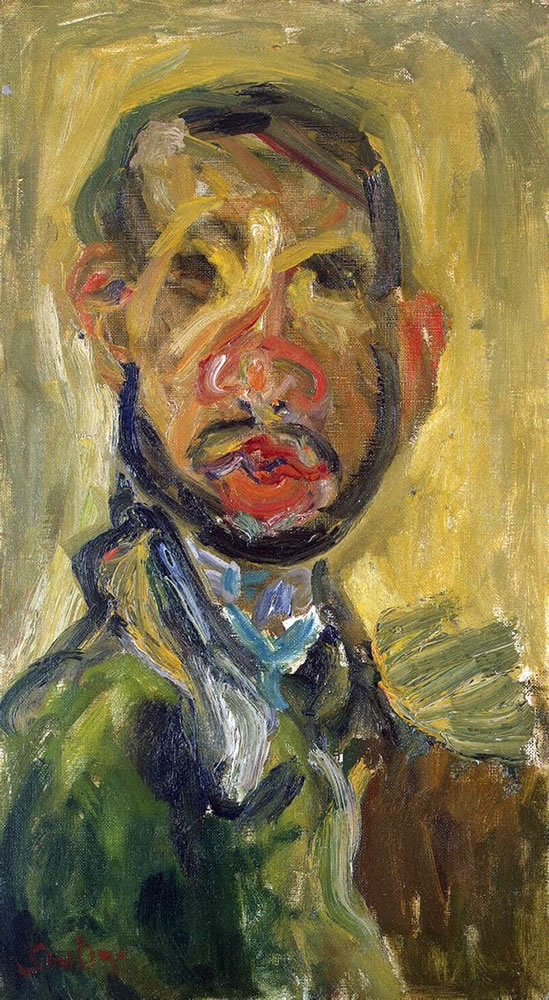
Because he was a misanthropic, awkward, semi-socialized genius, and because, in his own estimation, his work was primary and his personal relations hardly even tertiary, these two stories together cover more or less the whole of the artist’s life. For this reason it is exasperating to discover the catechismic pronouncements which repeat, in most works on the subject, that Soutine left behind hardly any letters, no diaries, no substantial record of his own thoughts put to paper, and so, with apologies, the man is terribly difficult to know. Left behind no trace of himself? But he is there, right before our eyes. The man was his art, and his paintings bellow from the walls on which they hang. As Hilton Kramer noted, in one of the rare accurate assessments of Soutine: “In a sense, Soutine had no biography outside his art; one might even say that his art was a substitute for a biography.”[2] Yes, he left scarcely anything of value except the art to which he consecrated his sickly body and colossal, muscular mind. If he had embalmed his soul and set it behind glass, viewers could hardly achieve greater proximity to the man than they do in the galleries which shelter his work.
In every artist, a cavernous ache to justify one’s art, to assure oneself afresh with each new work that one is capable of intelligence and honesty and quickening originality, must rage unabated. Complacency is spiritual suicide, and confidence can set in like rigor mortis, calcifying even brilliance. In front of the canvas (or the microphone, or the keyboard) one is, every time, every minute, on trial. Soutine scholars recognize that the artist was in the grip of a sinister psychic torture, but too often they misdiagnose the pain. They believe his torments were historical. His paintings were not riddled with the anxieties and terrors of the Jew in the twentieth century, as Elie Wiesel once indicated. The Cossacks and then the Nazis stalked him to an early death, but they had no authority inside his head, and there is no evidence of them in his work. There only his inner demons presided. Owing to his turbulent style, he is often called an expressionist, but Soutine painted what he saw, not what he felt; and what he saw, what he noticed and studied, was energy: not anxiety, not alienation, not abjection, not intensity of feeling, but energy, extreme vitality, as he detected it in the world around him. He studied it, and then strove to seal it in paint. The profundity of that assignment is what tormented him. He scraped himself against his own high standards, and the ensuing lacerations charged his work.
[1] 1893 is the year that Soutine gave to the police prefecture regarding his birth, but he told friends that he was born in 1894. Restellini quotes correspondence between Alfred Barnes and Pierre Loeb in which Barnes asks Loeb to discover Soutine’s date of birth and Loeb responds: “Soutine himself is not sure about the real date of his birth. He remembers being born in 1894 but doesn’t know the precise details.” Restellini, M. Soutine, Le Fou de Smilovitchi. Soutine. Ed. M. Restellini. Paris: Pinacotheque de Paris, 2007: 9-10
[2] Hilton Kramer “Soutine and the Problem of Expressionism” Artforum summer 1968