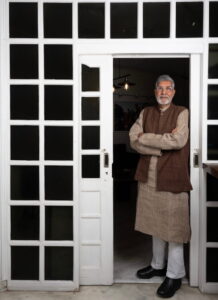
When a fire broke out in the forest, all the animals fled — except a hummingbird that flew towards the flames. It had been born and raised in that forest and could not watch it burn without doing something. It carried a single drop of water in its beak: it wanted to do its part. With this parable, Kailash Satyarthi tells the story of Karuna — compassion — in his book Karuna: The Power of Compassion. “It is a transformative force that makes us feel the suffering of others as if it were our own, and drives us to act to relieve it. A form of conscious problem-solving,” he explains to Il Foglio. Satyarthi is an Indian human rights activist and Nobel Peace Prize laureate. He has devoted his entire life to combating child slavery and exploitation, working to secure for children freedom, dignity, education, gender equality and justice. The Satyarthi Movement for Global Compassion (SMGC), which he founded, has saved more than one and a half million lives, has drastically reduced the number of children out of school and in child labour, has opened two rehabilitation centres for children freed from child labour, has rescued thousands of girls from child marriage, and has created more than 1,400 communities in which compassion is embedded in public and daily life. Yesterday he was in Venice for the presentation of Banksy’s The Migrant Child, restored thanks to Banca Ifis, and on the occasion we asked him about his work and the role of Europe — the actor that, more than any other in the world, guarantees the rule of law and social welfare — in the process he calls the “globalisation of compassion.” For Satyarthi, we are in the midst of a crisis of civilisation, and “human connection is the most powerful way to restore justice, peace, equality and sustainability. We need to rethink our approach to life and to society. This is an operational programme.” This approach assigns a central and irreplaceable role to young people, and recognises access to education and political participation as essential paths to emancipation. “Knowledge (vidya) is the one thing that cannot be stolen from you. It is at school that the process of liberation and dignity begins.” Fear and intolerance — the two great causes of humanity’s crisis — are the consequence of the failure of education, which is to say, the failure of civilisation. And even if “a child in a brick kiln in Bihar and a teenager disappearing into a screen are not the same situation, in both cases someone has failed to give them a genuine sense of agency. Many years ago, at the foot of the Himalayas, I met a child labourer — small and frail. He asked me whether the world was truly so poor that it could not give him a toy and a book, instead of forcing him to pick up a weapon or a tool. I have never recovered from that question. No one should. But it gives me hope that many of the children we have rescued from the worst forms of violence and exploitation have today become doctors, teachers, lawyers, engineers, activists for justice and freedom. A single spark of compassion, at the right moment, can ignite a whole lifetime of commitment. Every single childhood counts.” The SMGC has also given children space to make their voices heard. It invented and spread across India, down to the grassroots level, the Bal Panchayat — children’s councils in villages — where today 18,000 elected young leaders play an active role in governance: they identify which children in the village have dropped out of school, investigate community problems, and take the floor in public assemblies. In Europe, meanwhile — whose child protection system is among the most robust in the world — does it still make sense to speak of greater involvement of children in civic life? “Protection is not participation. One can be safe and still be silenced, cared for and yet invisible in the decisions that shape one’s world. Every child is born free. Freedom is the greatest gift, but if it does not include a voice, then something essential is missing. That absence surfaces later in the quality of citizenship and in the health of democracy. Children bring with them transparency and a sense of justice that adults have often buried. The young people who took to the streets across Europe over the climate were not asking to be protected: they were asking to be heard, while the political process excluded them from decisions about their own future. That is a democratic failure. Adults are responsible for poverty and injustice — not children. The least we can do is invite them into the rooms where decisions are made. Democratic habits form early. A child who has experienced genuine participation becomes a citizen. A child who has only ever been managed becomes a spectator. Europe already protects childhood in an extraordinary way; now it must build democratic participation as a right of childhood.” Satyarthi has faith in Europe, which he sees as a possible guide in the process of globalising compassion. And he considers the strategies for integrating compassion into leadership programmes, education and global governance to be the single most urgent question of our time. To this end, academics, professionals and scholars from around the world have come together to develop the Satyarthi Compassion Quotient™ — a measure of the compassion capacity of an individual and of a society, designed to assess and increase it — and have launched numerous thematic research programmes, including the development of a compassionate leadership framework to address the climate crisis: “The Earth is our first mother. Human wellbeing cannot be separated from the wellbeing of the living world that sustains us. If childhood is lost in one part of the world, the childhood of all humanity is lost. If freedom is taken away in one part of the world, the world is not free. No problem can be solved in isolation. Our lives are bound together with one another and with the Earth itself. To globalise compassion is to have compassion for the unborn child who will inherit a degraded planet, for the communities of the Global South that bear the heaviest costs of a crisis they did least to create. Europe has the capacity, the institutional architecture and the values to lead this process. The question is whether it will be able to follow those values all the way through, with consistency and honesty.”
On May 7, Kailash Satyarthi was in Venice for the presentation of the restoration of “The Migrant Child”, one of the two works by Banksy in Italy that Banca Ifis rescued from neglect and deterioration caused by the waters of the Venetian Lagoon. Created in 2019, “The Migrant Child” is Banksy’s denunciation of migration issues and children’s rights. A child wearing a life jacket stands upright, though his legs are still submerged in the canal water. He stretches his right arm upward, holding the stem of a plant that, like a distress flare, releases a thick plume of pink smoke. After years of neglect, Banca Ifis, following the initiative of Chairman Ernesto Fürstenberg Fassio, responded to the appeal launched by the Italian Ministry of Culture, the Veneto Region, and the City of Venice, ultimately saving the artwork. The bank also acquired the building on which the mural is painted — effectively the canvas of the work itself — and entrusted Zaha Hadid Architects with an ambitious restoration project that will transform it into a free cultural space where young artists will exhibit during the Venice Biennale.