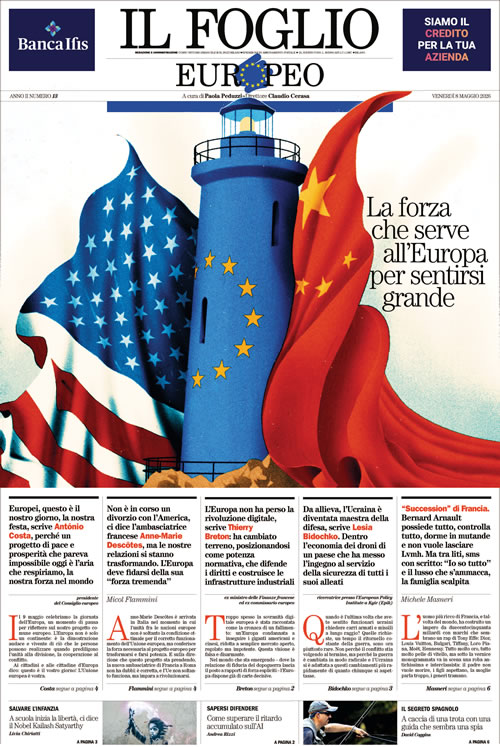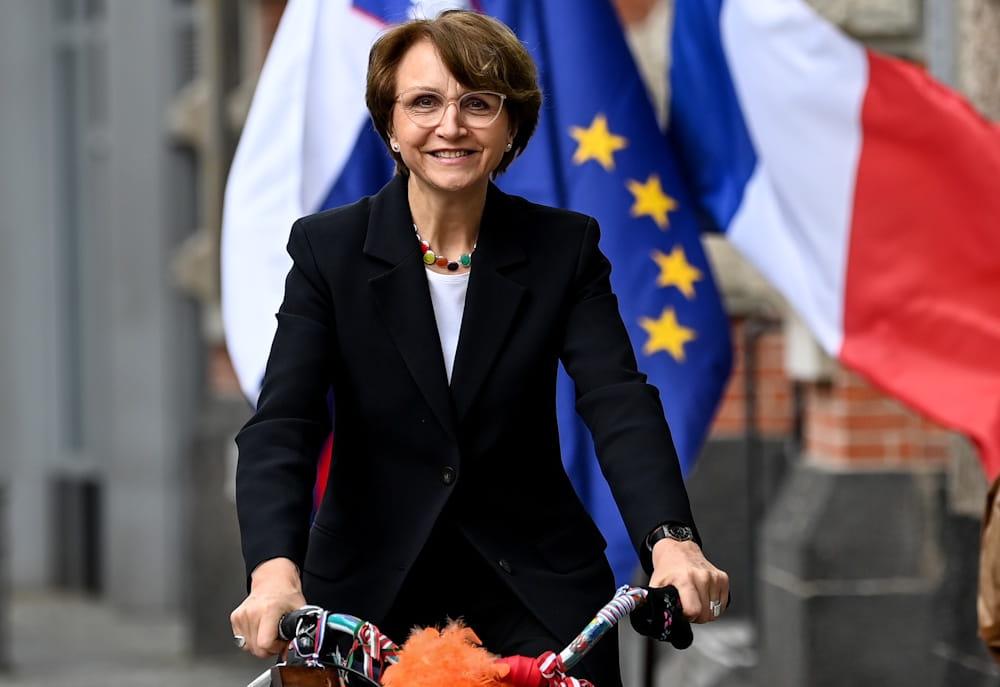
Anne-Marie Descôtes arrived in Italy at a moment when unity among European nations is not merely the optimal condition for the proper functioning of the European Union, but the very force that gives the European project the strength to transform itself and become a true power. And on the direction this project is taking, France’s new ambassador to Rome has no doubts: it is the right one, and the EU not only functions — it is learning to reinvent itself.
Navigating these unprecedented times means steering between a war on our borders and a relationship with our longstanding ally, the United States, so strained that some are already speaking of divorce. Not Descôtes. For the ambassador, the relationship with the Americans has changed, certainly, but the change did not come overnight. “We need this relationship with our American ally,” the ambassador tells Il Foglio, in her first interview since arriving in Italy. “When President Emmanuel Macron says we must work on our strategic autonomy and strengthen the European pillar of NATO, he does not mean the time for divorce has come. We must not think it is all over, because what is happening is nothing new — there has been an evolution in American foreign policy that began under Barack Obama. The difference is that today President Donald Trump expresses everything he thinks in his own brutal way.”
Trump’s actions and manner of communication have had an effect on the EU, which has not simply stood by and absorbed the blows: “Every country has its own relationship with the Americans, but take Denmark, for example — a country that has always maintained opt-outs on issues like defence, and yet, after Trump’s threats over Greenland, it is even more firmly inside the EU.” Greenland also demonstrated Europe’s capacity to respond in unity and deploy its own defensive measures. For too long, we Europeans refused to see the American shift; now it is impossible to look away. Equally impossible to ignore is the urgency and seriousness with which issues such as rearmament must be addressed, after four years of Ukraine defending Europe’s and NATO’s eastern flank against Russia. “In France too, it is difficult to discuss rearmament in public debate, but today we have a three-year military programming law in the budget that shows where the choices lie. Work is ongoing on this, and also on civilian resilience — security issues, including hybrid warfare, come up frequently in public discourse. France is the second most targeted country in Europe, after Ukraine. Every day we suffer hybrid attacks; our Foreign Ministry receives 300 million of them a year, and we must prepare for future threats that may target our healthcare systems or nuclear power plants. All of this must be factored in, even if it is not stated openly, so as not to generate anxiety.” On Italy and rearmament, the ambassador notes something she finds “interesting”: “There is a strong pacifist sensibility here, yet at the same time Italy has a highly advanced defence industry — a true centre of excellence. No one wants war, but one must be realistic” — and Italy is more realistic than it appears.
The first acceleration of our changes was not imposed by Trump but by Russia’s aggression against Ukraine. Trump has created an acceleration of the acceleration. Ambassador Descôtes does not minimise the losses Ukraine has suffered, but stresses that Russia has not achieved its objectives: “When Putin launched his aggression, the question of Ukraine’s accession to the EU was not truly on the table; now it is very much under discussion — it is almost a foregone conclusion. From that perspective, he has lost. There is something we need to make our allies understand: Putin wants a war against the West; he has started an ideological war, fighting against Western values — our values, and originally those of the United States as well. We must reason with our allies on two levels: the war itself, and what it represents.” On the Middle East too, following the American and Israeli strikes against the Islamic Republic of Iran, the Europeans remained united and solid, and on the question of navigating the Strait of Hormuz, says the ambassador, “we have shown ourselves to be reliable partners.” Descôtes returns to one of the fundamental questions facing Europeans: what we think of ourselves. “There is a tendency to always underestimate what we are and what we do. Clearly we must do more, but we also need to be far more aware and far more convinced of the meaning of the European project. And I believe that what appears to be our weakness — having to reach agreement among 27 — is also our true strength, and what makes us capable of managing complexity. This gives us tremendous force. We must believe it.”
In her career, the ambassador has navigated many complicated relationships, and in her experience extreme positions often lead to a virtuous synthesis. Before coming to Italy, and before serving as Secretary-General of the French Foreign Ministry, she was ambassador to Germany. France and Berlin are considered two pillars of the EU, which at various times have appeared to be in crisis: “The Germans speak of an ‘engine’; we speak of a ‘couple.’ But one must remember that from the very beginning, it was understood that the EU could not move forward without a minimum of consensus between Germany and France, because on every major issue — and I have seen this, I have lived it — the discussion begins from opposing viewpoints. Starting from such distant positions, in the middle you always find the states closer to the German approach and those closer to ours.”
Today Europe has enlarged, the international context has been upended, and the points of disagreement and agreement seem to have tripled. Even the relationship between France and Italy is often portrayed as one between two opposing, antagonistic nations — yet the common ground is considerable, and sometimes it took an exercise like the Quirinal Treaty, on which Descôtes personally worked, to make that plain: “Prime Minister Giorgia Meloni and Emmanuel Macron are both very pragmatic in their way of reading the world. They are convinced that we must act in a united way, as Europeans, and that the bilateral relationship must be strengthened. We are neighbours, we share a common history, and we already have a great deal in common in terms of cooperation on international and European matters, such as the discussions on the multiannual financial framework. There are strategic directions for Europe over the next seven years on which we share a common vision, and we cooperate in the defence sector as well.” There are no signs of Europe falling apart. The flags flying outside the French Embassy flutter and beat against the façade of Palazzo Farnese, their folds intertwining. That too seems a reminder of unity.