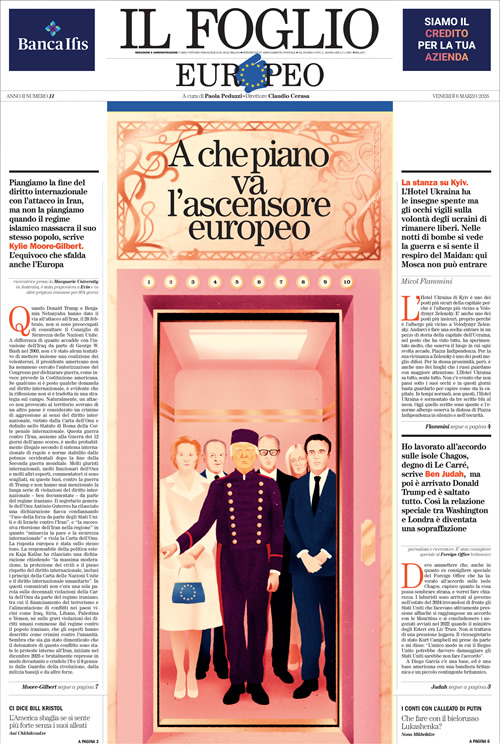
The Trump administration has made it clear that it considers the European Union – and not its individual members – an ideological enemy. It is stated in the National Security Strategy published at the end 2025, and it was reiterated by Secretary of State Marco Rubio during his speech at the Munich Conference in early February. The fact that Rubio was more pragmatic than Vice-President J. D. Vance a year ago, should not give rise to any illusions. This is also because, during the Conference, Rubio cancelled his planned meeting with the Ukrainians and then left for Slovakia and Hungary, countries that stand in the way of EU policies, paralyzing them. Slovakia and Hungary promptly continued with their blackmailing a few days later. But the constant American attacks, ranging from cultural to commercial battles, that naturally plunge regarding relations with Putin’s Russia, should not continually cripple the EU, because the strength to react exists – we just need to know how to use it.
The Trump administration has made it very clear that it sees the European Union – not its individual members – as an ideological enemy. Marco Rubio reinforced that point in Munich earlier this month, albeit in a politer fashion than J.D. Vance had done a year earlier. That Rubio cancelled his “E3” meeting on Ukraine in favour of going to Slovakia and Hungary to boost Fico and Orbán spoke volumes.
Europe thus knows what it must do – strengthen the EU and act collectively. That means implementing the Draghi report, strengthening cooperation between the big European defense powers, including the UK, and cooperating closely with other like-minded middle powers, including Canada. Trump wants to pick off countries bilaterally, where the US preponderance is overwhelming. Europe, acting in unison, causes him to back off, as we saw with the “Greenland moment” in Davos.
Two final thoughts. First, 2026 will be the year that Trump targets Europe’s digital regulations. Brussels and the EU’s member capitals must push back aggressively. The right to privacy and to protect our children from online predators and digital addiction is an issue that the person in the street can understand, and will rally behind. Second, the EU has to be at the negotiating table with Russia and Ukraine. All of Ukraine’s funding now comes from Europe. Zelensky should not be left alone in the negotiating chamber.
Edward Luce – Financial Times chief US commentator based in Washington. His latest book is Zbig: The Life of Zbigniew Brzezinski.
The notion of a « weak » Europe mainly stems from the mechanics of power at the European Union level, more than from any psychological lack of self-esteem. Europe is not a state, can’t function as such and isn’t ready to go through the institutional changes that’d be required to speak with one (unique) voice. The collegial nature of the European endeavor leads to constant debate and often exposes division – hence the reputation of weakness. But that’s a superficial impression and one can argue that beyond the decision process, Europe possesses many strengths: it’s huge market, strong rule of law, established peace and freedom, shared democracy, high level of development, ancient culture and civilization… We have a say: ”When I look at myself, I despair; when I compare myself, I find comfort.” We’re only weak if we let others think and act as if we were. And if we let them divide us to the point of paralysis.
Nevertheless, the mere fact that we’re asking why we appear so weak shows that the issue requires some action. It seems to me there are two easy things we can and should do to bolster our credibility: push forward whenever possible with “coalitions of the willing” (a process already started), leaving behind those who play Trump’s or Putin’s part; and find a stronger voice to unite and mobilize UE forces. On this account, I’d relay a suggestion that French essayist Nicolas Baverez has made in Le Figaro: give Mario Draghi at once the head position of both the European Commission and the European Council, so he can implement the key recommendations of his report on competitiveness.
A quick last point: American strength is a given, but its current aggressiveness isn’t reinforcing its clout. To the contrary, since American power has always been a combination of military might, diplomatic leverage and a certain degree of exemplarity. Now its soft power is in decay – an opportunity Europe shouldn’t miss to expand its own.
Philippe Gélie – Deputy Editor-in-Chief of Le Figaro and former US Bureau Chief.
The first thing to keep in mind is that the US is one country, while Europe depends on how you define it. The 27 countries in the European Union or more than 30 countries in the continent? Either way, it’s not one unified actor. The fact that the EU exists and that it can operate as a single market is an extraordinary achievement, considered the differences between the various countries. Europe hasn’t had to position itself as one actor in anything other than trade until now. And Europeans are aware that the EU is a strong actor when it comes to that. Efforts have been made during the years, but the EU didn’t need to be a political actor or to be strong geopolitically. And some countries are members of Nato some are not.
It’s not a matter of self esteem because it hasn’t been necessary to be strong about geopolitics in a harmonious world. No structures were built in that direction. That is what Nato was about. Nato is the military arm defending Europe and its an alliance with the Us. Now its clearly becoming necessary for Europe to become stronger in the geopolitical domain. The advantage for the Eu and for Europe is that its citizens want the EU to become more assertive and to play a larger role in geopolitics as well. They don’t’ like what they are seeing from the US. They want to be more independent. They want Europe to stand up to the United States.
What can be done? A lot is happening. Sovereign alternatives have been discussed. OThere is one interesting initiative, not in the EU but in the United Kingdom: Uk and London based banks are discussing a Uk based payment system alternative that would be operated by Uk banks backed by the Uk government. This very interesting initiative shows how quickly European governments and business entities are beginning to think how to reduce their countries and Europe dependence from the United States.
Elisabeth Braw – Security expert and senior fellow with the Atlantic Council’s Transatlantic Security Initiative. Here articles appear on the Guardian, the Times and Politico.