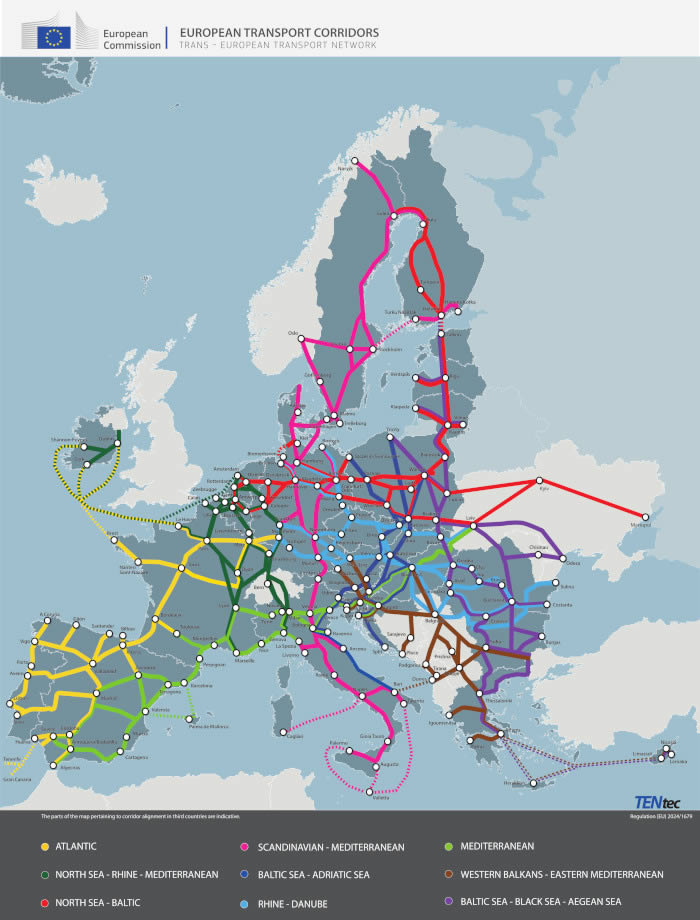
On a large map of Europe, a set of coloured lines crosses the continent like the lines of a metro map in a big city. “It’s the most evocative representation of the Trans-European Transport Network (TEN-T),” says Maurizio Bufalini, director of Telt, the Franco-Italian company digging the Turin-Lyon tunnel. “The routes are the metro lines and the cities are the stations.” Among those lines is a green one that crosses the continent from east to west, running from the Po Valley to the Alps. Simple, on paper. In reality, it changes name, route and even purpose, depending on who is describing it and when. That’s not a flaw: it’s the nature of a project that crosses five countries, spans decades, has weathered shifting political priorities, and has faced fierce opposition, such as that against the Turin-Lyon high-speed line (TAV).
The first thing that changes is the name. Originally it was called “Corridor 5,” defined between the Pan-European transport conference in Crete in 1994 and the one in Helsinki in 1997, to link freight and passengers from Venice to Kyiv. “At the time, the European Union wanted to break down national borders, which were clearly defined in rail transport,” explains Antoine Pecqueur, a journalist and author of “Géopolitique du rail” (Éditions Autrement, 2021). “The idea, from the outset, was to smooth the flow of goods across the continent.” In 2004 the line became the Lisbon-Kyiv corridor, a name that stuck around but has since become imprecise, because in 2013 the project was redefined, and the new “Mediterranean Corridor” now runs from Algeciras, in Spain, to the border with Ukraine. Why there, and not all the way to Portugal? “There’s no truly objective reason,” explains Mathieu Grosch, a former MEP and the corridor’s European coordinator. “It’s more a matter of balance between the corridors” — a systemic choice, not a mystery to be solved.
That same year, 2013, two journalists, Luca Rastello and Andrea De Benedetti, set off on foot along the line. The result was “Binario morto“ (“Dead End Track,” Chiarelettere, 2013), an account of a route far from linear or finished. “In the debate at the time there was an elephant in the room,” recalls De Benedetti. “The other countries involved seemed to be simply waiting for us at the Turin-Lyon banquet, as if everything were already in place except for the infamous tunnel, but no one had ever gone to check.” From that journey, recalls De Benedetti, who is a writer and teacher, “some grotesque issues emerged”: for example, “when we got to Trieste looking for the train to Ljubljana, we ended up renting a car, because the connection didn’t exist then, and it still doesn’t exist today.”
Today, however, according to Grosch, the Mediterranean Corridor shouldn’t be thought of as a single track. “It’s not just about trains,” the former MEP points out. “There are also roads, ports, inland waterways, airports.” This multimodal logic is reflected on the map by the splitting of the green line. West of Milan, the corridor runs both along the Ligurian coast toward France, via Ventimiglia, and through the mountains of Piedmont, via the tunnel currently being dug between Susa and Saint-Jean-de-Maurienne — the one that has fuelled the No Tav movement for more than twenty years. One line on the map, two routes in reality, because, as Pecqueur notes, “tracks are expensive, and inevitably require public money.
The figures, indeed, are astronomical. Completing the entire Mediterranean Corridor costs, according to Grosch, between 55 and 60 billion euros, of which the European Union funds at most 15 to 20 percent; the rest falls to the member states and other sources. On the Turin-Lyon line alone, Europe invests more: Bufalini points to “more than 14 billion” for the cross-border section of the tunnel, split a quarter each between Italy and France, with the remaining 50 percent coming from the EU. “Europe needs the railway, but the railway needs Europe,” Grosch sums up.
Finally, the purpose changes too. No longer just freight: also ecology, and increasingly defence. “The ultimate goal of the whole TEN-T project is decarbonisation,” says Bufalini. “Rail is the mode that consumes the least.” A goal that also runs through everyday consumption: the hypermobility of goods, for the director of Telt, isn’t a memory of the 1990s — it’s how we live today. “Apart from the last mile, which has to be done by Amazon’s delivery van,” he explains, “if there’s no train, those goods move on giant container ships that then get loaded onto trucks.”
Then there’s defence. “Ecology remains a very important element, but now this has been added to it,” says Grosch. After Russia’s invasion of Ukraine, the European Commission and NATO have been pushing “military mobility” — the ability to move troops and equipment quickly in the event of a crisis. In November 2025 the Commission and the High Representative presented a Joint Communication on Military Mobility, a historic step for European defence, with the goal of establishing a European Union military mobility area by the end of 2027. On the Mediterranean Corridor, each country’s military flags weak points to the planners — bridges, for example — and the works that are most urgent, “while the strategy itself remains classified,” Grosch explains.
And the Turin-Lyon tunnel? For Bufalini, nothing changes: “It already meets the highest civilian standard, which coincides with the military one.” A project born for trade, then, but fundamentally compatible with military needs too. “On 31 December 2033 the Turin-Lyon line will be operational,” Bufalini guarantees. Grosch is more cautious: the access lines, especially in France, may not be ready in time, and the final date has yet to be confirmed. Asked about the corridor’s future, he allows himself a wish: “I hope that tomorrow it will be a corridor of reconstruction, rather than of defence.”
What remains is the map, with its clean, coloured lines, as neat as a metro diagram. Bufalini had said as much from the start, as a compliment: “It’s the most evocative representation.” But a continent, unlike a metro system, doesn’t move in just one direction.