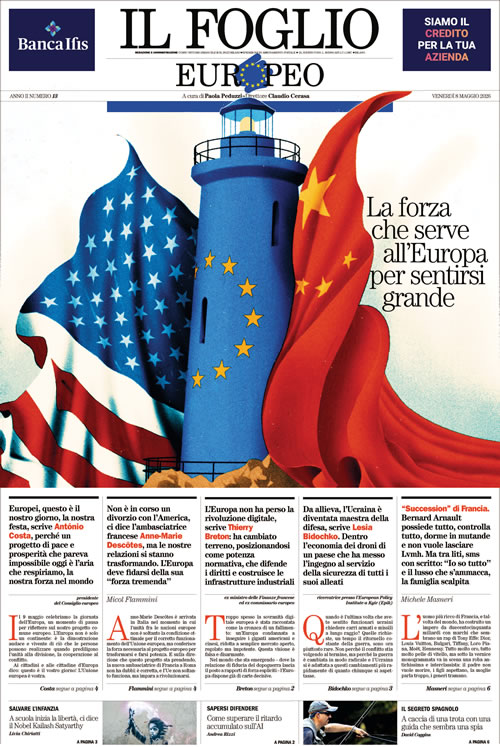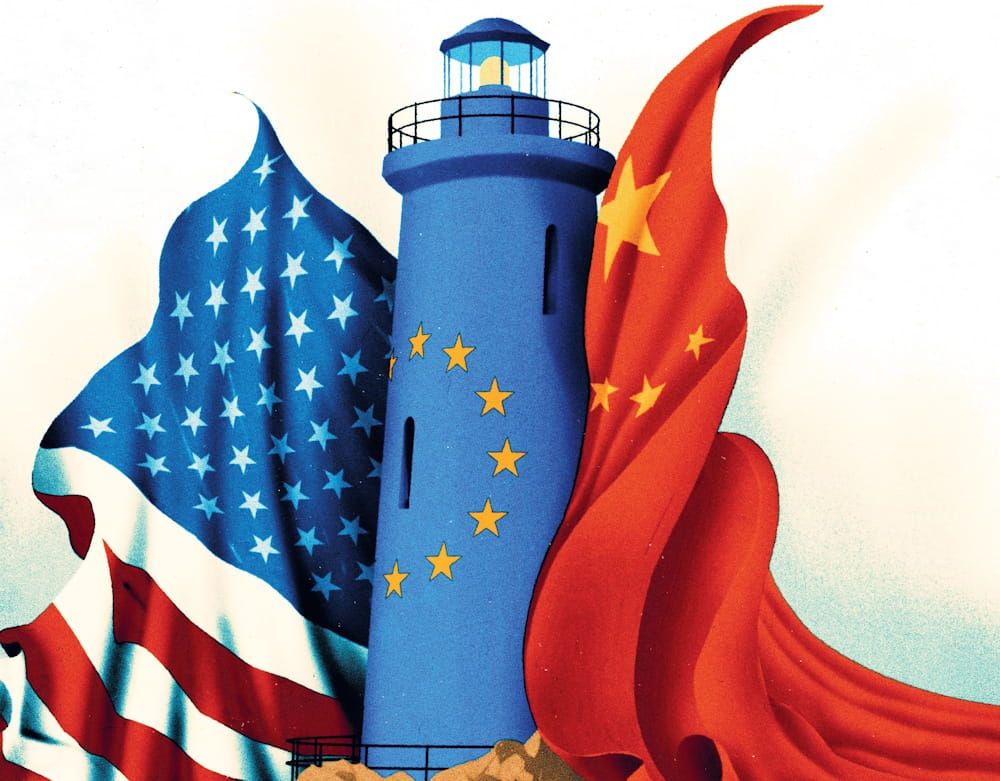
The world is witnessing the violent birth of a new era, defined by the rise of unleashed nationalist and imperialist forces. The phase that opened with the fall of the Berlin Wall — a time of extraordinary expansion of globalisation, democratic progress, and the construction of new international institutions — is over. In this new phase, Europe risks being subjugated by great powers that, without scruple, are seeking to reconfigure the global order and assert their interests in a transformed landscape. Russia attacks from the east; the United States has explicitly declared its intention to cultivate resistance against the European integration project, which remains is the only instrument available to the peoples of the continent to guarantee their independence; and China, though it has launched no physical or verbal attacks, also has an interest in weakening the EU — and to that end supports Russia, which exhausts Europe, distracts it, and obstructs its path toward competitiveness.
In this context, it is understandable that European public debate is heavily focused on the challenge of building autonomous defence capabilities, now that no one fully trusts American protection any longer. Europe remains a US military protectorate and must develop a genuinely credible deterrent force of its own. Against this backdrop, it is self-evident that technological dependence — and the lag accumulated in strategic sectors — represents a first-order threat that doubles the risk of Europeans finding themselves reduced to the condition of vassals. As the slogan of the shadowy technology company Palantir suggests, the hard power of the modern age is built on software, and the deterrent weapon of this century is artificial intelligence.
The United States and China lead the race for dominance in this technology. It is a race made up of several distinct competitive segments, well analysed in Stanford University’s recent AI Index Report. The United States has the upper hand in key areas such as innovation, the volume of investment, the size of the private sector, and the number of data centres; China appears ahead in terms of patents and publications, and in the deployment of AI within the real economy. Europeans are lagging behind. They lead on the regulatory front and possess high-calibre human capital — but, on the whole, the gap is serious, and there is no shortage of factors that give cause for concern about deep dependency.
The stakes could not be higher, and not only in military terms. The economic impact is incalculable, as is the impact effect on the battle for control of minds. The struggle to shape the new era has the cognitive front as one of its most decisive dimensions. The assault being waged against the rules-based multilateral order, against human rights and democracy, is a revanchist offensive that rests on emotional foundations: resentment and a hunger for revenge. From the east, those of a Russia humiliated by the collapse of the Soviet Union, or of a China seeking to reclaim its role as the Middle Kingdom after the so-called century of humiliation. From the west, those of the popular strata that felt abandoned by globalisation and are now seeking to recover lost ground by bringing nationalist forces to power. The contest to control the mechanisms capable of generating desired sentiments — to win support and to weaken the forces that instead uphold liberal democratic proposals — is an existential struggle. Propaganda has existed since time immemorial, but today’s quantitative and qualitative capacity is diabolical.
In the face of all this, the work ahead for Europe is immense. It is necessary to complete the single market in capital markets union, as Enrico Letta has argued, making it truly integrated, deep, and liquid, so that European savings no longer flow en masse toward the United States but are instead invested within the European productive sphere. At the same time, a change in investment culture is needed — one that accepts greater risk in the service of innovation.
It is equally indispensable to advance the construction of a resilient and competitive energy market capable of delivering affordable energy, a factor of essential importance given the enormous consumption demands of certain computational activities. It is also vital to reflect on the public digital assets needed to defend the democratic model in the age of the revanchists. Connectivity, data centres, industrial capacity, satellites: what do Europeans need? Autarky is a foolish illusion. But failing to pursue some measure of protection and independence is nothing short of suicide. It is unlikely that Europe will be able to match the two superpowers in the field of large language models. Nevertheless, the future is uncertain, new paths may open, and in the segment of AI applications, for instance, a successful European trajectory is conceivable.
The era that is dying was no idyll. Terrible abuses were committed, from the genocide in Rwanda to the invasion of Iraq. But it also delivered, through the process of global integration, remarkable achievements — chief among them lifting hundreds of millions of people out of poverty. In the new era, however, interdependence has become a coercive instrument, wielded without scruple by powers intent on advancing their own interests. Europe must succeed in reducing the perimeter of its critical dependencies and equipping itself with retaliatory capacity. The field of AI is central to this mission. We are not starting from scratch: the Dutch company ASML, for example, holds a near-monopolistic position in the manufacture of machines essential to the production of the most advanced microchips, which are decisive for the development of AI. But far more will be needed if we are not to be subjugated.
The EU was born as a project to guarantee peace among its members; it then developed as an instrument to allow them to prosper in the age of globalisation; now it must succeed in adapting to the era of the revanchist assault. Viktor Orbán’s defeat in Hungary opens an opportunity to take a new step forward in the European integration project. Narrow national interests and petty partisan concerns must be abandoned. This may be the last train before the night closes in.
Andrea Rizzi is the Global Affairs correspondent for El País*, where he writes a weekly column dedicated to Europe. In 2026 he published L’assalto dei revanscisti (Feltrinelli).