

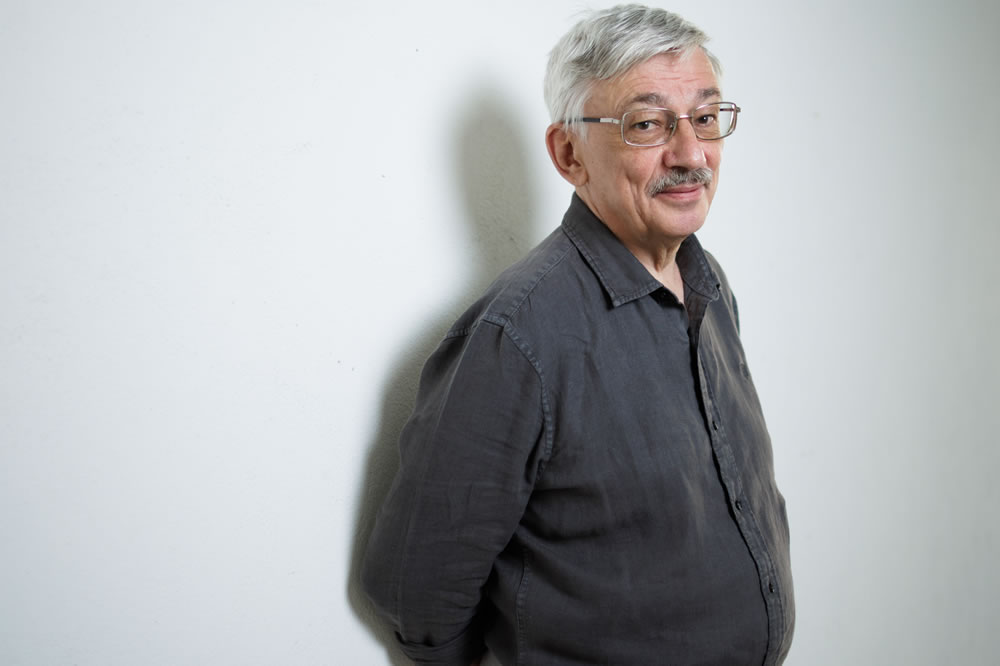
Oleg Orlov tells his life story as if he wanted to show it to you, step by step, moment by moment. It seems that at any moment he might pull out a photo album or a timeline, on which to mark historical and personal dates, always so intertwined in a life like his. Yet in every pause, while he tells his story, he seems to have to guard a secret: there’s what he cannot say to protect those of his family who remained in Russia; there are the grim thoughts of one of the most steadfast builders of Russian democracy – someone who has never stopped believing in it, yet now seems terrified at the idea of losing Russia, his country, the only place he wants to live in, and the one he can no longer return to.
Oleg Orlov, biologist, dissident, co-founder of the Memorial organization, was sentenced in 2022 to two and a half years of detention in a penal colony for speaking out against Moscow’s aggression in Ukraine. He had done so in an article, in which he wrote that Russia is governed by a fascist regime. He knew well what he was heading toward, but he could not choose silence. He chose detention, was accused of having discredited the Russian Armed Forces. In one of the first hearings, he brought to court “The End of the Regime,” a volume by Aleksandr Baunov, which talks about Russia without ever naming it, but offering the example of three past regimes to show that every dictatorship reaches a point of self-implosion. Orlov was freed last summer, during the last major prisoner exchange negotiated by the Biden Administration. He was taken out of Russia, cannot return there, works from Europe, mainly from Berlin, to try to accelerate the implosion of that regime he defined as fascist.
His expression is worried, every now and then an ironic flash erupts in his eyes, which seems to color his face, make him look younger. “I understood that something was about to happen from small signs, courtesies”, he tells Il Foglio, reliving his last days of imprisonment in the Syzran prison, waiting to be taken to a penal colony. “Some officials came to get me in my cell and told me: ‘Please come, we need to go talk.’ ‘Please’ is not a recurring expression with prisoners. I didn’t know what to think. Much less did I know what to think when, in front of the prison director, I heard him address me with my patronymic and not with my surname. He said to me: ‘Oleg Petrovich’. I was stunned.” He was no longer Orlov, he had become Oleg Petrovich and the amazement still resurfaces on his face during the story, a smile appears, and it seems impossible that he managed to hold back a similar one in front of that director who proposed that he write a request for clemency to President Vladimir Putin to be freed: “‘We have an offer,’ he told me. I refused.” They gave him twenty minutes to think about it, brought him back to the cell he shared with another prisoner. Twenty minutes later, the sheet he should have filled out with the clemency request was blank, untouched. Again, always with the same unusual polite manners, they took him to the director. “I explained that I was not guilty, that I had been imprisoned for exercising my right to speak freely. Therefore I could never have asked for clemency. I found myself talking with the prison director about freedom of expression, the Constitution, human rights, prison conditions. He listened. In the end he sent me back to my cell.” He slammed the door behind his shoulders as it closed, and Orlov thought that the next step toward the outside would be the penal colony.
They came to get him one morning, very early, told him to put everything in his backpack and from there began the journey toward freedom. But he wasn’t told immediately. He took two planes, always unaware of his destination. When he was already in Moscow, he understood that he would be taken to Lefortovo prison, it could only mean one thing: a new trial, starting all over again. Lefortovo is a very well-known prison, prisoners accused of espionage are locked up inside it, detention is very harsh, macabre legends circulate inside it, the frightening codes invented by the guards and passed down over time mark the rhythms of the days. “It’s a timeless stone box, you have nothing with you. I was convinced I wouldn’t hold up.” He stayed there five days, then the unthinkable happened and the moment when a cell door opens, for a former prisoner, lasts forever. Orlov remembers it: “They told me: this is your release form, you have been pardoned by the will of the president. I hadn’t asked for any clemency, I didn’t want to sign the form he was handing me. They told me to get dressed, I took off the Lefortovo uniform.” And then, once he left the stone box, he found himself in front of a bus. He got in, everything became clear: “Inside, Andrej Pivovarov and Sasa Skochilenko were waiting for me. I understood, they were exchanging us for some criminal detained in the West. We greeted each other, we hugged, the guards yelled at us to stay seated. But by now who cared about the shouts of the guards and the FSB men who were escorting us.” Then the counting began: Orlov, activist Pivovarov, artist Skochilenko, arrested for spreading anti-war messages, started counting who else, besides them, could have been part of the exchange: too many have remained prisoners of the regime.
Orlov has chosen to live in Berlin, the German capital is becoming the center of dissidence, of a new Russia under construction that wants to show it can be the alternative to the regime. Orlov remains pragmatic, never exaggerates when he talks about the end of Putin’s regime. He knows how rooted it is in Russia, how weak the opposition abroad is, how much weight the quarrels among opponents have, which often make more noise than the common mission of overthrowing the dictator. Orlov has much clearer ideas, he is not a politician, he has no aspirations to be a leader of some current. He went toward prison, saw his Memorial organization banned and sees only one road to heal Russia, it’s one-way and passes through Ukraine, where Orlov went to do the work that Memorial has always dealt with: investigating crimes committed by the Russian army and collecting evidence of them. “We weren’t alone, during the trip we were introduced by the Human Rights Protection Group of Kharkiv. No one, among the people I met, ever refused to speak to me as a Russian. I told my story, there was attention and desire to tell, to show. Often the conversations were bilingual, me in Russian and them in Ukrainian. I cannot fail to understand those who told me they will never forgive Russia, but Ukrainians are lucid. I met people tortured by Russian soldiers, with suffering upon them, with a relationship with death that had marked them, however, no one treated me as an enemy. I’ll go back, there’s a lot to do.”
That’s where his work lies. Ukraine may be the place from which the history and future of Russia can be reconstructed. Memorial, as an organization founded in 1989, had understood the right path to healing Moscow: exposing the crimes of the Soviet regime to ensure they would not be repeated. Those crimes have since been blurred, concealed by the Kremlin. “We saw the crimes committed by the Russian army in Chechnya. We recognized them again in Ukraine. These are not isolated incidents, not the actions of individual sadistic soldiers or violent battalions. No, it’s a method.”
Today, Russia is telling its story in Ukraine, and Orlov is fully aware of it. He seems determined to record all the evil he witnesses. He is convinced of one thing: the future begins with memory.
