

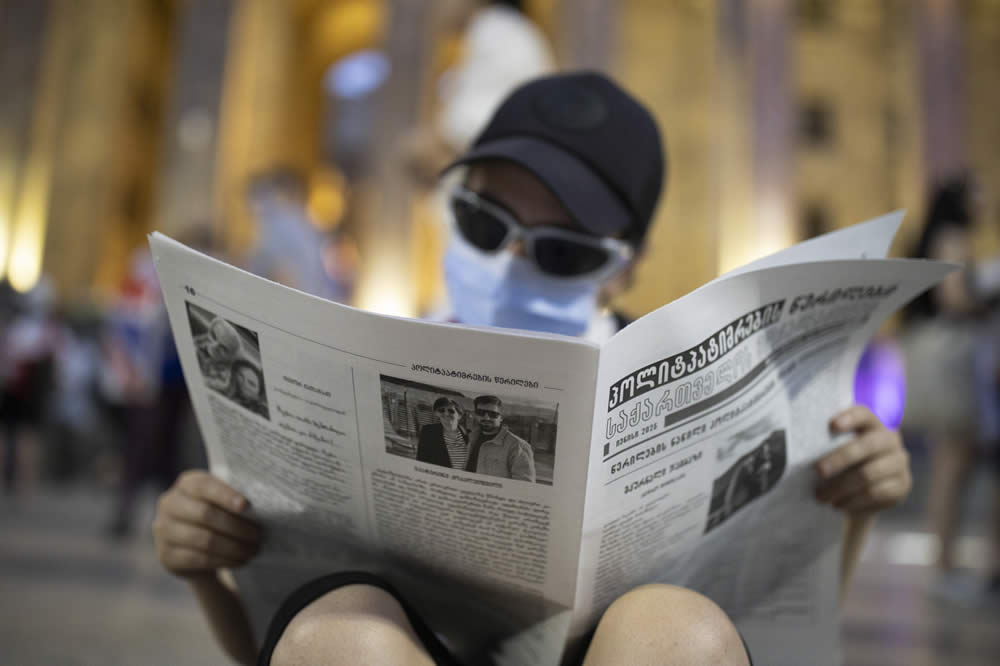
There is a moment in a country’s history when the boundary between reality and nightmare dissolves. In Georgia, that moment has arrived. Not with a coup d’état nor with tanks in the streets, but slowly, methodically, under the mask of a democratic government that has emptied institutions of their meaning, transforming them into instruments of persecution. Power has a face and a name: Bidzina Ivanishvili. Oligarch, de facto master of the Georgian Dream party, he has built a regime that governs through fear. “Georgia today is a prison,” you hear said in the streets.” And if it continues like this, we’ll all end up inside. Some as prisoners, others as guards. But all inside.”
Today, in Georgia thinking freely or simply dissenting means risking arrest. It means becoming a target. The list of victims grows longer every day: activists, journalists, students, doctors, teachers, actors, poets. They have committed no crimes, they have spoken. They have not bowed down. The forms of repression are manifold: arbitrary arrests, beatings, censorship, denunciations, rigged trials, legalized plunder, systematic violations of human rights. The list is long, too long for a small but stubborn country – a country that has already known darkness. And knows how to recognize it, when it comes back.
What follows are personal and painful stories, told while trying to remain faithful to the words of those who lived them.
An activist, now a political prisoner, recently lost his father. He could not accompany him on his final journey: the regime prevented him. It’s the fourth time a prisoner of conscience has lost a parent while unjustly behind bars. “My father had health issues, but not with his heart. He put his hand to his chest only when I was arrested. To me you are murderers. I promise you that the day will come when you will have to answer before the law,” he shouted in the judge’s face.
Then there’s SABA JIKIA, nineteen years old, sentenced to four and a half years in prison. These were his closing words at the trial: “I have to spend the years of my youth in prison, but I’ve found a new family, I’ve met extraordinary boys, I’ve learned the value of freedom. And above all, I’ll have a great story to tell my grandchildren. Thank you for giving me the chance to demonstrate my love for the homeland and to fight for an idea.”
GIORDI MINDADZE, a twenty-one-year-old medical student, was sentenced to five years in prison. His “crime”: having slightly wounded an officer with a firework. A simple burn on the foot. “So what?” comments a government-loyal official sarcastically, “what were they supposed to do, give him a medal?” But when another officer shoots a young man and wounds him in the shoulder, no one is arrested. Not even a day in prison. There is one kind of justice for the enemies of the government, and a very different one for its servants.
And then there are the bodies. The bodies that are consumed. MZIA AMAGHLOBELI, a journalist, has been in prison for months and has serious health problems. Now she is almost blind. A medical assessment states she could have preserved up to 90 percent of her sight. But, in the authorities’ indifference, she remained without treatment. “This is torture,” someone whispers. And it’s true. It is for every square meter of cell, for every imposed silence, for every denied visit. “I could barely stand, they immediately threw me into the first room,” Mzia recounts, describing her arrest. “When they pushed me inside and told me to sit down, a young man burst in, screaming and cursing. At the second and third curse he emphasized the fact that I was a woman. The room was very narrow, I tried to look elsewhere, he loomed over me and continued to insult me. When I raised my eyes, he spat in my face. Even today I don’t forgive myself for that silence: how did I manage not to destroy everything, not to scream? Instead the only thing I managed to do was suddenly stand up and say: bring me water, take me to the bathroom. A woman, a policewoman who was in the room, took a glass of water to give it to me, but a voice stopped her: ‘No, no water! Let her wet herself!'”
What happens in courtrooms, in prisons and during interrogations is not justice. It’s state vengeance. These are show trials, where sentences are written before evidence is even presented. Power has abolished the presumption of innocence and transformed dissent into a crime. A new law imposes the closure of hearings to the media. Journalists will have to reveal their sources. In one stroke journalism has been assassinated and what remained of the rule of law buried.
Those who still have the courage to protest do so knowing they will pay a price. On June 9, NINO, a teacher, attended a hearing in solidarity with political prisoners. Shortly after she was arrested on the false charge of having assaulted an officer. She faces four to seven years in prison. Do you know who arrested teachers on absurd charges? The Soviet Union. Nino’s story recalls that of teacher Maro. It was the winter of 1937, MARO BOTIASHVILI was in Tbilisi to attend university lectures. A professor spoke about Queen Tamara and Georgia’s golden age. As she left the classroom, she was arrested. They told her: “Apparently you’re fascinated by old Georgia’s glory… and what do you say about the great days of Soviet Georgia?” Later, in some letters, Maro recalled those years: “The prison was overcrowded, the air unbreathable, the hygienic conditions inhuman. The interrogations, for women, were real torture. They used many methods: the most painful and humiliating was being dragged by the hair. As soon as we managed to find scissors, we cut our hair ourselves.” In another letter she wrote: “Outside there’s war. We work in a tailor shop. Here every day is the same as the next. It only changes if someone dies. Prisoner Vara Pirtskhalava has swollen completely. Tomorrow, probably, it will be her turn. Every morning we find a dead person. We can’t even cry anymore.” Maro spent fifteen years in prison, only because for her Georgia’s history, her country, and Queen Tamara were more important than the USSR.
Today the Georgian regime treats women as the Soviet Union did. In Georgia, women are insulted by police with obscene and humiliating words, assaulted in elevators, trapped, doused with paint and pepper spray, threatened with rape. Public employees, honest and courageous workers, are fired just for telling the truth.
And then there’s the story of ALEKSI TIRKIA, seriously injured during the demonstrations. Before telling it, he warns us: “I’m not looking for sympathy, I’m seeking justice . I want to make sure this never happens again. I want accountability, and I want the State to take care of its citizens. If you can, share this story, support me, or simply let me know that my voice hasn’t been lost.” Aleksi is 22 years old. He says he couldn’t remain indifferent. So he decided to protest peacefully. “It was an attempt to express my freedom.” During the protest, a tear gas canister launched by police hit him full in the face. The consequences? Cerebral edema, damage to the eye socket and trigeminal nerve, severe reduction in sight. Surgical implantation in the forehead was necessary. Now he also faces psychological rehabilitation. “I didn’t just experience physical pain, but deep trauma. When you’re a free citizen, you don’t expect a canister to change your face, your life, your future. This was the result of violence and irresponsibility. Not just toward me, but toward many young people trying to make their voice heard.”
Meanwhile, the short film “A Story About Freedom,” dedicated to Georgian independence, is being screened everywhere by activists. But its director, Giorgi Okmelashvili, is in prison. So is its narrator, actor Andro Chichinadze. Both arrested during protests against the so-called “Russian law”. Because that’s exactly what this is about: a copy of the Kremlin’s legislation to strike NGOs and media. The government accuses civic organizations of being “agents of the West”, “saboteurs”, “spies”. The same language of Soviet times. In 1937, the celebrated poet Titsian Tabidze was executed. The charge? “Terrorist and espionage activities under the protection of a capitalist state.” Today poets aren’t shot, but imprisoned yes. Propaganda depicts them as internal enemies. Just like then.
And so, Georgia sinks. Day by day, the country is losing something that cannot be easily rebuilt: trust in justice, freedom of speech, hope. “Everything that had been built in thirty years, laboriously and imperfectly, is being dismantled at great speed. For what? For one man’s personal power. To satiate the arrogance of those who believe governing means punishing, and that fear is more useful than consensus,” writes university professor Giorgi Maisuradze.
Yet, among courtroom halls and prison cells, something resists. Mzia’s trembling voice, the courage of Giorgi and Saba, the handkerchief clutched in the hand of a weeping mother, the film screened by those who have been silenced: they are proof that there is still life. “Anyone who attends a hearing understands immediately,” writes an activist: “You will see evil in its banality, shame, fear. But you will also see courage. You will see truth.”
And then there’s MATE DEVIDZE, a young twenty-one-year-old prisoner, sentenced to four years and six months, who tells the judge: “Forgive me, friends, but I must leave the courtroom: I cannot listen to this sentence. I go in search of light in the endless darkness.” Today, from prison, Mate encourages his peers: “I have found the light: it is you. The faith we carry in our hearts, guarded with so much love, will win in the end. I have only one request: tears, only after victory. And let them be of joy. I am not dead, and in this struggle no one will die. Since life dances so, close all doors to death, the poet said. Never allow the system to put invisible handcuffs on you, which its servants have now made their own. And to those who still remain silent: none of us thought we would end up behind bars. Raise your voice, otherwise those bloodied hands will knock at your door too. Don’t give up! Fight for your freedom! Fight until it’s too late! Freedom to you, to us, to all of Georgia! Ah, I was about to forget… one last thing: I am just a simple boy, who loves the homeland and freedom. Just like you. Don’t call me a hero. I am not. But I am free. Just like you.”
