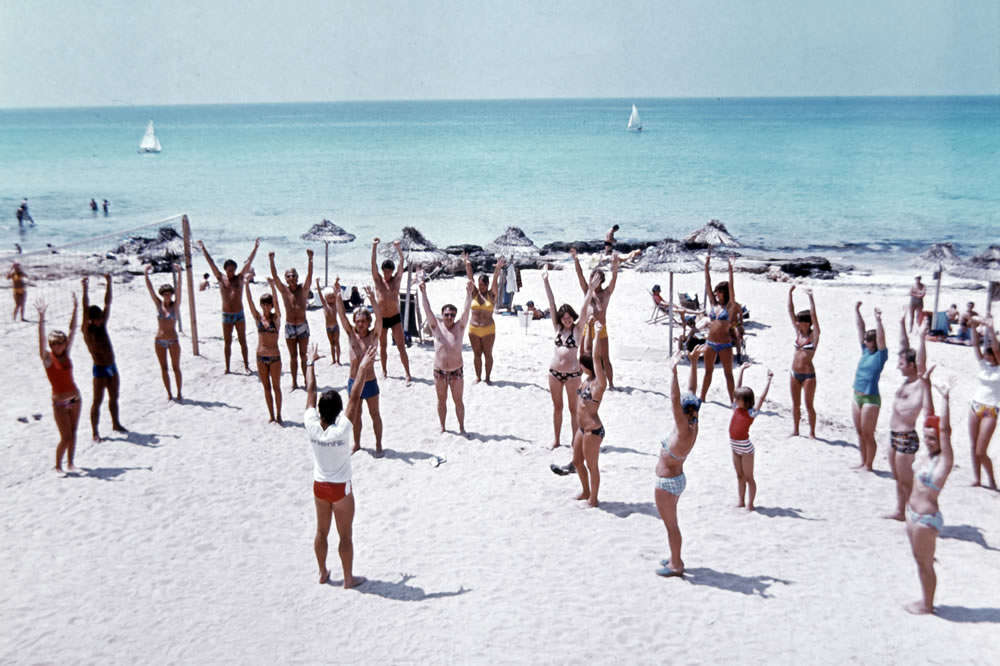
Sometime in July 1959, a young English woman named Judith Roberts was arrested at a beachfront bar in Benidorm for the crime of wearing a bikini. According to local law, her attire was allowed on the sand, but not in the bar.
When a policeman ordered her to cover up, she refused. Fuelled by alcohol, the ruckus quickly escalated. He told her to leave, she demurred, he grabbed her, she slapped him, he hauled her away. Within days, news of the incident circled the globe. It was not a good look for Spain’s fledgling tourism industry.
Spain in the 1950s defined prudery. The country reflected the moral values of its dictator, Generalissimo Francisco Franco, who had ruled since the end of the civil war in 1939. The short, rotund, rather ugly Franco was awkward with women, had no sense of humour, no appreciation of culture and was perishingly dull. He had an enormously high opinion of himself, and a low opinion of his people. For two decades, he had imposed his character on his country, encouraging Spaniards to share his febrile fears of Jews, Freemasons, socialists, foreign money, competent women, interesting people and sex. He despised almost all women except his wife, his daughter and the Virgin Mary, which explains why he worked assiduously to limit female rights.
Franco wanted to make Spain great again, but had so far only managed to bankrupt his nation and destroy its international standing. His solution to Spain’s enormous economic problems was to create an autarky sealed off from the rest of the world. Yet Spain was never strong enough to exist in isolation. For most of his dictatorship, she was the poorest country in western Europe. Not until the late 1950s did Spain return to the living standards that had existed before the civil war.
Suddenly, around 1955, fortunes improved, and Franco took credit for that success. In truth, the reasons for the unanticipated boom were antithetical to his misguided policy. The main driver of economic growth was the tourists who flocked to Spain’s beaches, in particular Benidorm. Across Europe, postwar prosperity had made regular trips to the Med affordable even for the working class. Holidays in the sun became enormously popular.
Spain’s fragile economic boom was, however, held together by the thin straps of the bikini. To Spanish conservatives, it seemed the Devil’s work, yet if bikinis were banned, tourists would instead flock to more liberal Italy or France. Acutely aware that criminalizing the bikini would jeopardize Spain’s fragile economic recovery, the young mayor of Benidorm, Francisco Zaragoza Orts, unilaterally ordered that they could be worn on his beach.
Though a devoted supporter of Franco, Zaragoza believed that fascism could not survive if Spain remained poor. He also understood that the bikini was essential to prosperity. His permissiveness nevertheless attracted widespread criticism. The local bishop threatened to erect signs outside Benidorm proclaiming it “El Infierno” (Hell) and the Archbishop of Valencia, Marcelino Olaechea, threatened Zaragoza with excommunication.
An official government report in 1957 was packed with lurid hyperbole about an epidemic of sex on the beach. “We have been told that there is an extraordinary number of Swedish, Finnish, German and British tourists in Benidorm this year and that their scandalous, shameless behaviour has turned that beach into a brothel.” Mention was also made of “numerous homosexuals” flouncing on the sand, scaring away decent folk. Scandinavians were singled out for condemnation. “The Nordic women holidaymakers are characterised by their eroticism and man-hunting, especially chasing adolescent Spaniards and producing the most abject spectacle on the beach at night, near the little hotels, under trucks, etc.” (Yes, I’m also intrigued by the idea of sex under a truck.)
Fearful that prudery would destroy Benidorm’s prosperity, Zaragoza requested an audience with the Generalissimo. It’s not quite clear when this happened since Zaragoza is an unreliable narrator, inclined to embellish his stories. According to his version, he jumped on his Vespa and rode nine hours to Madrid to deliver Franco a lesson about bikinis. He claimed that the Generalissimo was unfamiliar with the phenomenon and had to have it explained to him. Whatever the case, Zaragoza proved persuasive. Despite severe moral misgivings, Franco came to understand the benefits of a thriving tourist industry. He threw his weight behind Zaragoza and lifted the prohibition on bikinis – as long as they were confined to the beach. It’s that distinction that led to the arrest of poor Judith Roberts.
Thanks to the bikini, Benidorm was quickly transformed from a small fishing village to an ugly city with hundreds of high rise tourist properties. The effect was duplicated all along the Spanish coast, with cheap resorts spreading like a fungus. Foreign investment in hotels, bars and restaurants rose exponentially. Tourist income increased from $125 million in 1959 to $3.1 billion in 1973.
Neither Zaragoza nor Franco understood the long term implications of the bikini. Those tiny pieces of cloth perfectly encapsulated the aspirations of the Spanish people for modernity, liberation and prosperity. Franco’s plans for Spain had always depended upon his people remaining ignorant, isolated and poor. Wealth, however, rendered them rebellious and ambitious. They aspired to be like those Scandinavians who had invaded their beaches. Tourist money allowed Spaniards to purchase televisions, cars and clothes, all of which were liberating. In 1960, just one percent of households had access to a television. By 1970, ninety percent did. Franco had inadvertently created a country of consumers, impossible to control.
The role of the bikini in undermining fascism is intriguing but not unique. The connection between fashion and liberalism is well known among historians; consumerism is a recognised driver of political change. In mediaeval times, the Silk Road was, first and foremost, a trade route, but it also served as a conduit for political and social ideas that would eventually undermine autocracy. More recently, communism in Europe and Asia was destroyed not by bombs and bullets but by Levis and Coca-Cola – totalitarian regimes could not compete with the empire of things. It remains to be seen whether something similar to the bikini effect will topple today’s illiberal regimes. What is certain is that it’s probably not a good idea to force the working class into austerity in order to make billionaires even wealthier.
Fascism in Spain quickly disintegrated after Franco died on November 20, 1975. It had always depended on Spaniards remaining poor and ignorant, yet neither was possible after the bikini invasion. Nowadays, Zaragoza, who died in 2008, is celebrated as the man who brought the bikini – and prosperity – to Spain. He’s credited with undermining fascism, ironically the opposite of what he’d actually intended.
Gerard DeGroot is emeritus professor of history at the University of St. Andrews. He is the author of numerous books, including The Seventies Unplugged.