A dense conifer forest in winter, and among the tall trees, barely visible, black FPV drones bursting into the natural beauty: it is a painting that forms part of the project “New Military Landscape.” “We show how the spaces of Ukraine have changed during the war,” says painter Ihor Husyev, standing in the middle of a studio located in an office building on the right bank of Kyiv. One of the floors is occupied by the Cultural Forces of Ukraine, an association of soldiers, artists and musicians dedicated to the moral and psychological support of the troops and to promoting Ukrainian culture among civilians.
Husyev, fifty-five, is a painter from Odessa, a creator of performances and installations, and the founder of an underground gallery. In the army he was a simple rifleman. Last year he served in the Kharkiv region. He later moved from a combat unit to the Cultural Forces and, together with fellow artist Stas Zhalobnyuk, founded the artistic collective Forest Brothers. “We were both stationed in the forest, but each in his own,” he says, “and now I am exploring how to draw inspiration from the reality we live in.”
In another room there is a music studio where a rehearsal is underway: a saxophonist and a guitarist are playing. There is also a room filled with computers — “it’s a pilot space,” explains Pavlo, who runs it: soldiers in rehabilitation will be able to come here, play video games, and in this way recover their psychological equilibrium.
A little further along, photographer Oleksandr Zakletskyi, who had served in the International Legion, presents his photo project on children and the war. “But in my photos you will see neither children nor blood,” he says. Instead there are many toys scattered among houses destroyed by Russian bombardments. “This is a bullet-riddled car in the Kyiv region, the one people were using to flee the occupation,” Zakletskyi recounts: “There was a large inscription on it that said ‘children’ — it didn’t save them.”
The association of artists and cultural figures who joined the army was founded in 2022. For a long time it was called “Cultural Landing” and was initially aimed exclusively at military personnel. It was founded by Mykola Syerha, a musician and well-known television presenter who joined the army from the very first days of the full-scale invasion. “One day Mykola picked up his guitar and went from one unit to another. They were very intimate gatherings, but he saw that soldiers at the front needed them,” recounts Tymur, the Cultural Forces’ operations director. Over time, other people from the cultural world joined the initiative, whose primary goal is to motivate those fighting to defend the country. The General Staff backed the idea. “When a famous writer or singer arrives at the front, the soldiers realize that this is a shared war, one in which everyone takes part,” says Tymur. All the more so given that many of the cultural figures have combat experience, and some have sustained serious wounds. Yuriy Ivaskevych, a tenor with the Zaporizhzhia Regional Philharmonic Orchestra, became a machine gunner during the war, was wounded, and had a leg amputated. He now supports the troops not with weapons, but with song.
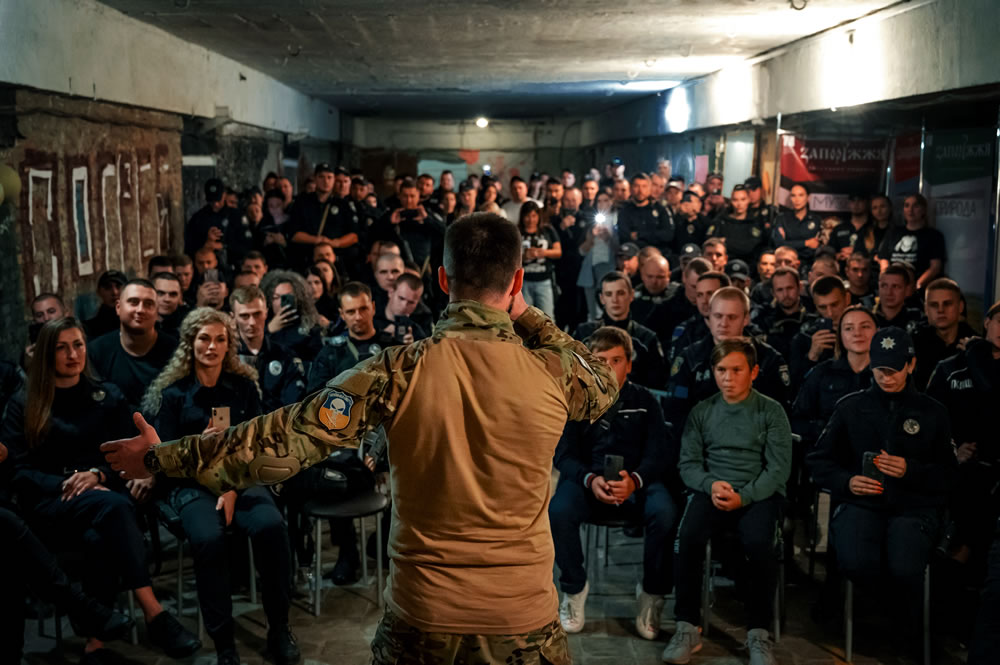
The Cultural Forces have eight mobile groups — each comprising five to seven people — operating along the front line in the regions of Kharkiv, Donetsk, Sumy, Zaporizhzhia and Mykolaiv. They are deployed to these sectors for several months at a time and meet regularly with soldiers, even as the journey to reach them grows increasingly dangerous because of Russian drones in the sky. “They are actors, musicians, poets, comedians, singers,” says Mykhailo Oliynyk, head of the mobile groups: “They arrive at a village house in the Donetsk region where five or six soldiers are stationed and they talk with them. It is not simply a concert.” These occasions sometimes help improve internal communication among the soldiers, who during these gatherings sing their favorite songs together. In civilian life, Oliynyk was a composer and pianist who wrote music for film and advertising — but today there is no time for creativity.
Artists and musicians are not always welcomed with enthusiasm. The fighters are often tired and exhausted, but in the end they give their sincere thanks. For this reason, before heading to the front, it is necessary to understand the morale of that specific unit, Oliynyk explains. Over the course of the full-scale invasion, the Cultural Forces have organized more than six thousand meetings with soldiers — not only in combat zones, but also in hospitals and training bases.
Another of their projects is “A Book for the Front.” In many bookshops a poster is displayed inviting customers to buy a book and donate it to a soldier. “The bookshops then send us the books, we pass them to the mobile groups, and they bring them to the front,” explains Andriy Ovcharuk, the project’s coordinator. Before the full-scale invasion he worked in a publishing house; in 2022 he went to fight in an infantry battalion and served in the Donetsk sector until 2024. The Cultural Forces then invited him to do much the same work he had done before — only within the army. Visitors to all the major Ukrainian literary festivals can buy books for the front, both classics and new releases, and publishers have joined the initiative by donating books to the army. Now the soldiers themselves contact Ovcharuk, sending him lists of specific requests: the most sought-after titles are books on Ukrainian history (by historians Serhiy Plokhiy and Yaroslav Hrytsak), on psychology, and then fantasy and crime fiction. Stephen King and Andrzej Sapkowski’s Witcher saga are the bestsellers among the troops. Every month the Cultural Forces send fifteen hundred books to the front and to hospitals. More than fifty thousand have been delivered in total.
There is also no shortage of international collaboration. This past March, British musician Sting called for the release of Ukrainian musicians who, despite not having taken part in combat, were captured in Mariupol in 2022. The Cultural Forces make no secret of the fact that the making of that video was their initiative. They are now trying to secure an audience with the Pope: nine musicians remain in Russian captivity.